
Tinubu’s Drug Trafficking Records: US Court Gives Ultimatum to Pirro’s Attorney
US Court Orders Pirro’s Team to Release Tinubu’s Drug Trafficking Files Within 48 Hours.
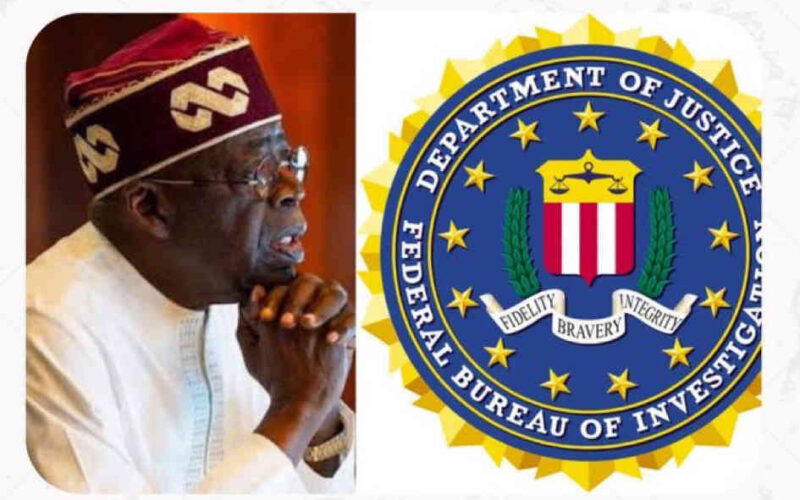
President Bola Tinubu has formally aligned himself with a request submitted by the United States Department of Justice, seeking a 10-day extension to respond to a court directive regarding the release of documents pertaining to allegations of drug trafficking against him.
The development follows a recent filing in a Washington, D.C., federal court, where Tinubu’s legal representatives joined the motion for an extended deadline.
Von Batten-Montague-York L.C., a Washington-based lobbying firm retained by former Vice-President Atiku Abubakar, publicly shared the notice of joinder filed by Christopher Carmichael, one of Tinubu’s attorneys, on behalf of the Nigerian president.
The filing was submitted to the U.S. District Court, where it was recorded as part of ongoing litigation.
“Intervenor joins Defendants’ motion for a 10-day extension of time to file response to the motion for summary judgment (DE 92), in as much as Intervenor requests that the responses remain on the same schedule. Plaintiff opposes this request, and Defendant does not,” the notice of joinder states.
Despite Tinubu’s request for additional time, the lobbying group reported that the presiding judge swiftly denied the extension. The firm further alleged that the Nigerian president’s legal strategy may involve leveraging political connections in Washington to argue that the disclosure of these records could undermine bilateral relations between the United States and Nigeria.
“We surmise that President #Tinubu wants to use any delay to call upon his friends in DC to argue that the release of these files would harm U.S.-Nigeria relations and undermine his ability to work with the United States to combat terrorism and the killing of Christians in Northern Nigeria,” the lobbying group stated in a social media post.
The firm went on to assert that any attempt by U.S. government officials to interfere with the judicial process or the Freedom of Information Act (FOIA) on behalf of Tinubu should be investigated and result in disciplinary action.
“We believe that any U.S. government personnel who improperly attempt to interfere with the judicial or FOIA process on behalf of #Nigerian President #Tinubu to prevent the lawful release of these records should be exposed and fired,” the statement read.
Prior to the filing of the notice of joinder, Von Batten-Montague-York L.C. had already shared updates on the case through its social media channels. In a post published on X (formerly Twitter) on Tuesday, the firm announced that Jeanine Pirro, a U.S. attorney, had initiated legal proceedings to compel the Federal Bureau of Investigation (FBI) and the Drug Enforcement Administration (DEA) to release records of their investigations into Tinubu’s alleged involvement in drug trafficking.
Atiku Doubles Down: Tinubu’s Certificates Are Forged
The lobbying group noted that Pirro had requested a 10-day extension, but Judge Beryl Howell granted only four additional days, setting the new deadline for August 21. The judge emphasized that the case had been pending for more than three years, underscoring the prolonged nature of the litigation.
The Origins of the Case
In 2022 and 2023, Aaron Greenspan, an American entrepreneur and founder of PlainSite, submitted 12 FOIA requests to six different U.S. federal agencies. Greenspan sought records related to criminal investigations into a heroin trafficking ring that operated in Chicago during the early 1990s. Specifically, he requested documents concerning four individuals allegedly connected to the operation: Bola Tinubu, Lee Andrew Edwards, Mueez Abegboyega Akande, and Abiodun Agbele.
Five of the agencies responded to Greenspan’s requests with Glomar responses, a legal term referring to a refusal to confirm or deny the existence of the requested records. Dissatisfied with these responses, Greenspan escalated the matter by filing an appeal with the Department of Justice’s Office of Information Policy (OIP).
However, the OIP upheld the agencies’ refusal to disclose the records, prompting Greenspan to file a lawsuit on June 12, 2023. The initial defendants named in the suit included the FBI, DEA, IRS, the Executive Office for United States Attorneys (EOUSA), and the Department of State. The Central Intelligence Agency (CIA) was later added as a defendant in the first amended complaint.
In April 2025, Judge Beryl Howell issued a ruling declaring that the Glomar responses from the FBI and DEA were improper and must be lifted. The judge determined that the agencies had failed to demonstrate a cognizable privacy interest in concealing the fact that Tinubu was a subject of a criminal investigation. Additionally, Howell found that the FBI and DEA did not provide sufficient evidence to justify the burden of sustaining their Glomar responses.
The 1993 Drug Trafficking Allegations
The controversy surrounding Tinubu’s alleged involvement in drug trafficking in the United States dates back to 1993. During that year, Tinubu forfeited $460,000 to the U.S. government following allegations linked to heroin trafficking. This case became a significant issue in the lead-up to the 2023 Nigerian presidential election, with opponents arguing that the forfeiture should have disqualified Tinubu from contesting.
In litigation arising from the 2023 election, Peter Obi, the Labour Party’s former presidential candidate, and Atiku Abubakar, the Peoples Democratic Party’s (PDP) candidate, contended before the Presidential Election Petition Court (PEPC) that Tinubu ought to have been disqualified due to the 1993 civil forfeiture of $460,000 in the United States.
However, in its judgment, the PEPC ruled that the petitioners had failed to establish that Tinubu had been convicted of any criminal offense in the United States. The court further noted that the forfeiture proceedings were civil in nature, rather than criminal, and therefore did not meet the threshold for disqualification under Nigerian electoral law.
You May Also Like


Trending Now