
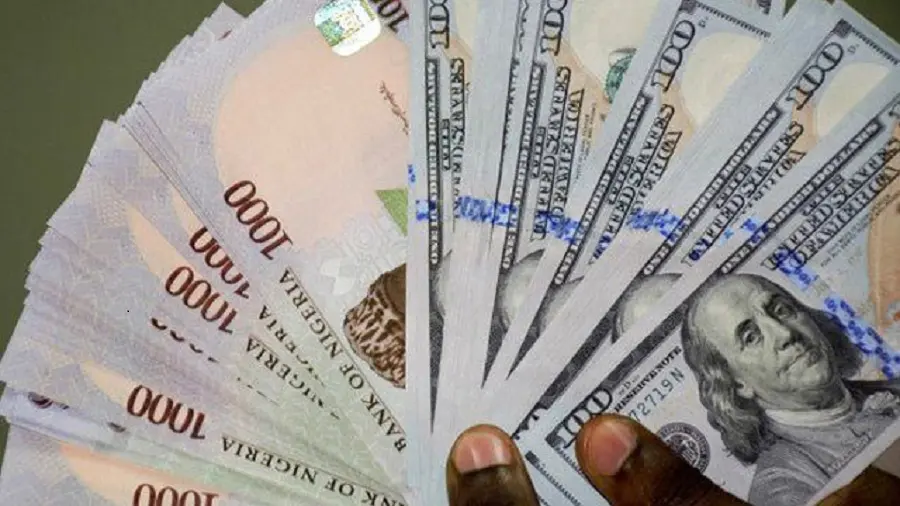
Dollar to Naira Exchange Rate Today, September 15, 2026
The naira opened trading on Tuesday, September 15, 2026 at about ₦1,326.30 per dollar at the official Nigerian Foreign Exchange Market (NFEM), while street dealers quoted the greenback between ₦1,385 and ₦1,410 in the parallel market.
The official figure is the Central Bank of Nigeria’s (CBN) latest published NFEM rate of ₦1,326.3014/$1 for Monday, September 14 — a marginal appreciation of 22 kobo, or 0.02 per cent, from Friday’s ₦1,326.5192/$1. The NFEM rate is derived from the volume-weighted average of transactions in the official market.
Dollar to Naira Exchange Rate Today September 12, 2026
At the parallel market, dealers in Lagos, Abuja and Kano quoted the dollar at roughly ₦1,385 on the buying side and ₦1,410 on the selling side for cash retail transactions. Rates vary by dealer, location and transaction size.
Dollar to Naira Today: The Numbers at a Glance
| Market | Rate (₦/$1) | Notes |
|---|---|---|
| Official (NFEM, CBN) | ₦1,326.30 | Weighted average, latest published data (Sept 14) |
| Parallel market – buying | ₦1,385 | What dealers pay you per dollar |
| Parallel market – selling | ₦1,410 | What you pay per dollar |
| Parallel market premium | ₦83.70 | About 6% above the official rate |
The naira also gained against other major currencies at the official window in the September 14 session, strengthening by ₦5.70 against the pound sterling to ₦1,786.13/£1 and by ₦13.75 against the euro to ₦1,529.36/€1.
How the Official Rate Has Moved This Month
The official market has been unusually calm. The naira has traded in a narrow band for most of September, with the rate confined largely to the ₦1,320–₦1,330 corridor.
| Date | NFEM Rate (₦/$1) | Direction |
|---|---|---|
| Sept 4 | ₦1,321.22 | Near two-year high |
| Sept 7 | ₦1,320.56 | Stronger |
| Sept 10 | ₦1,328.22 | Softer |
| Sept 11 | ₦1,326.52 | Appreciated ₦1.69 |
| Sept 14 | ₦1,326.30 | Appreciated 22 kobo |
Earlier this month, the naira touched ₦1,315/$1 at the official market — its strongest level in about two years. On a 12-month view, the dollar has shed roughly 12 per cent against the naira, having opened around ₦1,504.83 in September 2025.
Why the Naira Is Holding Firm
Three forces are doing most of the work.
- A record reserves buffer. Nigeria’s gross external reserves climbed to $54.21 billion as of September 7, 2026 — the highest since December 2008. Reserves are up about $8.6 billion, or roughly 19 per cent, from $45.56 billion at the start of January, and have already beaten the CBN’s own full-year 2026 projection of $51.04 billion.
- Stronger diaspora remittances. Remittance inflows through International Money Transfer Operators (IMTOs) hit a record $947 million in July 2026. Flows for the first seven months of the year reached $3.8 billion, up 50.2 per cent year-on-year, putting the CBN close to its $1 billion monthly target.
- Tighter monetary policy and regular FX sales. Elevated interest rates have kept naira assets attractive to foreign portfolio investors, while the CBN continues to sell dollars directly to authorised dealer banks — including a $151 million injection in the latest round.
The macro backdrop is also improving. Headline inflation stood at 15.43 per cent in the latest National Bureau of Statistics reading, with food inflation at 20.31 per cent. Real GDP grew 4.43 per cent year-on-year in Q2 2026, public debt remains below 40 per cent of GDP, Moody’s has lifted Nigeria’s sovereign outlook to positive, and FTSE Russell returns Nigeria to “Frontier Market” status effective September 21, 2026.
What Today’s Rate Means for Your Money
Because the official window and the street market quote very different prices, where you buy dollars determines how much you actually pay.
| Amount | Cost at Official (₦1,326.30) | Cost at Parallel Selling (₦1,410) | Extra Cost |
|---|---|---|---|
| $100 | ₦132,630 | ₦141,000 | ₦8,370 |
| $500 | ₦663,150 | ₦705,000 | ₦41,850 |
| $1,000 | ₦1,326,300 | ₦1,410,000 | ₦83,700 |
| $5,000 | ₦6,631,500 | ₦7,050,000 | ₦418,500 |
Practical steps to avoid overpaying:
- Route legitimate needs through banks or licensed BDCs. School fees, medical bills, travel allowances and import payments are cheaper via the official window where you qualify.
- Send remittances through IMTOs. Formal channels are cheaper and traceable, and the CBN’s reforms have narrowed the rate gap with informal operators.
- Compare before converting. Spreads at the parallel market can move by ₦10–₦25 within a single day.
- Avoid speculation with borrowed money. A narrowing official-to-parallel gap of just ₦83.70 leaves little room for profitable arbitrage after costs and risk.
What to Watch This Week
The key question is whether the naira can establish ₦1,300/$1 as a durable support level. Two variables matter most: continued strength in oil earnings and portfolio inflows, and the direction of the US dollar ahead of the Federal Reserve’s next policy signals.
Sustained dollar weakness would give emerging-market currencies including the naira more room to appreciate. But a reversal in global risk appetite — or a softer oil price — would quickly test the CBN’s $54 billion buffer.
For households, a stable naira slows the rise in imported costs but does not reverse prices already paid. Exchange-rate calm is a foundation, not a cure.
You May Also Like
Trending Now