Documents Unveil How Fake Federal Office Solicited Funds and Land From State Governors
… Fake Agency scandal in Nigeria
An investigation conducted by the Independent Corrupt Practices and Related Offences Commission (ICPC) has recently uncovered another entity operating as an unapproved federal government agency without presidential authorization.
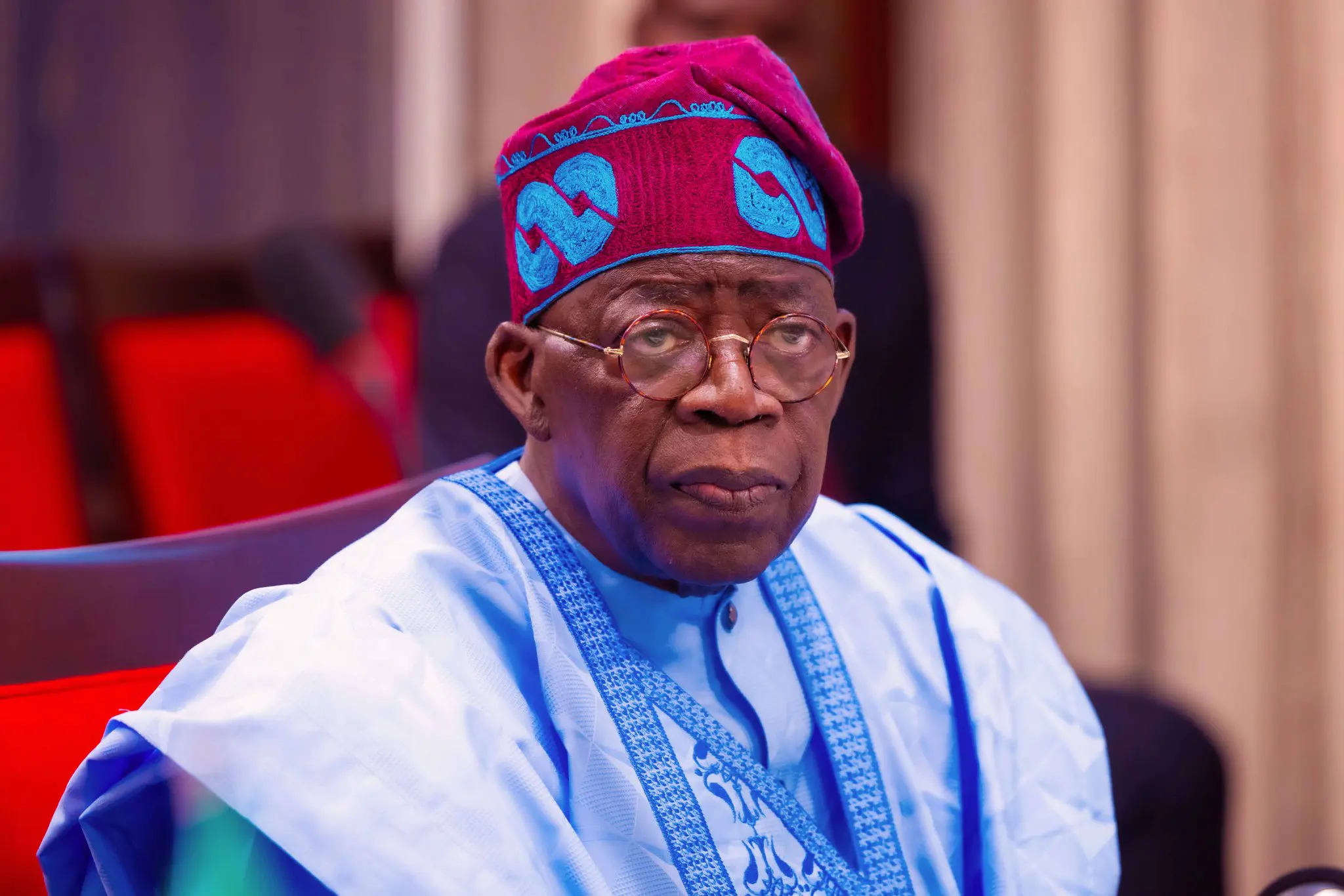
Following the exposure of this unauthorized body, President Bola Ahmed Tinubu directed the immediate suspension of three top government officials identified as enablers of the scheme and ordered the arrest of the agency’s coordinator.
The entity, operating under the name National Brands Development and Made in Nigeria Special Project Office, allegedly claimed to function under the Office of the Secretary to the Government of the Federation (OSGF).
Throughout its operations, it presented itself to various state governments across the federation as an official initiative originating directly from the Presidency.
These revelations were publicly disclosed by ICPC Chairperson, Dr. Musa Aliyu, while addressing journalists after a meeting with President Tinubu last Friday.
Official documents obtained by PREMIUM TIMES further confirm that the entity aggressively marketed itself to state governors as a legitimate federal establishment operating out of the OSGF.
Structure and Mode of Operation
Documents bearing official presidency insignia included appointment letters, executive approvals, and extensive official correspondence sent to multiple state governors requesting financial patronage, land allocations, and various other forms of institutional backing.
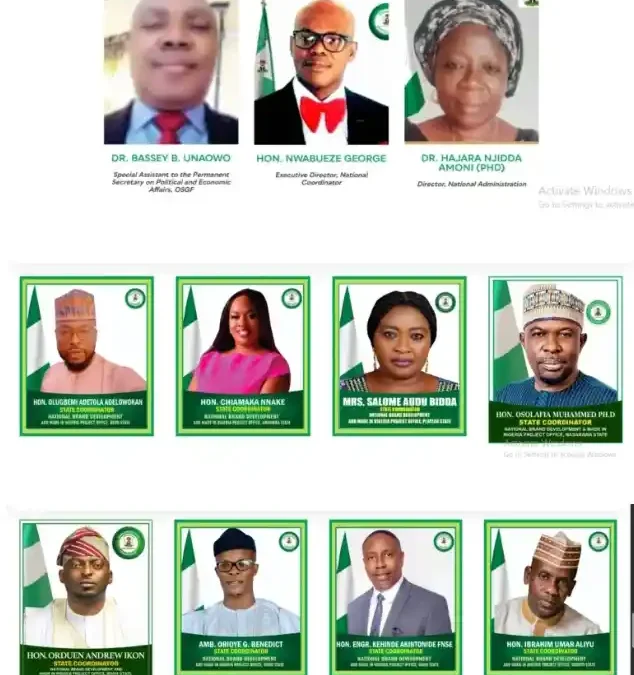
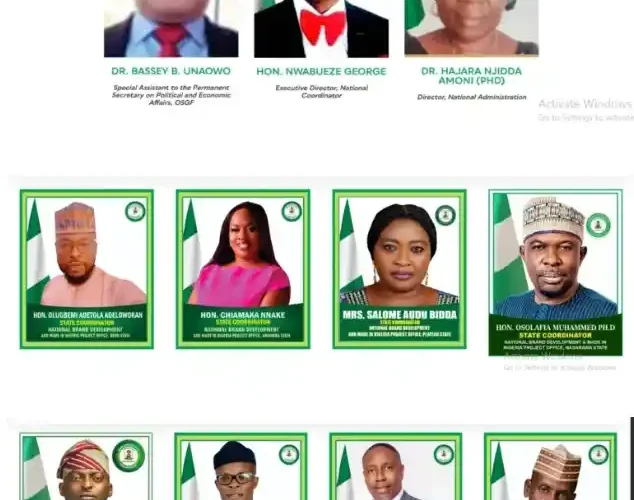
Beyond its written appeals, the illegal agency established an operational presence that included a dedicated website and appointed state coordinators operating nationwide, including within the Federal Capital Territory (FCT).
Also Read: Tinubu US Drug Records: Buratai Urges Unity, Defense of Sovereignty
During the months of January and February, the entity submitted formal written solicitations to the governors of Lagos, Imo, Ondo, Sokoto, Edo, and Nasarawa states.
These communications specifically sought state government endorsement, the selection of state coordinators, mandatory participation fees or direct funding, land grants, and state involvement in domestic and international programs.
Every piece of correspondence sent to state executives was signed by Nwabueze George, the primary promoter of the entity. In these official documents, George held himself out as the Executive Director of the National Coordinator, Made in Nigeria Project.
The organization repeatedly reinforced its assertion that it was a legitimate federal initiative operating within the administrative framework of the OSGF. The official letterhead used for all communications carried the prominent header: “The Presidency – National Brands Development and Made in Nigeria Special Project Office.” Furthermore, the correspondence explicitly indicated that the office functioned under the OSGF, Director SGF Office, located at Shagari House, Three Arms Zone, Abuja.
State-by-State Solicitations and Demands
Detailed documentation reveals how the entity engaged specific state governments with distinct demands, official requests, and solicitation frameworks.
Lagos State
In a letter dated 9 January, marked as a “Third Reminder” and addressed directly to Lagos State Governor Babajide Sanwo-Olu, the organization urged the governor to nominate and formally appoint a Lagos State coordinator for its purported Made in Nigeria project.
The letter stated that establishing this state-level appointment would facilitate vital collaboration between federal and state governmental authorities. Additionally, it asserted that the partnership would promote local production, support small and medium-sized enterprises (SMEs), drive industrial growth, and expand international trade opportunities.
According to the document, the nominated individual’s details were required for “formal confirmation” and the subsequent issuance of an official appointment letter from the Abuja office.
Edo State
In official correspondence dated 23 February, the agency sought executive authorization and financial funding to sponsor participants at an international summit in Bahrain.
The communication explicitly directed the Edo State Government to remit payments into financial bank accounts registered under the name of the Made in Nigeria Project Office, Abuja.
To facilitate these transfers, the organization provided two accounts held at Zenith Bank: a local naira account and a foreign currency dollar domiciliary account.
The document specified that the agency was awaiting payment of $2,500 per person to cover registration, exhibition space, and general participation fees for the Bahrain engagement.
The promoter proposed a specific state delegation quota consisting of five government officials and 25 private-sector participants from Edo State. At the quoted rate of $2,500 per individual, funding a full delegation of 30 representatives amounted to a total cost of $75,000—a figure equivalent to approximately N100 million based on prevailing exchange rates at the time.
Nasarawa State
The extensive correspondence sent to Nasarawa State illustrates the broad scope of the entity’s organizational ambitions. The agency formally requested the support of Governor Abdullahi Sule to host a prospective “national stakeholders’” meeting in Lafia, scheduled to take place from 28 to 30 April. The proposed gathering was designed to convene national coordinating officers alongside various state coordinators. A central objective of the meeting was to formally inaugurate a State Coordinators Executive Council composed of representatives drawn from all 36 states and the Federal Capital Territory. The entity declared that this event would mark the official national launch of its organizational structure.
Ondo State
The entity sought to establish a permanent physical infrastructure within Ondo State. On 13 January, it dispatched a letter to Governor Lucky Aiyedatiwa requesting a substantial grant of land to build a proposed “Made in Nigeria Product Market.” This facility was described in the letter as a designated national platform intended for promoting, manufacturing, displaying, and commercializing Nigerian-made goods, local brands, and domestic services.
The organization maintained that the physical market would offer dedicated operational space to local manufacturers, artisans, industrial innovators, and SMEs, while serving as a standardized reference hub for Made in Nigeria products. The promoters explicitly assured Governor Aiyedatiwa that the planned facility would adhere strictly to the Ondo Master Plan and conform with all relevant state developmental regulations.
Imo State
In a letter dated 23 January, the promoters extended a formal invitation to Imo State Governor Hope Uzodimma, designating him as a “special guest of honour” and keynote speaker at its planned national inaugural convention, scheduled for 5 to 7 February in Lafia, Nasarawa State. Going beyond a standard invitation, the document explicitly requested that the governor provide comprehensive financial sponsorship. The requested financial backing was specified to cover transportation costs, hotel accommodation, feeding expenses, conference materials, participant registration, training modules, and general administrative logistics.
Following this initial solicitation, the organization extended further invitations to state governments urging participation in series of upcoming international trade fairs and product exhibitions scheduled in Burundi, Equatorial Guinea, China, South Korea, and Oman.
Sokoto State
In a letter dispatched on 10 February to Governor Ahmad Aliyu, the organization formally invited Sokoto State to participate in upcoming international food and agricultural expos scheduled in Bahrain and Azerbaijan. Emphasizing once again that it operated directly under the mandate of the OSGF, the letter stated that the agency possessed an official mandate to promote non-oil exports, showcase Nigerian agricultural potential, and attract foreign direct investment.
The Bahrain agricultural exhibition was scheduled to take place from 1 to 5 April, while the Azerbaijan trade expo was slated for 5 to 8 May. The organization promised that participating state governments would gain direct access to international markets, structured bilateral meetings with global buyers and institutional investors, and crucial exposure to international export quality standards and advanced agricultural technologies.
Ejes Gist News stands for truth, responsible journalism, editorial integrity and fearless accountability.
You May Also Like
Trending Now