
US Journalist explains hidden questions behind Tinubu’s $460,000 US drug forfeiture case
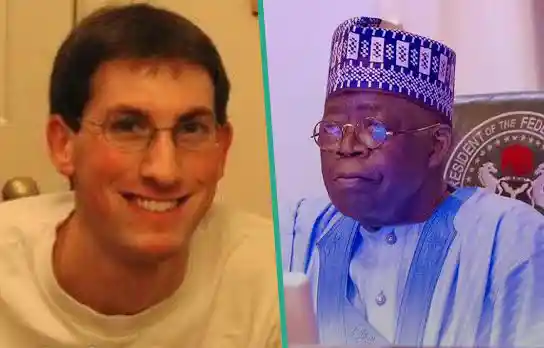
Greenspan Alleges Tinubu Misled US Court About 1993 Political Status
Aaron Greenspan, an American journalist who founded the transparency group PlainSite and advocates for Freedom of Information, has said that President Bola Tinubu’s lawyer told a United States court that his client had never been in politics in 1993, an account Greenspan described as untrue.
Greenspan set out his position in an interview with former presidential spokesperson Laolu Akande on Inside Sources, aired on Channels TV, about the litigation he filed seeking US government records connected to investigations involving Tinubu in the 1990s.
The discussion covered his relationship with the Nigerian lawyer Von Batten, recent court filings, Tinubu’s political status in 1993, FBI and DEA records, the sealed case involving Abiodun Agbele, the $460,000 civil forfeiture and the possibility of a separate sealed criminal proceeding.
No relationship with Von Batten
Asked about his relationship with Von Batten and whether the two were working together on the matter, Greenspan said: “There is absolutely no relationship between me and Mr. Von Batten, any other political figure in Nigeria or their lobbyists or their agents. I have no interest, financially or otherwise, in Nigerian politics. I’ve never met Mr. Von Batten, and I’ve never spoken to him. The only time we’ve ever interacted is when he was required to get my permission to file something in court, and I made it very clear in my response to him that we have no relationship. We are not working together.”
He said Von Batten appears to share a common interest, since his client, as Greenspan understands it, is Tinubu’s political opponent, and Greenspan believed that was why Von Batten backed the litigation.
On his reasons for going to court, Greenspan said he cares about the transparency of what took place in American courts. “I filed this case because I am interested in the transparency aspect of what happened in the United States courts.”
August 28 filing and the claim about AI-written briefs
Greenspan said the most recent development he had seen no headlines about was his claim that Tinubu gave the court false information. “The most recent thing that I think has come up that I have not seen any headlines about, much to my surprise, is that Mr. Tinubu lied to the court and he did that on August 28th when his lawyer informed the court that he had never been in politics in 1993, that he had never held elected office during that year.”
He added: “And that’s simply untrue, as far as I can tell. My understanding is that Mr. Tinubu was in the Nigerian Senate in 1993 and in fact was elected in 1992. And I think it’s surprising that a head of state would come to an American court and say something so obviously provably false.”
Greenspan said his recollection was that the attorney’s name is Chris Carmichael, although he said he should probably double-check that and that the name could be found on PlainSite.
He said he believed the briefs filed in court by Tinubu’s attorney may have been written by artificial intelligence, pointing to other errors in the briefs that he called suggestive of AI-type errors.
Greenspan raised a further issue with the same brief, concerning the Privacy Act. “There’s another problem with that same brief, which is that he claims that in a separate American law, this whole case is about the Freedom of Information Act. But there’s another law called the Privacy Act, and Mr. Tinubu claims rights under the Privacy Act,” he said.
“The problem is that the Privacy Act only applies to US citizens. And my understanding, unless he’s claiming otherwise, which I haven’t seen, but maybe that’s the implication here, is that he’s a US citizen. My understanding is that Mr. Tinubu is not a US citizen, and therefore he would have no rights under the Privacy Act.”
Summary judgment, the Gomaa exemption and the Agbele case
Asked where the case stands, Greenspan said: “We had a summary judgment round about a year ago, which I won. And as a result of that, the court said that the FBI and the DEA had to produce documents that they were trying to withhold under what’s called a Gomaa exemption.”
“Gomaa means you neither confirm nor deny that the documents exist, so you just leave it open-ended. So we got rid of that. We moved on to the stage of these documents actually exist,” he said.
He added: “So that’s the fight that we’re having now in a second round of summary judgment motions and, you know, I think it’s regrettable that it’s gotten to this stage where it has to be this complex.”
Greenspan said the case stood out for him because it involves somebody who was running for office when the FOI requests were filed. “I thought this case was specifically interesting because it involves somebody who was running for office at the time that all these FOI requests were filed. And this person’s name is Bola Tinubu, and his wife was involved and maybe his mother was involved.”
“And here’s the bank accounts. And so my question here was, is there a case that was filed under seal against Mr. Tinubu and as a condition for that staying under seal, he had to give something up to the government, something beyond the $460,000 offer?”
According to Greenspan, it is now known for certain, because the records are available to the public at the National Archives in Chicago, that a related case exists under seal, and that case is the criminal indictment of Abiodun Agbele.
On Agbele’s link to the ring, Greenspan said: “Mr. Agbele was indicted and that case is still under seal. And we know that it’s under seal because we have a transcript from a trial in 1990. I want to say three, but it may have started in 1992 where a DEA special agent named Vincent Bellbo testified on the stand that he participated in the indictment of Mr. Agbele, who was tied to the same ring.”
“So if you look for that case, you can’t find it. It’s not there, which means it’s under seal. So we already have a little bit of smoke here. The question is, is there fire? And through this case, I’m hoping to answer that.”
Greenspan described the investigation as a serious one at the time and said a number of people were involved in the drug ring. “There was a man named Louis Akande, and he was living in Chicago, and he was the one who was actually facilitating distribution of heroin, which was coming from Thailand and other places in Asia through Nigeria,” he said.
He went on: “And Mr. Akande worked with it, saying it’s his nephew. I don’t know if that’s strictly true or if it’s a more cultural uncle kind of relationship, but Mr. Akande had a nephew and that nephew, it says, was Mr. Agbele.”
Tinubu, Greenspan said, was not distributing heroin directly. “Bola Tinubu comes into this because he was not distributing heroin directly. He was laundering money for the proceeds from the heroin distribution. So he was strictly, as far as I can tell, on the money laundering side and the other individuals who were charged were actually, you know, making sure drugs got to the places they needed to go.”
Civil forfeiture and a possible parallel criminal case
Asked whether the sealed case differs from the one for which Tinubu paid $460,000, Greenspan said at least three known cases are tied to the drug ring. “There’s a 1992 set of criminal indictments, which is where this transcript comes from, and that’s available in the National Archives,” he said.
He added: “There’s the unknown, the date of indictment of Mr. Agbele. And then there’s the criminal forfeiture case, which involves Bola Tinubu.”
“So the three cases all look like the same drug ring. But they’re going to be enforced. There could be a criminal indictment of Bola Tinubu as well, and that’s what we’re trying to figure out.”
Asked about the stance of Tinubu’s lawyers and spokespeople in Nigeria, who have called the $460,000 matter a civil forfeiture, Greenspan said he had not described it as a criminal forfeiture and that they are correct that it is a civil forfeiture case.
He said the question is whether a separate but related criminal case exists under seal. “The question is whether there is a related, separate but related criminal case that is under seal. And those two can exist in parallel and you would only know about one of them, and that would be by design, because that would be what the Department of Justice in the 1990s decided was the best way to handle the situation.”
“The question is, did they just think that because that’s what they thought or did they think that because there was some sort of negotiation that took place that resulted in it working out that way?”
He continued: “Most people, when they commit the kinds of crimes that are elucidated in the affidavit by the IRS Special Agent, if you cheat on your taxes, if you distribute narcotics, or you help distribute narcotics, or you launder money or you engage in a conspiracy, those are all felonies and you’ll go to jail.”
About Plain Site
PlainSite is a US based website dedicated to legal data transparency advocacy developed and maintained by Aaron Greenspan. PlainSite provides both free and paid access to legal documents and information about the US legal system on a variety of subjects and caselaw