
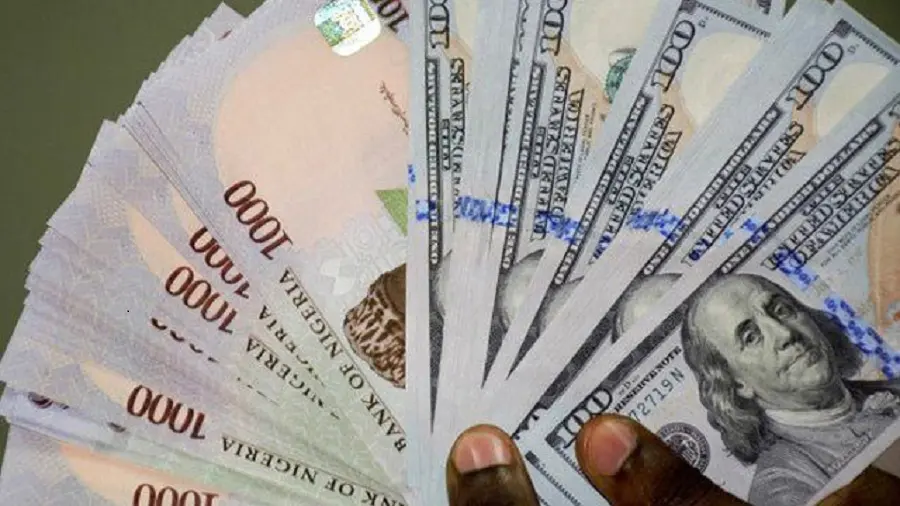
Dollar to Naira Exchange Rate, November 10, 2026: Naira Slips as External Reserves Pause Growth
The dollar to naira exchange rate weakened across Nigeria’s foreign exchange markets on Tuesday, November 10, 2026, as trading activity slowed and the country’s external reserves paused a year-long build-up.
Data published by the Central Bank of Nigeria (CBN) showed the naira fell by N2.55 to N1,349.34 per dollar at the Nigerian Foreign Exchange Market (NFEM), compared with N1,346.79 at the close of trading on Friday, November 6, 2026.
Parallel market operators quoted the naira at N1,415 per dollar on Monday, N7 weaker than the N1,408 recorded at the end of the previous week.
Dollar to Naira Exchange Rate
The latest Dollar to Naira Exchange Rate Today November 10, 2026 are :
- Selling Rate : N 1,350
- Buying Rate : N 1, 340
Official and parallel rates at a glance
| Market segment | Rate on November 9, 2026 | Previous close (November 6, 2026) | Change |
|---|---|---|---|
| NFEM (official) | N1,349.34/$ | N1,346.79/$ | -N2.55 |
| Parallel market | N1,415/$ | N1,408/$ | -N7.00 |
| Official-parallel gap | N66 (4.89%) | N61 (4.53%) | Widened |
BusinessDay reported that parallel market quotes ranged between N1,410 and N1,430 to the dollar on Monday, and that the spread between the two segments had widened to as much as N69, or 5.13 per cent, from less than 2 per cent previously. Rates in the parallel market vary between operators and locations.
The mid-market rate tracked by the payments platform Wise stood at N1,383 to the dollar on November 9, 2026, a reference point that sits between the official and parallel quotes.
Trading volumes fall as activity moderates
Turnover at the official window declined 9.70 per cent to $210.38 million on Monday from $232.98 million on Friday, while the number of deals fell 21.09 per cent to 116 from 147, CBN data showed.
Activity had strengthened at the end of the prior week. Friday turnover rose 24.84 per cent to $475.12 million from $380.57 million on Thursday, and deals increased 25.2 per cent to 313 from 250.
On a weekly basis, BusinessDay reported that NFEM turnover fell 53.17 per cent to $1.92 billion from $4.10 billion, with transactions down 21.46 per cent to 1,325. Interbank turnover dropped 63.26 per cent to $556.79 million, and deals fell 32.09 per cent to 472.
Why the naira weakened
Analysts at the Financial Markets Dealers Association (FMDA), in their latest weekly report, described divergent movements across the two segments, with the official market firming while the parallel market softened.
- Dollar to Naira Exchange Rate Today Nov 9 2026 as FX Reserves Stay Above $55bn
- Dollar to naira rate: naira slips as FX turnover and reserves fall
According to the FMDA, the NFEM rate appreciated 0.34 per cent to N1,347.64 per dollar, while the parallel market rate depreciated 1.38 per cent to N1,410.60. The premium between the markets widened to N62.96 from about N39 the previous week, reversing a narrowing trend recorded in October 2026.
The Guardian reported that the parallel market rate averaged N1,394 to the dollar in the week to November 8, 2026, down 1.79 per cent from N1,369, citing increased foreign exchange demand, seasonal payment obligations and a stronger United States dollar.
Analysts at Cowry Asset Management Limited said the naira was expected to remain relatively stable in the near term, supported by CBN interventions and measures to improve liquidity at the official window. They cautioned that persistent demand, seasonal foreign currency obligations and dollar movements abroad could sustain pressure on the currency.
External reserves pause their climb
Nigeria’s external reserves, which give the CBN room to intervene in the foreign exchange market and meet external obligations, declined 0.36 per cent to $55.06 billion as of November 6, 2026, CBN data showed.
BusinessDay reported a $130 million weekly fall to $55.13 billion as of November 5, 2026, from $55.26 billion on October 27, 2026. The FMDA put the week-on-week decline at 0.16 per cent to $55.133 billion, describing it as a slight pause after reserves rose above $55 billion to their highest level since December 2008.
The buffers remain well above year-earlier levels. Reserves were up 27.10 per cent from $43.32 billion in the corresponding period of 2025, and up 27.32 per cent from $43.30 billion on the same basis, according to CBN figures cited by the two publications.
At $54.9 billion at the end of September 2026, gross reserves provided an estimated 15.7 months of merchandise import cover and 10.7 months of total import cover, including services, based on balance of payments data for the 12 months to March 2026. Measured against the net reserves figure of $46 billion cited by CBN Governor Olayemi Cardoso, cover stood at 13.2 months for merchandise imports and 8.9 months for total imports.
Policy stance and the one-year picture
Speaking at an investor engagement in Bangkok, Cardoso said the gap between official and parallel rates had narrowed significantly to less than 2 per cent from about 60 per cent, crediting foreign exchange reforms and the buffers built during the process.
“When you travel now, you don’t have to look for foreign exchange; you can use your Naira card and pay for whatever you want,” Cardoso said.
The CBN governor said in Abuja in July 2026 that the naira must remain market-driven and competitive rather than artificially supported, describing a market with willing buyers and willing sellers.
| Measure | November 2025 | November 2026 | Change |
|---|---|---|---|
| Official rate (NFEM) | N1,436.74/$ | N1,346.79/$ | Naira up 6.26% |
| Gross external reserves | $43.32 billion | $55.06 billion (Nov 6) | Up 27.10% |
Over 12 months, the naira strengthened 6.26 per cent against the dollar, gaining N89.95, according to CBN data cited by BusinessDay. A stronger naira can lower the local cost of imported raw materials, machinery and pharmaceuticals, and reduce the naira burden of servicing dollar-denominated debt, although the pass-through to consumer prices depends on how quickly importers adjust.
What to watch
The Guardian reported that Bonny Light crude fell 10.45 per cent to $106.90 per barrel from $119.37, and that Brent posted its steepest weekly loss since mid-April 2026 amid hopes of a diplomatic breakthrough in the Middle East. Oil receipts are a core source of Nigeria’s foreign exchange inflows.
Analysts surveyed by both publications identified crude oil prices, the pace of foreign exchange inflows, CBN intervention capacity and the strength of the US dollar as the main variables likely to shape the naira in the near term.
Households and businesses converting dollars should note that parallel market quotes differ by operator and carry settlement risk, while official window rates apply to eligible transactions processed through authorised dealers.
Ejes Gist News stands for truth, responsible journalism, editorial integrity and fearless accountability.
You May Also Like
Trending Now