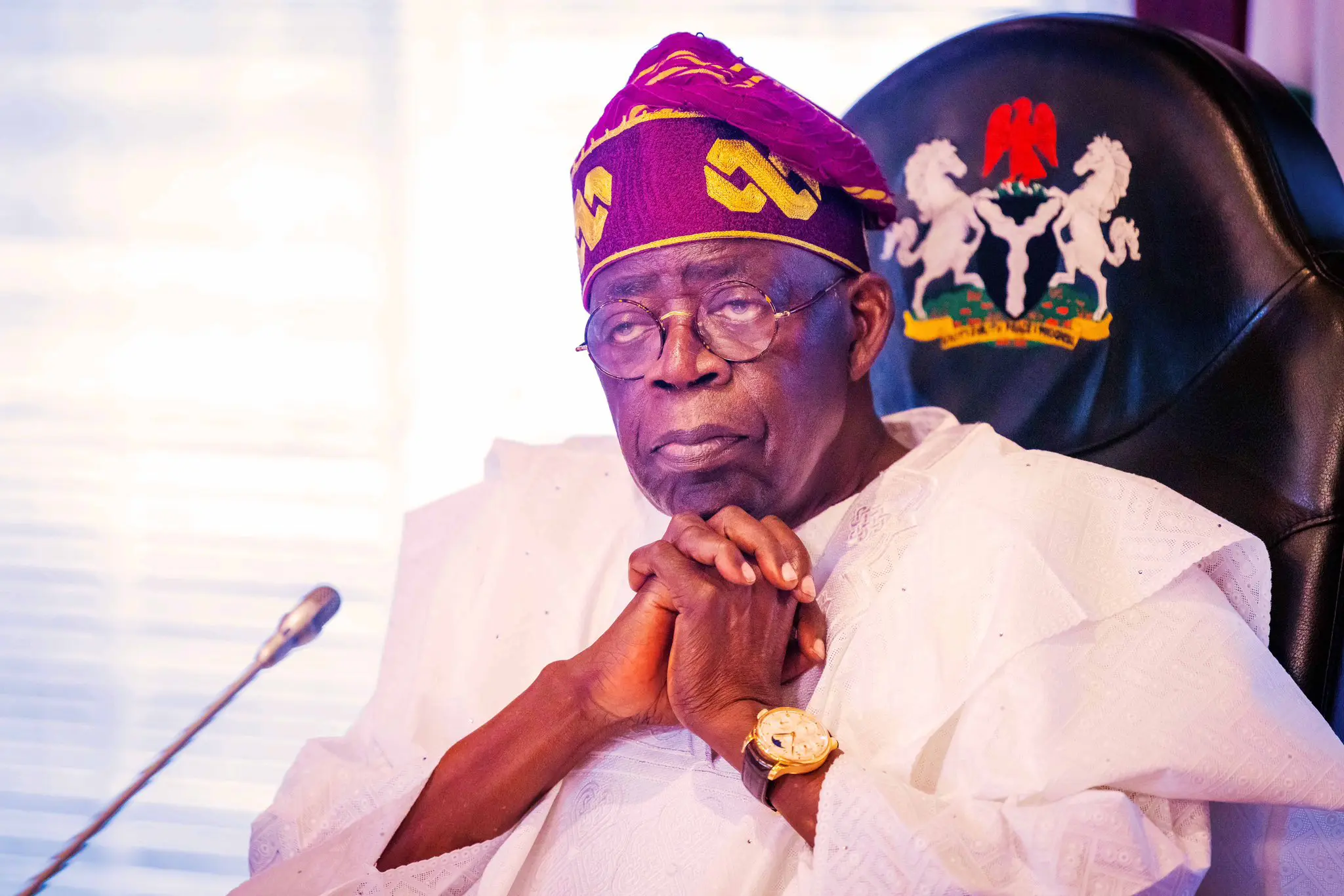
Certificate Forgery: Court Asked to Disqualify Tinubu From 2027 Election
Kano, Nigeria – A fresh legal challenge seeking to bar President Bola Ahmed Tinubu from contesting the 2027 presidential election has been filed at the Federal High Court in Kano, reopening a contentious debate over the Nigerian leader’s academic and professional credentials that first erupted during the 2023 election cycle.
The suit was filed by the Centre for Reform and Public Advocacy, a civil society organisation, according to court documents reviewed by Daily Trust. The group accuses Mr Tinubu of submitting forged documents to the Independent National Electoral Commission, including a diploma from Chicago State University in the United States and a discharge certificate from the National Youth Service Corps.
The case, marked FHC/K/CS/312/2026, names Mr Tinubu as the first defendant, INEC as the second defendant, and Chicago State University as the third defendant. No date has been set for the first hearing.
The Foundation of the Case
At the heart of the suit is an allegation that Mr Tinubu does not meet the minimum constitutional requirement to hold the office of president: a valid secondary school certificate.
The plaintiff argues that Mr Tinubu has long claimed to have attended Government College Lagos, a prominent secondary school in Nigeria’s commercial capital. However, the group points to official records showing that the school was established in 1974. Mr Tinubu, by his own publicly available biography, would have completed secondary education around 1970 — four years before the institution came into existence.
This chronological impossibility, the group contends, means the president could not have obtained a legitimate secondary school certificate from that institution, and by extension, cannot satisfy the basic educational threshold prescribed by Nigeria’s constitution for presidential candidates.
The suit does not identify which secondary school, if any, Mr Tinubu actually attended. It simply argues that the one he has publicly claimed is historically incompatible with his stated age and academic timeline.
The Chicago State University Question
The lawsuit draws heavily on evidence that emerged from a United States court proceeding in 2023.
That year, former Vice President Atiku Abubakar — Mr Tinubu’s main challenger in the 2023 presidential election — sought and obtained a U.S. court order compelling Chicago State University to release the president’s academic records. The case, In Re: Application of Atiku Abubakar (No. 23 CV 05099), was part of Mr Abubakar’s broader effort to prove that Mr Tinubu had submitted forged credentials to INEC.
When the records were eventually released, they became the subject of intense scrutiny. Nigerian courts later examined the documents, but the Supreme Court ultimately ruled that the evidence did not meet the legal threshold required to overturn an election result.
The Centre for Reform and Public Advocacy now argues that the same documents contain material that warrants a fresh judicial examination. The group claims the records reveal false entries and inconsistencies, including what it describes as a forged University of Cambridge General Certificate of Education.
The Cambridge GCE is an internationally recognised qualification typically taken by students in Commonwealth countries. Presenting a forged version of this certificate to an electoral body would, if proven, constitute a serious violation of Nigeria’s electoral laws.
The NYSC Certificate
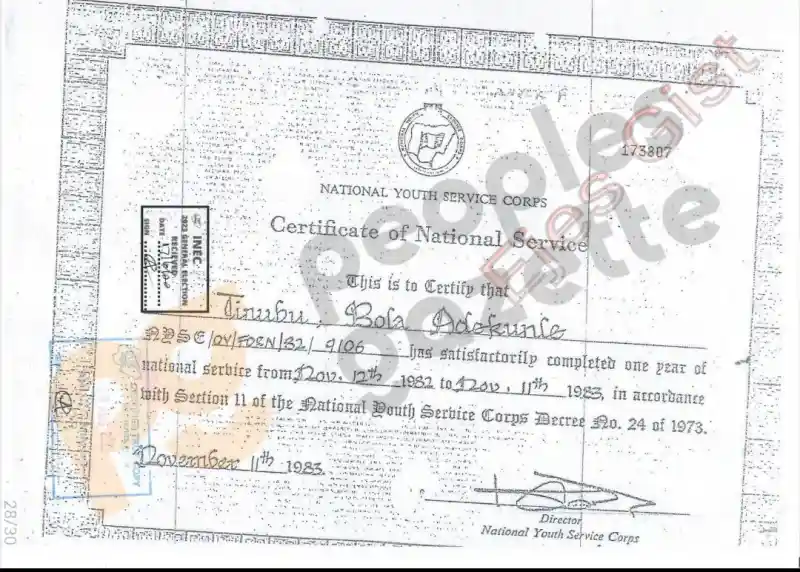
Beyond the academic records, the plaintiff also challenges the authenticity of Mr Tinubu’s National Youth Service Corps discharge certificate.
The NYSC is a mandatory one-year national service programme for Nigerian graduates under the age of 30 at the time of graduation. A valid NYSC discharge certificate is a requirement for employment in the public sector and is among the documents typically submitted by candidates for high political office.
- Popular Serving Senator Remanded in Prison for NYSC Certificate Forgery
- Supreme Court Dismisses Atiku Abubakar’s Fresh Evidence on Tinubu’s Certificate Forgery
The advocacy group says it has written formal letters to both the NYSC and the Office of the Secretary to the Government of the Federation, requesting that both institutions issue official disclaimers on the certificate Mr Tinubu presented to INEC.
Whether these institutions have responded — and if so, what their responses contained — is not yet publicly known. The letters, however, have been submitted as part of the plaintiff’s documentary evidence before the court.
Allegations of INEC Inaction
The lawsuit also directs criticism at Nigeria’s electoral commission.
According to the court filings, the Centre for Reform and Public Advocacy submitted a detailed petition to INEC on 19 June 2026. The petition, the group says, asked the commission to formally clarify Mr Tinubu’s eligibility to contest the presidency in light of the allegations surrounding his certificates.
The group claims INEC did not act on the petition. No public statement was issued. No private response was received. The silence, the plaintiff argues, left litigation as the only remaining avenue for seeking accountability.
INEC has not commented on the specific allegation of inaction. The commission typically does not respond to individual petitions through public statements, preferring to address such matters in court when named as a party.
What the Plaintiffs Are Asking For
The reliefs sought by the Centre for Reform and Public Advocacy are extensive. The group is asking the Federal High Court in Kano to issue the following orders:
- A declaration that Mr Tinubu’s Chicago State University certificate is forged and therefore invalid for electoral purposes.
- An order directing INEC to disqualify Mr Tinubu from appearing on the ballot for the 2027 presidential election.
- An order directing Chicago State University to strike Mr Tinubu’s name from its official records.
- A perpetual injunction barring INEC from uploading, accepting, or processing Mr Tinubu’s name as a candidate for the presidency.
The group has also submitted affidavits of non-multiplicity of action — a legal requirement confirming that the same matter is not being pursued in another court — as well as sworn witness statements and supporting documentary exhibits.
Political and Legal Significance
This lawsuit, while not the first of its kind, arrives at a politically sensitive moment.
Nigeria’s 2027 general election is still more than a year away, but the political landscape is already taking shape. President Tinubu, who took office in May 2023, is widely expected to seek re-election as the candidate of the All Progressives Congress. His main opponents are yet to formally declare, though opposition parties have begun early consultations.
By filing the case now, the plaintiffs have given the judiciary ample time to hear and determine the matter before party primaries commence. This distinguishes the current suit from the certificate-related challenges of 2023, which were filed close to the election and were ultimately dismissed on both procedural and substantive grounds.
Legal observers note that the case could test the boundaries of pre-election litigation in Nigeria. While courts have previously ruled that they cannot disqualify a candidate over documents already reviewed and accepted by INEC during a previous election, this suit seeks disqualification from a future election — a legal question that has not been definitively settled.
Reactions
As of the time of this report, neither the presidency nor Mr Tinubu’s legal team has issued any statement in response to the suit. A spokesperson for the president could not be reached for comment.
INEC has also remained silent. The commission typically refrains from commenting on pending litigation.
Chicago State University has not publicly addressed the latest filing. In 2023, the university confirmed that Mr Tinubu attended and graduated from the institution but declined to authenticate specific documents, citing privacy laws and the pending U.S. court case.
Background
Questions about Mr Tinubu’s academic background have followed him through multiple election cycles.
During the 2023 campaign, opposition figures and civil society groups repeatedly called on him to clarify discrepancies in his official records. The Independent National Electoral Commission maintained throughout that period that it had verified all documents submitted by candidates in accordance with the law.
Nigeria’s Supreme Court, in its ruling on the 2023 presidential election petition, held that the petitioners had failed to prove their allegations of certificate forgery beyond reasonable doubt. The court declined to nullify the election result on those grounds.
The new suit, however, is not an election petition. It is a pre-election matter that seeks to prevent Mr Tinubu from even appearing on the ballot in 2027 — a distinction that may give the plaintiffs a different legal pathway.
You May Also Like
Trending Now