Justice Lifu in Trouble as Appeal Court Rubbishes His ‘Anarchy’ Judgment – Judge Known for Rulings That Could Set Nigeria Into Civil War
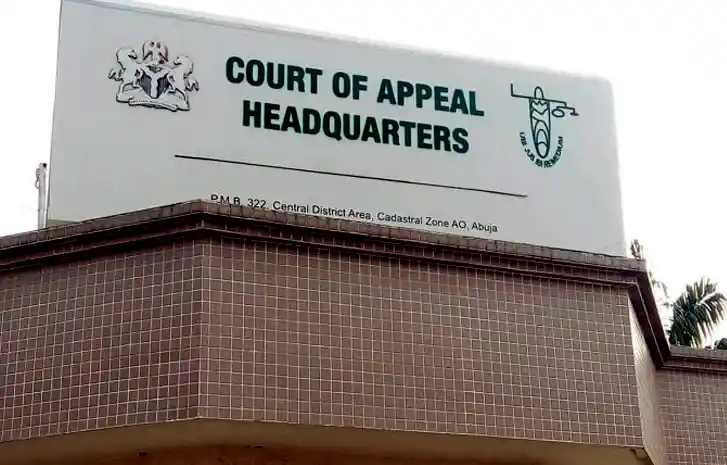
The Court of Appeal has delivered a stinging rebuke to Justice Peter Lifu of the Federal High Court, Abuja, describing his ruling that ordered the deregistration of five political parties as “the highest form of judicial impertinence” and a “brazen violation” of judicial hierarchy.
Justice Lifu, who has become known for delivering controversial judgments that critics say could plunge Nigeria into civil war, was heavily condemned by the appellate court for disregarding an earlier order of the Court of Appeal staying proceedings in the case.
In a unanimous decision delivered on Tuesday, a three-member panel led by Justice A.B. Mohammed faulted the high court judge for proceeding with the case despite an earlier order of the appellate court staying proceedings.
The appellate court held that the lower court acted while an appeal and a valid stay order were pending before it and consequently ordered that the status quo be maintained pending the determination of the appeal.
Also Read : Four Top Judges Behind Conflicting Orders and Frivolous Ex-parte Motions
“Courts are enjoined to protect their integrity. This court has supervisory authority over the trial court. This court has the duty to invoke its powers in ensuring that its orders are obeyed,” the panel ruled.
The court invoked a Supreme Court precedent, declaring that a judge who acted in such a manner “is unfit for the bench as it amounts to judicial rascality.”
What Justice Lifu Did
Justice Lifu had on Monday ordered the Independent National Electoral Commission (INEC) to immediately deregister the African Democratic Congress (ADC), Accord Party, Action Alliance (AA), Action Peoples Party (APP), and Zenith Labour Party (ZLP).
The suit was instituted by the National Forum of Former Legislators, which sought an order compelling INEC to remove the parties from its register.
However, the Court of Appeal had issued an Enrolment Order on May 22 expressly granting a stay of proceedings in Suit No. FHC/ABJ/CS/2637/2025 – the very proceedings in which Justice Lifu subsequently proceeded to deliver judgment.
Despite being aware of the order, the judge went ahead to deliver the ruling.
How the Judgment Was Delivered – Via WhatsApp
In a shocking revelation, counsel to the ADC, Shuaibu Aruwa, SAN, told the appellate court that Justice Lifu communicated the judgment’s delivery to the party via WhatsApp.
Aruwa described the lower court’s conduct as an “invitation to anarchy” and urged the appellate court to invoke its disciplinary jurisdiction under Section 6 of the 1999 Constitution to sanction the judge.
“The action of the trial judge calls for swift and extraordinary measures from this court. We have come to the stage where this court should press the reset button,” Aruwa stated.
INEC, which had been ordered to deregister the parties, told the appellate court it was unaware of the judgment’s delivery and only learned about it through media reports.
INEC’s counsel, Haliru Mohammed, said the commission had been aware of the Court of Appeal’s restraining order and therefore did not oppose the application for a stay of execution.
Reactions: ‘Invitation to Anarchy’
The judgment has sparked widespread outrage from political leaders and stakeholders.
Former Senate President and ADC National Chairman, David Mark, declared that the judiciary, rather than the opposition party, is the institution facing scrutiny over the controversy.
“The ADC is not on trial. Rather, it is the judiciary that is on trial and the nation is waiting to see how the National Judicial Council is going to handle this precarious situation,” Mark said.
The ADC chairman expressed concern over what he described as unprecedented judicial actions, alleging that Justice Lifu ignored an order of the Court of Appeal directing a stay of proceedings.
Federal lawmaker Ikenga Ugochinyere, who is also the national leader of the APP, described the judgment as an “invitation to anarchy” and a threat to Nigeria’s democratic order.
“Our nation cannot be allowed to degenerate to that level. This judgment is an invitation to anarchy. Political parties cannot simply be wiped out in a democracy because that is not what democracy represents,” he said.
Atiku Abubakar’s aide, Paul Ibe, described the judgment as “the height of judicial rascality” and alleged it was part of a broader effort to push Nigeria toward a one-party state.
“The so-called deregistration of the African Democratic Congress along with other parties by Justice Peter Lifu may yet be the biggest manifestation of Tinubu’s hell-bent bid to undermine the opposition and entrench a de facto one-party state,” Ibe wrote on X.
Dan Nwanyanwu, National Chairman of the Zenith Labour Party, described the ruling as a “travesty of justice” and said it would “expose all that has been allegedly going on in that particular court.”
“What happened today is a travesty of justice. What happened today can never be accommodated in the legal practice… That is irresponsible with the greatest respect. It is something that will now expose all that has been going on within the judiciary, particularly the federal high court,” Nwanyanwu said.
Lawyer: ‘A Very Useless Judgment’
Kalu Kalu, a frontline lawyer and member of the ADC legal team, described Justice Lifu’s order as a “useless ruling.”
“This is a very useless judgment. Very, very useless judgment. Even a university student, a law university student, will tell you that once a Court of Appeal gives any judgment or ruling, that the lower court is bound by that ruling,” he said on Arise News.
Kalu explained that the Court of Appeal gave a ruling staying proceedings at the Federal High Court, and the ruling was brought to Justice Lifu’s attention – yet he proceeded regardless.
CSO Petitions NJC
A civil society organisation, Tap Initiative for Citizens’ Development, has petitioned the National Judicial Council (NJC), seeking an investigation into Justice Lifu’s conduct.
In the petition dated June 16, the group asked Chief Justice of Nigeria Kudirat Kekere-Ekun, who chairs the NJC, to investigate Lifu for disregarding a subsisting court order and pending appellate proceedings.
The CSO said it was concerned that the judgment was delivered while an appeal on the matter was pending before the Court of Appeal and despite an enrolment order staying proceedings in the suit.
The group urged the NJC to determine whether the judge’s conduct breached provisions of the code of conduct for judicial officers relating to integrity, due process, fairness, and public confidence.
“The decision has the potential to heighten political tension, destabilise the democratic space, and create unnecessary friction capable of undermining law and order,” the organisation said.
The group stressed that the judiciary remains the last hope of the common citizen and that its legitimacy is sustained not only by constitutional authority but by unwavering public confidence in its fairness, discipline, and respect for the rule of law.
What Happens Next?
The Court of Appeal granted the application for a stay of execution and suspended enforcement of the judgment.
The appellate court’s ruling means the five political parties remain registered and can participate in upcoming elections pending the determination of the substantive appeal.
But the controversy is far from over. With the NJC petition now filed, Justice Lifu’s conduct is under scrutiny. And with the 2026 off-cycle governorship elections and the 2027 general elections approaching, the implications of this saga could be far-reaching.
Ejes Gist News Verdict
Justice Peter Lifu’s ruling that ordered the deregistration of five political parties has been emphatically overturned by the Court of Appeal – and the appellate court did not hold back.
Describing the judgment as “the highest form of judicial impertinence” and the judge’s conduct as “judicial rascality,” the Court of Appeal has sent a clear message: lower courts cannot disregard superior court orders.
But the big questions remain: Will the NJC sanction Justice Lifu? And what does this controversy say about the state of Nigeria’s judiciary ahead of the 2027 elections?
What do you think?
Should Justice Lifu be sanctioned for disregarding a Court of Appeal order? Is the judiciary truly on trial as David Mark suggested?
Drop your opinion in the comments below. Let’s gist!
You May Also Like



Trending Now