
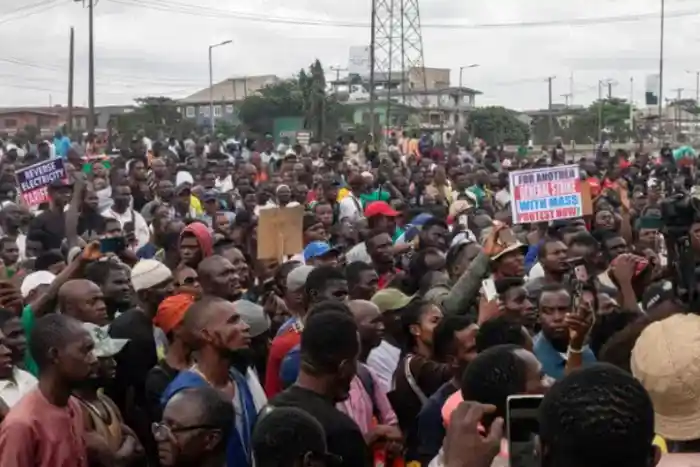
LAGOS – In the early hours of March 12, youths took to the streets of Lagos to protest what residents and business owners have described as a persistent and worsening electricity crisis. Chanting “we are not asking for too much, give us light,” the demonstrators voiced frustrations that have been building across the state for months as power outages disrupt daily life and economic activity.
For most residents, the situation has significantly worsened living conditions, while for business owners, the erratic power supply has driven up operating costs and disrupted daily activities. Small-scale traders, barbers, welders, and restaurant operators who rely on stable electricity to power their equipment have been particularly hard hit, with many forced to rely on expensive generators to remain operational.
Ikeja Electric Cites Gas Constraints
The protest follows a public notice issued by Ikeja Electric on March 11, in which the distribution company acknowledged widespread disruptions and attributed them to gas supply constraints affecting power generation on the national grid.
Also Read : Diplomatic Snub: India, Other Nations Reject Nigeria’s Ambassadorial Nominees Over Tenure Concerns
“The current situation is due to gas supply constraints affecting the national grid. This has resulted in a significant energy shortfall, necessitating increased load shedding across all our feeders,” the company stated, adding that it was maintaining communication with stakeholders to help restore normal generation levels.
Ejes Gist News reports that the explanation points to a structural problem deeply embedded in Nigeria’s electricity value chain. The country’s power system relies heavily on gas-fired thermal plants connected to the national grid, which is managed by the Transmission Company of Nigeria.
Although Nigeria’s installed generation capacity technically exceeds 13,000 megawatts, available capacity frequently fluctuates between 3,000 and 5,000 megawatts due to a combination of factors:
-
Gas supply shortages affecting thermal plants
-
Transmission bottlenecks limiting power evacuation
-
Plant maintenance issues reducing available capacity
-
Grid instability leading to system collapses
Gas-fired plants account for more than 70 per cent of Nigeria’s electricity generation, meaning any disruption in gas supply triggers near-immediate nationwide shortages that cascade down to distribution companies and ultimately to consumers.
Campaign Promise Under Scrutiny
As the protests unfolded, residents were quick to resurrect a campaign promise made by President Bola Tinubu during his election campaign. In a widely circulated video from that period, Tinubu had declared to Nigerians:
“Whichever way, by all means necessary, you must have electricity, and you will not pay for estimated billing anymore. A promise made will be a promise kept. If I don’t keep the promise and I come back for second term, don’t vote for me.”
That promise has become a recurring reference point for Nigerians navigating daily life without reliable power. Wednesday’s protest made clear that patience with the current administration on this issue is wearing thin, with demonstrators demanding tangible results rather than policy announcements.
Government Launches New Power Sector Initiative
On March 6, President Tinubu inaugurated an 11-member committee to drive the establishment of the Grid Asset Management Company Limited (GAMCO), a new initiative aimed at addressing Nigeria’s persistent power sector challenges. The Federal Executive Council had previously approved the company’s establishment as part of efforts to tackle stranded power generation, transmission bottlenecks, and grid management inefficiencies.
The committee, chaired by the President’s Chief of Staff, includes the Attorney General Lateef Fagbemi, the Ministers of Power, Works, Finance, Communications, Science and Technology, Aviation, and the Minister of State for Petroleum, among others.
According to a statement from the Presidency, the committee is tasked with:
-
Reviewing existing laws and regulatory frameworks governing the electricity value chain
-
Identifying conflicts or gaps that may hinder GAMCO’s implementation
-
Recommending legal and administrative reforms to facilitate the company’s operations
-
Developing a roadmap for the commercialisation of grid management functions
Whether the committee’s work will translate into tangible relief for Lagos residents and the country at large remains to be determined by its outcomes and subsequent implementation.
Structural Challenges Remain
Industry analysts note that while initiatives like GAMCO address transmission and grid management issues, they do not directly resolve the fundamental gas supply constraints currently causing the blackouts. The interdependence between gas production, power generation, and distribution means that solving Nigeria’s electricity crisis requires coordinated action across multiple sectors.
For Lagos residents who took to the streets on March 12, the immediate concern is restoration of power to their homes and businesses. Until the structural issues are addressed, the gap between policy announcements and lived reality is likely to persist, with citizens continuing to bear the burden of the nation’s electricity challenges.