Just Five Left: Meet the Governors Still Outside APC as Party Secures 31 States
ABUJA – The All Progressives Congress (APC) has cemented its dominance across Nigeria’s political landscape, now claiming control of 31 out of the country’s 36 states following a historic wave of defections by governors from opposition parties. As the ruling party celebrates its expanded influence, attention has shifted to the five governors who remain outside its fold.
The APC recently highlighted its dominance in a post on its official X (formerly Twitter) page with the inscription “31/36”, signaling that only a handful of states are currently governed by politicians from other parties. The declaration follows months of political realignments that saw nine governors cross over to the ruling party.
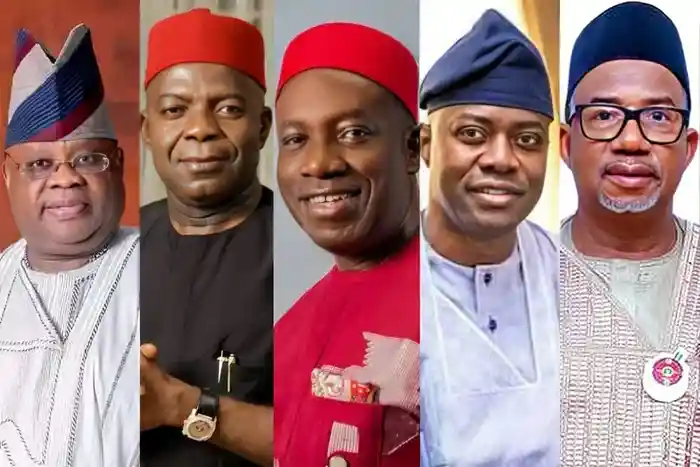
Ejes Gist News presents the five governors yet to join the APC and the parties they currently represent.
The Five Opposition Governors
1. Governor Bala Mohammed – Bauchi State
Party: Peoples Democratic Party (PDP)
State: North-East
Governor Bala Mohammed remains a steadfast member of the Peoples Democratic Party and stands as one of the most prominent opposition figures in the country. He currently serves as the chairman of the PDP Governors’ Forum, a position that places him at the center of efforts to sustain the party’s relevance despite the wave of defections to the APC.
Meet the Nine Governors who Defected to APC as Party Claims Control of 31 States (Full List)
Mohammed has been vocal in defending the PDP’s position in Nigeria’s political landscape, frequently criticizing APC policies while advocating for a stronger opposition coalition ahead of 2027. His continued presence in the PDP makes Bauchi a critical opposition stronghold in the North-East region.
2. Governor Seyi Makinde – Oyo State
Party: Peoples Democratic Party (PDP)
State: South-West
Oyo State Governor Seyi Makinde remains in the PDP, positioning himself as a leading opposition voice in the South-West region. Despite the APC’s dominance in the South-West—where the ruling party controls Lagos, Ogun, Ondo, Ekiti, and Osun—Makinde has successfully held Oyo for the opposition.
Makinde has been vocal about strengthening the PDP’s internal structures and has positioned himself as a key player in any opposition coalition seeking to challenge the APC in 2027. His performance in Oyo, a state with significant political weight in the South-West, keeps the region from being a complete APC sweep.
3. Governor Alex Otti – Abia State
Party: Labour Party (LP)
State: South-East
Governor Alex Otti represents a unique political force as the only Labour Party governor in Nigeria. His victory in the 2023 governorship election was part of the Labour Party’s surge in popularity during the last general election cycle, driven by the presidential candidacy of Peter Obi.
Otti has remained with the Labour Party despite the wave of defections sweeping other regions. His position in Abia makes him a key figure in the South-East, where the APC recently gained a foothold through Governor Peter Mbah’s defection but has not yet achieved full regional dominance.
4. Governor Charles Soludo – Anambra State
Party: All Progressives Grand Alliance (APGA)
State: South-East
Governor Charles Soludo governs Anambra State under the All Progressives Grand Alliance (APGA), a regional party with deep roots in the South-East. Soludo, a former Central Bank of Nigeria governor, won the 2021 governorship election under the APGA banner and has maintained his party affiliation despite the realignment wave.
APGA has traditionally held Anambra as its stronghold, and Soludo’s continued presence in the party preserves one of Nigeria’s few remaining regional party structures. His position also keeps the South-East politically diverse, with Anambra under APGA, Abia under Labour Party, and Enugu now under APC following Governor Mbah’s defection.
5. Governor Ademola Adeleke – Osun State
Party: Peoples Democratic Party (PDP)
State: South-West
Governor Ademola Adeleke completes the list of opposition governors, governing Osun State under the PDP banner. Adeleke famously defeated the APC in the 2022 Osun governorship election, pulling off an upset in a state that had leaned toward the ruling party.
His continued presence in the PDP keeps Osun among the five states not controlled by the APC and provides the opposition with a foothold in the South-West. Adeleke’s popularity in Osun, driven by his grassroots appeal, makes him a significant figure in any opposition calculations for 2027.
Complete List of Opposition Governors
| No. | Governor | State | Region | Party |
|---|---|---|---|---|
| 1 | Bala Mohammed | Bauchi | North-East | PDP |
| 2 | Seyi Makinde | Oyo | South-West | PDP |
| 3 | Alex Otti | Abia | South-East | Labour Party |
| 4 | Charles Soludo | Anambra | South-East | APGA |
| 5 | Ademola Adeleke | Osun | South-West | PDP |
Regional Breakdown of Opposition States
| Region | Opposition States | APC States |
|---|---|---|
| North-East | Bauchi (1) | 5 |
| North-West | 0 | 7 |
| North-Central | 0 | 6 |
| South-West | Oyo, Osun (2) | 4 |
| South-East | Abia, Anambra (2) | 1 (Enugu) |
| South-South | 0 | 6 |
The Shrinking Opposition
The five opposition governors represent a dramatic reduction in opposition-held states compared to the 2023 election outcome. Several factors explain their continued presence outside the APC:
1. Regional Party Loyalty
Governors like Soludo (APGA) and Otti (Labour Party) lead regional or issue-based parties with dedicated followings that resist absorption into the APC structure.
2. Personal Political Calculations
Governors such as Makinde and Mohammed have positioned themselves as national opposition figures, with ambitions that may extend beyond their states.
3. State-Level Popularity
Adeleke’s victory in Osun was built on personal popularity that transcends party labels, giving him flexibility to remain outside the ruling party.
4. Opposition Coalition Dynamics
Some governors may be waiting to see how opposition parties structure themselves for 2027 before making final alignment decisions.
Political Implications for 2027
The five remaining opposition governors carry significance beyond their individual states:
Opposition Leadership
Bala Mohammed, as PDP Governors’ Forum chairman, serves as a rallying point for opposition forces. His continued presence in Bauchi provides the PDP with a northern anchor.
South-West Resistance
Makinde and Adeleke together hold two South-West states against the APC’s four. Their ability to coordinate opposition strategy in the region could influence one of Nigeria’s most politically significant zones.
South-East Diversity
The South-East now features three parties across its five states: APC (Enugu), Labour Party (Abia), and APGA (Anambra). This diversity could make the region a battleground for coalition building.
Potential for Further Defections
Political observers note that with more than a year before the 2027 election cycle gathers full momentum, further realignments may still occur. The five governors face continued pressure to align with the ruling party, particularly as APC’s dominance grows.
What the Governors Are Saying
Governor Bala Mohammed (Bauchi): Has repeatedly stated that the PDP remains strong and that defections will not weaken the party’s resolve to contest and win in 2027.
Governor Seyi Makinde (Oyo): Has positioned himself as a defender of opposition unity, frequently hosting meetings with other non-APC governors.
Governor Alex Otti (Abia): Emphasizes his Labour Party mandate as distinct from both APC and PDP, suggesting he may chart an independent course.
Governor Charles Soludo (Anambra): Has maintained that APGA remains the authentic voice of the South-East and that regional interests are best served by maintaining the party’s identity.
Governor Ademola Adeleke (Osun): Focuses on governance in Osun while maintaining PDP affiliation, with his dance-filled campaigns and people-centric approach keeping him popular despite national trends.
The Road to 2027
As the APC celebrates its 31-state dominance, the five opposition governors represent both resistance and uncertainty. Their decisions in the coming months—whether to stand firm, form a united opposition coalition, or eventually join the ruling party—will significantly shape the political landscape ahead of the 2027 elections.
For now, they remain the faces of opposition governance in Nigeria, governing islands of resistance in a sea of APC dominance.
Whether they can hold the line or eventually join the ruling party wave will be one of the defining political stories between now and the next national polls.
Ejes Gist News stands for truth, responsible journalism, editorial integrity and fearless accountability.
You May Also Like



Trending Now