INEC’s Explanation for AI Images on Voters’ List Raises National Security Concerns, Tietie Says
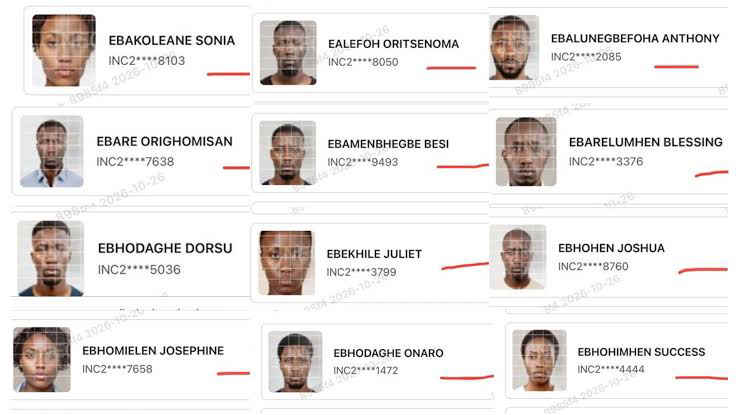
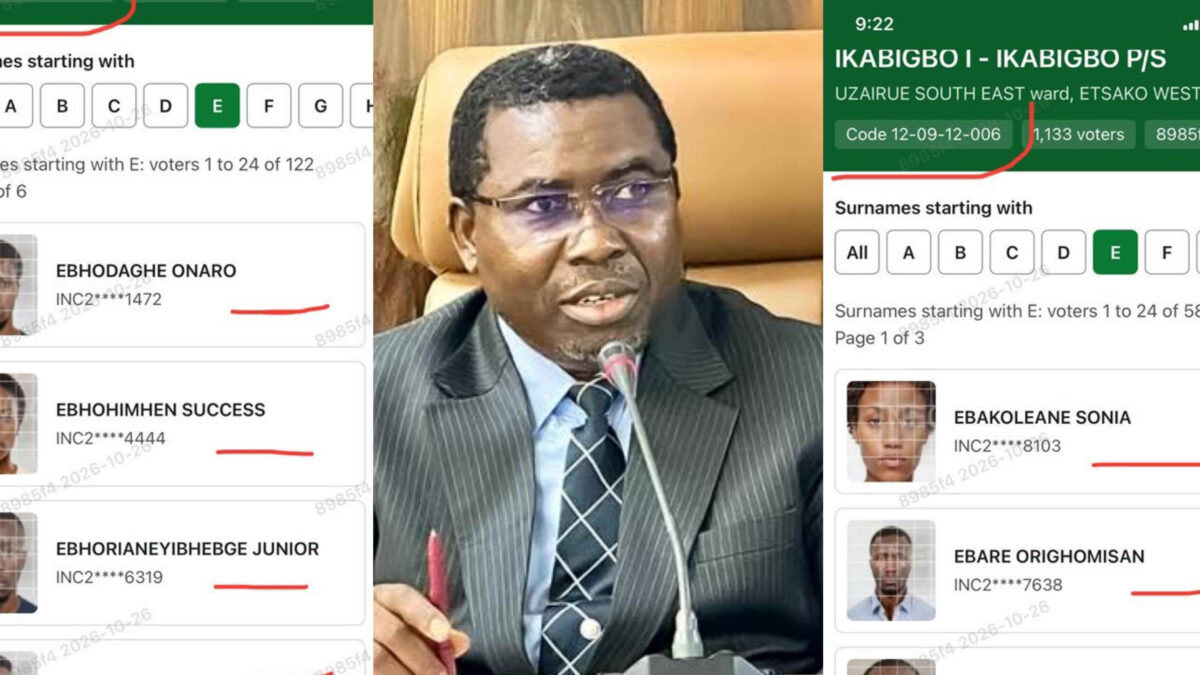
A lawyer and public affairs analyst, Frank Tietie, says the explanation the Independent National Electoral Commission gave for artificial intelligence-generated photographs in Nigeria’s preliminary voters‘ register raises national security concerns and requires immediate clarification of the commission’s next steps.
Tietie, who spoke on Arise News, argued that INEC’s account — that field officers with access to its database introduced the questionable records — leaves unanswered questions about how such entries entered a system meant to safeguard the credibility of elections.
Ejes Gist News reports that his intervention adds to mounting scrutiny of the register ahead of the 2027 general election.
- INEC Breaks Silence, Speaks on Choosing Tinubu As Its Preferred Presidential Candidate Ahead of 2027 Elections
- Rig And Die’ Targets Election Riggers, Not Voters, Omo-Agege’s Aide Insists
“The only explanation INEC can give is that its compromised officers were responsible for generating those pictures and that information. That is a big problem,” Tietie said.
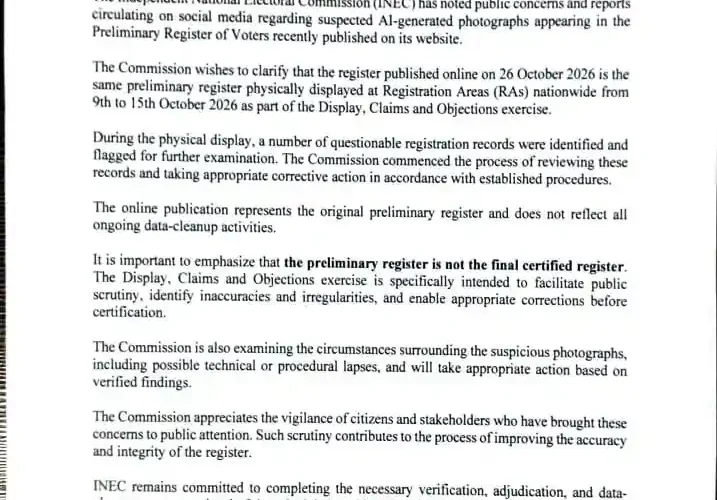
What INEC said about the AI images on the voters’ list
INEC’s director of information and communication technology, Lawrence Bayode, said in an interview on Arise Television that registration officers across the country used their official login details to introduce irregular entries into the voter database.
Bayode said the commission detected the anomalies through its Automated Biometric Identification System, known as ABIS, which examined registration data and flagged suspect records.
“We have registration officers on the field. And these registration officers, they have login details to log into the system. So what we have found is that some of these registration officers, not all of them now, some of them across the states nationwide, they’ve done different things to bring these irregularities onto the register,” he said.
He added that not every questionable photograph was machine-generated, saying some reflected poor registration practice.
“Some of these pictures are AI-generated. Some of them not AI-generated, but very bad registration. And this thing got into the register by the registration officers and because they have access to register people,” he said.
Bayode said the commission had identified the affected records and established how some of the irregularities were introduced, but that the reasons behind the officers’ actions remained unclear.
INEC published the preliminary register of voters for public scrutiny on Oct. 26, 2026, through its online display portal. The exercise is designed to allow citizens to check their details and seek corrections before elections.
Tietie questions INEC’s next steps
Tietie said he expected the commission to convene a stakeholders’ meeting involving all political parties to explain the controversy in full.
“I look forward to what INEC will do next, whether it will convene a stakeholders’ meeting involving all the political parties and sufficiently explain what happened,” he stated.
He said the purpose of displaying the register was to let citizens identify discrepancies in their personal information and correct them before voting, and warned that fictitious records could inflate voter figures.
“INEC must immediately redeem its integrity, or else it is leading the country towards its own form of anarchy. It must not be responsible for failing Nigerians,” he said.
Tietie argued that the commission had received the funding required for its responsibilities in previous election cycles and should be held accountable for shortcomings in the register, adding that restoring confidence would require action beyond explanatory statements.
Civil society and opposition reaction
Electoral observers have described the discrepancies as a threat to public confidence. Abideen Olasupo, chairman of BallotEyes and YvoteNaija, told the Sunday Tribune that trust in an election begins with the register.
“Trust in an election begins long before polling day; it begins with citizens believing that the register accurately reflects eligible voters… When people see questionable identities or duplicate records, they may conclude the process is already compromised, which discourages registration, verification, and turnout,” he said.
Samson Itodo, executive director of Yiaga Africa, said the infirmities in the register were substantial rather than clerical.
“These AI-generated images and suspected cases of register padding raises fundamental questions about the credibility of the register. A compromised voter register is a compromised foundation for credible elections. The infirmities in the register are not minor errors. They pose grave threats to voting rights and our democracy,” he said.
Kola Ologbondiyan, director of media and publicity for the African Democratic Congress presidential campaign council, told the Sunday Tribune that identifying the staff involved would not be sufficient on its own.
“I think that, beyond identifying these staff, they have to clean up the system in a manner that Nigerians can trust INEC. That, too, is also very, very important. They must clean up the voters’ register,” he said.
The Sunday Tribune reported that the ruling All Progressives Congress presidential campaign council had not commented on the controversy, while opposition parties questioned INEC’s neutrality and capacity to conduct the 2027 general election, with votes scheduled for Jan. 16 and Feb. 6, 2027.
INEC’s technology record under scrutiny
The dispute has revived debate about the commission’s reliance on technology to protect the register. According to the Sunday Tribune’s review of successive reforms, INEC introduced an electronic register after the 2011 elections, then added permanent voter cards and smart card readers for the 2015 general election.
| Technology | Introduced | Function |
|---|---|---|
| Electronic voter register | 2011 | Digitised record of registered voters |
| Permanent voter card and smart card reader | 2015 | Card-based identity check at polling units |
| Bimodal Voter Accreditation System | 2022 | Fingerprint and facial authentication of voters |
| INEC Result Viewing Portal | 2023 | Upload of polling unit results |
The Bimodal Voter Accreditation System was deployed in the Ekiti and Osun states governorship elections in 2022, while the result viewing portal was introduced ahead of the 2023 elections, when upload failures and disparities between posted and announced figures drew criticism.
The Sunday Tribune reported that the current INEC chairman, Joash Amupitan, who assumed office in October 2025, has not introduced new election technology and has focused on consolidating earlier reforms, including public online access to the voters’ register.
Ejes Gist News stands for truth, responsible journalism, editorial integrity and fearless accountability.
You May Also Like
Trending Now