11th Senate Presidency: APC Crisis Gets Messier As Akpabio, Wike, Okorocha, Ganduje Gang Up Against Uzodimma
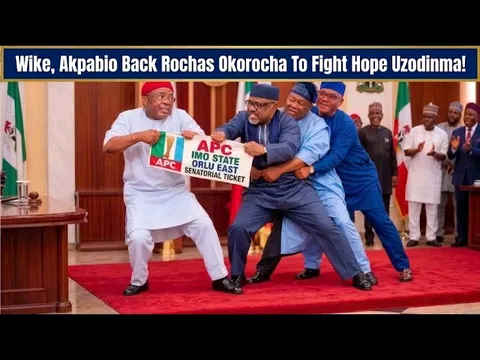
The battle for control of the 11th National Assembly appears to be generating fresh political tensions within the ruling All Progressives Congress (APC), following a Federal High Court judgment recognising former Imo State Governor Rochas Okorocha as the party’s candidate for Imo West Senatorial District in the 2027 general elections.
The judgment, which nullified the senatorial ticket claimed by incumbent Imo State Governor Hope Uzodimma, has added another dimension to the growing political rivalry among some of the party’s most influential figures ahead of the next political dispensation.
Although the legal dispute centred on the outcome of the APC senatorial primary in Imo West, the development has triggered wider discussions about the reported ambition of Uzodimma to become Senate President after completing his tenure as governor in 2027.
The governor, who currently chairs the Progressive Governors Forum (PGF), is believed to be positioning himself for a return to the National Assembly, a move that could put him in direct competition with incumbent Senate President Godswill Akpabio, who is also seeking to retain his position in the 11th Senate.
The emerging political contest has reportedly drawn the interest of other influential figures, including Minister of the Federal Capital Territory (FCT), Nyesom Wike, former APC National Chairman Abdullahi Ganduje and former Imo State Governor Rochas Okorocha.
While there is no established evidence that the politicians jointly orchestrated the legal setback against Uzodimma, their separate political interests and disagreements with the Imo governor have raised questions about the possibility of emerging alliances against his growing influence within the ruling party.
Court judgment hands Okorocha Imo West ticket
The latest development followed a judgment delivered on Thursday, October 29, by Justice Obiora Egwuatu of the Federal High Court in Abuja.
The court directed the Independent National Electoral Commission (INEC) to recognise Okorocha as the APC candidate for Imo West Senatorial District, popularly known as Orlu Zone, after holding that evidence presented before it established that the former governor won the party’s senatorial primary conducted on May 18.
The court also restrained Uzodimma from continuing to present himself as the APC candidate for the constituency.
Okorocha had approached the court to challenge the recognition of Uzodimma as the winner of the primary election, insisting that he emerged victorious in the exercise.
The judgment represents a significant setback for Uzodimma, who previously represented Imo West in the Senate between 2011 and 2019 before becoming governor in 2020.
Beyond the immediate implications for the 2027 senatorial election, the ruling has complicated the political calculations surrounding the governor’s reported ambition to return to the Senate and possibly emerge as the next Senate President.
The development is particularly significant because Uzodimma and Okorocha are longstanding political rivals from the same senatorial district, with both politicians having maintained competing political interests in Imo State.
Akpabio moves to secure another Senate presidency
At the centre of the unfolding political contest is the reported disagreement between Uzodimma and Akpabio over the leadership of the 11th Senate.
Akpabio, who currently presides over the Senate, has made no secret of his interest in retaining the position after the 2027 general elections.
During the inauguration of the APC Presidential Campaign Council in Abuja, the Senate President reportedly appealed to President Bola Tinubu to support his ambition to return as the leader of the next National Assembly.
His position has placed him in a potentially difficult political contest with Uzodimma, whose growing influence within the APC has fuelled speculation about his own legislative ambitions.
Akpabio has also made comments interpreted in political circles as a warning to the Imo governor to concentrate on his responsibilities as governor rather than entertain ambitions concerning the Senate leadership.
The disagreement became more pronounced on October 15 when senators, during plenary, declared that there was no vacancy in the offices of the Senate President and other principal officers of the 11th National Assembly.
The declaration, championed by Senate Chief Whip, Senator Tahir Monguno, and supported by Senator Cyril Fasuyi, was widely viewed as an attempt to strengthen Akpabio’s position ahead of the next leadership contest.
Although the decision of the next Senate President will ultimately rest with newly elected senators when the 11th National Assembly is inaugurated, the declaration demonstrated that Akpabio’s supporters were already positioning themselves for the political battle.
Former Edo State Governor and Senator representing Edo North, Adams Oshiomhole, is also among the influential politicians whose names have featured in discussions surrounding the emerging Senate leadership calculations.
Wike’s disagreement with Uzodimma deepens
Another major dimension of the unfolding political crisis is the reported disagreement between Uzodimma and Wike.
Although Wike remains a member of the Peoples Democratic Party (PDP), his position in the Tinubu administration and his political relationship with the President have made him an influential figure in the political calculations surrounding the 2027 elections.
The FCT minister has reportedly been uncomfortable with Uzodimma’s growing influence and his perceived ambition to become Senate President.
Wike has also been quoted in political circles as making a strong declaration that he would not be alive to witness Uzodimma becoming Senate President. The reported remark has further fuelled speculation about the depth of their political differences.
Their disagreement, however, goes beyond the contest for the Senate presidency and extends to the mobilisation of political support for Tinubu’s re-election.
Wike has been promoting the Rainbow Coalition, a political platform designed to mobilise support for the President across party lines.
However, Uzodimma, in his capacity as chairman of the Progressive Governors Forum, has opposed political arrangements that he believes could undermine the APC’s structures and its candidates in the 2027 elections.
On September 15, the Imo governor declared that APC governors would not participate in or endorse political arrangements capable of weakening the party.
The disagreement became more visible on October 27 when Uzodimma declared that there was no Rainbow Coalition in Imo State.
Speaking during the distribution of campaign vehicles under the PBAT Door-to-Door Movement, the governor insisted that APC members must operate within the party’s recognised structures.
He also warned that the vehicles distributed to supporters could be withdrawn if they were used for political activities outside the APC.
The position was interpreted in some political quarters as a direct challenge to Wike’s mobilisation strategy, particularly given the minister’s influence in Rivers State and his efforts to build political alliances across party lines.
The development has raised questions about whether the two politicians are pursuing competing political interests despite their professed support for Tinubu’s second-term ambition.
Ganduje and Okorocha enter the political equation
The reported involvement of Ganduje and the emergence of Okorocha as the beneficiary of the Imo West court judgment have further complicated Uzodimma’s political situation.
Ganduje, who resigned as APC National Chairman in June 2025, is among the party chieftains whose political relationship with the Imo governor has attracted attention.
There have been allegations within party circles that Uzodimma played a role in the political circumstances surrounding Ganduje’s departure from the national chairmanship.
However, the allegation has not been independently established, while Ganduje’s resignation was officially attributed to the need to attend to urgent personal matters.
Nevertheless, political observers believe that existing disagreements among influential APC figures could influence the alliances and calculations ahead of the 2027 elections.
Okorocha’s emergence as the recognised APC candidate for Imo West has also introduced another challenge for Uzodimma.
The former governor has maintained a longstanding political rivalry with his successor, particularly over control of the Orlu political structure.
For Okorocha, the judgment offers an opportunity to return to the Senate after his previous tenure as governor and senator.
For Uzodimma, however, the decision represents a disruption to his reported plan to return to the National Assembly after completing his governorship tenure.
Some party stakeholders have expressed suspicion that political opponents may be exploring alliances with Uzodimma’s longstanding rivals to weaken his influence within the APC.
However, there is no established evidence that Akpabio, Wike or Ganduje sponsored Okorocha’s court action or influenced the judgment.
The court’s decision was based on the evidence presented concerning the conduct and outcome of the APC primary election.
APC campaign appointments expose deeper divisions
The latest confrontation is also unfolding against the background of earlier disagreements over appointments into the APC Presidential Campaign Council.
The composition of the council reportedly generated resentment among some party stakeholders who felt excluded from strategic positions despite their contributions to the party.
The Media and Publicity Directorate, headed by the Minister of Information and National Orientation, Mohammed Idris Malagi, became one of the areas of disagreement.
Some stakeholders reportedly complained that influential APC chieftains were sidelined in the distribution of campaign responsibilities.
There were also concerns over the reported appointment of political figures outside the APC to coordinate Tinubu’s re-election campaign in states such as Anambra, Osun and Rivers.
The appointments reportedly generated dissatisfaction among some longstanding party members, who questioned why individuals outside the party’s established structures were being given influential campaign responsibilities.
Some stakeholders accused the campaign leadership of prioritising political relationships over party loyalty, while others expressed concerns about inadequate consultation with governors and the APC National Working Committee.
The Director-General of the Presidential Campaign Council, Senator Abdulaziz Yari, was subsequently reported to be making efforts to accommodate aggrieved stakeholders through possible adjustments to some appointments.
The disagreements highlighted the difficulty facing the ruling party in balancing the interests of its various political tendencies ahead of the 2027 elections.
More cracks emerge within APC leadership
Beyond the immediate contest involving Uzodimma, Akpabio and Wike, the APC has continued to experience disagreements over political appointments, control of party structures and the influence of governors in decision-making.
Ganduje’s resignation as national chairman in June 2025, after less than two years in office, was one of the developments that exposed the delicate balance of interests within the ruling party.
There have also been disagreements within the Progressive Governors Forum over leadership, accountability and the management of the collective political interests of APC governors.
At a point, reports emerged that some APC governors were uncomfortable with Uzodimma’s leadership of the forum, raising questions about the level of support he enjoyed among his colleagues.
Although the disagreements did not bring the activities of the forum to a halt, they demonstrated that the governors’ platform was not immune to the internal political tensions affecting the national party.
The emerging situation suggests that the struggle within the APC may extend beyond the Senate presidency to a broader contest over political influence, strategic appointments and control of the party’s structures ahead of the next political dispensation.
With serving senators, governors, ministers and former political officeholders pursuing different interests, the possibility of temporary alliances among competing political camps has become a major subject of discussion.
Tinubu faces internal challenge ahead of 2027
For President Tinubu, the growing disagreements among influential APC figures present another political challenge as preparations for his re-election gather momentum.
The President’s second-term ambition depends significantly on the cooperation of governors, senators, ministers, party executives, former political officeholders and grassroots mobilisation structures across the country.
However, the emerging rivalry among some of these political actors has raised concerns about the ruling party’s ability to maintain a common direction ahead of the elections.
Party stakeholders fear that politicians who should be concentrating on mobilising support for Tinubu could instead devote their resources and political energy to settling personal disagreements and protecting their individual ambitions.
One of the major concerns is that aggrieved political actors may not openly oppose the President but could gradually withdraw their commitment to grassroots mobilisation and campaign activities.
The disagreements over the Senate presidency, Rainbow Coalition, campaign appointments and control of state political structures could also create competing centres of authority within the ruling party.
Ultimately, the leadership of the 11th Senate will be determined by the elected senators when the next National Assembly is inaugurated. However, the political manoeuvring ahead of the 2027 elections suggests that the battle for the position could become one of the major tests of unity within the APC.
For Uzodimma, the court judgment involving Okorocha has introduced an unexpected obstacle to his reported legislative ambition, while Akpabio’s determination to retain the Senate presidency and Wike’s growing disagreements with the Imo governor have added further complications.
Whether these political interests will eventually translate into a coordinated opposition to Uzodimma or remain separate rivalries is yet to be established. What is increasingly evident, however, is that the APC’s internal struggle for influence is becoming another major issue confronting the ruling party ahead of 2027.
Ejes Gist News stands for truth, responsible journalism, editorial integrity and fearless accountability.
You May Also Like
Trending Now