


Advertisements
The Federal Government of Nigeria has formally withdrawn the criminal defamation case instituted against Senator Natasha Akpoti-Uduaghan, representing Kogi Central Senatorial District in the 10th National Assembly.
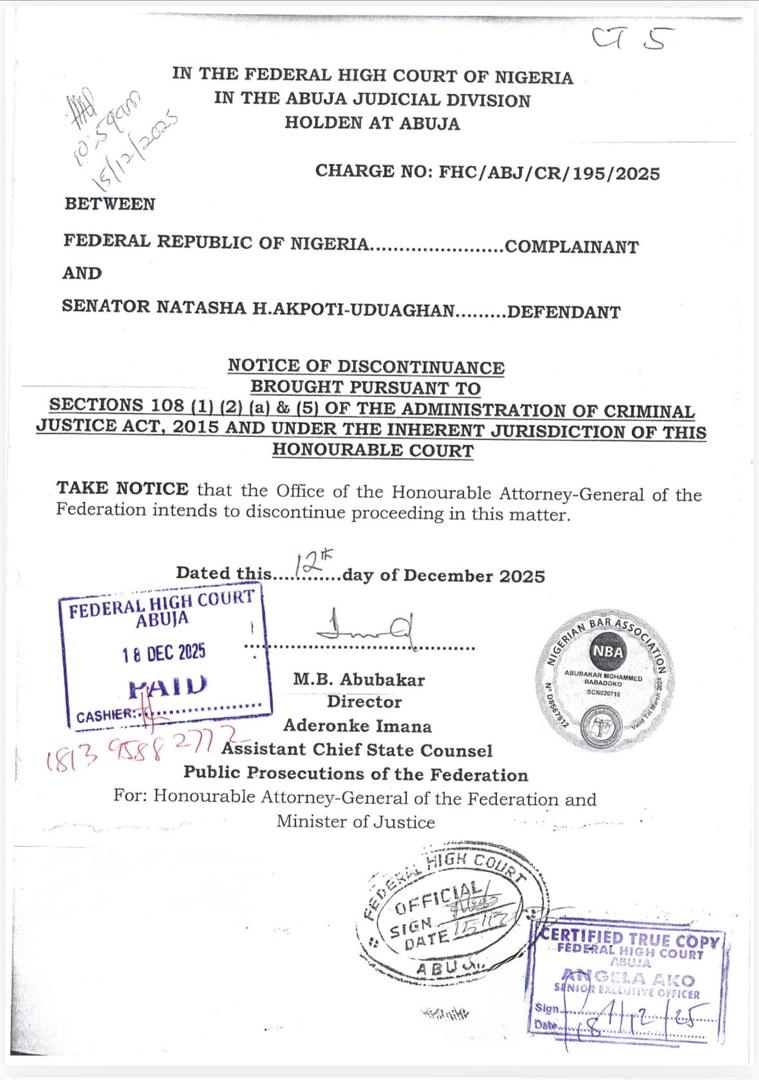
Court filings obtained from the Federal High Court confirm that the prosecution has been discontinued, bringing an end to one of the criminal proceedings arising from allegations involving the Senate President, Godswill Akpabio, and a former governor of Kogi State, Yahaya Bello.
The withdrawal marks a significant development in a legal dispute that has drawn national attention, raised questions about the use of criminal defamation laws, and highlighted tensions between political office holders and freedom of expression within Nigeria’s democratic framework. Ejes Gist News reports that the notice of discontinuance was filed by the Office of the Attorney General of the Federation, acting on behalf of the Federal Government.
Advertisements
Background to the Criminal Case Against Senator Akpoti-Uduaghan
Senator Natasha Akpoti-Uduaghan became the subject of criminal prosecution following public statements she made during a televised political programme. The comments were aired on Politics Today, a current affairs programme hosted by Seun Okinbaloye, where the senator alleged that Senate President Godswill Akpabio and former Kogi State Governor Yahaya Bello were involved in a plot to eliminate her.
Advertisements
The statements triggered petitions from the individuals named in the allegations. These petitions were subsequently forwarded to law enforcement agencies, culminating in criminal charges filed by the Federal Government against the senator. The charges bordered on criminal defamation and cyber-related offences, anchored on Nigeria’s existing legal framework governing defamatory statements and online communication.
The senator maintained that her remarks were made in the context of expressing concerns over threats to her personal safety. She also disclosed that she had earlier submitted a petition to the Inspector General of Police, alleging threats to her life, but claimed that the petition was ignored before criminal charges were filed against her.
Legal Basis of the Withdrawn Case
The discontinued criminal case was initiated by the Federal Government, acting through the Office of the Attorney General of the Federation, rather than by Senate President Akpabio in his personal capacity. This distinction became central to public discussions, as criminal defamation cases in Nigeria are often prosecuted by the state, even when they originate from private complaints.
A notice of discontinuance, dated December 12, 2025, was formally filed before the Federal High Court. The document notified the court of the government’s intention to terminate the proceedings against Senator Akpoti-Uduaghan. Under Nigerian law, the Attorney General of the Federation possesses constitutional authority to discontinue criminal prosecutions at any stage before judgment, a power commonly referred to as nolle prosequi.
By filing the notice, the Federal Government effectively brought the criminal case to an end, relieving the senator of further obligation to stand trial on those specific charges.
Profile of Senator Natasha Akpoti-Uduaghan
Senator Natasha Akpoti-Uduaghan is a first-term lawmaker in the 10th National Assembly, representing Kogi Central Senatorial District. She is one of the prominent female voices in Nigeria’s Senate and has been known for her outspoken positions on governance, accountability, and security-related issues.
Her political career has been shaped by previous legal battles, electoral disputes, and public advocacy. As a senator, she has remained visible in national discourse, particularly on matters affecting her constituency and broader national concerns.
The criminal defamation case added to a series of legal challenges that have intersected with her political activities, reinforcing her prominence in Nigeria’s political landscape.
Witnesses Listed Before the Discontinuance
Prior to the withdrawal of the case, several high-profile individuals were listed as witnesses for the prosecution. These included:
- Governor Usman Ododo of Kogi State
- Senator Ekpenyong Asuquo
- Ambassador Reno Omokri
- Sandra Duru
Their inclusion underscored the political weight attached to the case and suggested that the trial, if it had proceeded, would have involved testimonies from influential political and public figures.
The discontinuance of the proceedings meant that these witnesses were no longer required to testify in relation to that specific criminal charge.
One of Two Criminal Cases Filed Against the Senator
The withdrawn charge was one of two criminal cases instituted by the Federal Government against Senator Akpoti-Uduaghan. Court records indicate that a second criminal case, also initiated by the government, remains pending.
According to information available from the court registry, the second case is scheduled to come up for hearing on a Monday following the filing of the notice of discontinuance in the first matter. Legal observers have indicated that the second case may also be withdrawn, although no formal notice has been filed at the time of reporting.
Both cases share a similar origin, having emerged from the same set of allegations and petitions involving the senator’s televised statements.
Relationship Between the Criminal Case and Civil Defamation Actions
In addition to the criminal proceedings, Senate President Godswill Akpabio has been involved in civil litigation connected to the dispute. In December 2025, he filed a ₦200 billion defamation lawsuit against Senator Akpoti-Uduaghan at the High Court of the Federal Capital Territory.
In that suit, Akpabio accused the senator of publishing malicious allegations, including claims of sexual harassment, which he asserted were false and damaging to his reputation. Court documents show that he is seeking extensive reliefs, including:
- Monetary damages amounting to ₦200 billion
- Formal retractions of the alleged defamatory statements
- Nationwide broadcast apologies
The civil case remains distinct from the criminal proceedings, as it was filed by Akpabio in his personal capacity and seeks private remedies rather than criminal sanctions.
Akpabio’s Public Commitment to Withdraw Defamation Cases
The withdrawal of the criminal case against Senator Akpoti-Uduaghan followed a public announcement by Senate President Godswill Akpabio, in which he stated that he had directed his legal team to discontinue all defamation cases he had instituted against individuals.
On January 1, a report indicated that Akpabio made the announcement during a church programme, attributing his decision to a sermon delivered by a cleric. He disclosed that he had multiple cases in court against individuals he accused of defaming him but had resolved to withdraw them.
“I had almost nine cases in court against some individuals who defamed me, who lied against me, who slandered my name,” Akpabio stated. He explained that the message he received during the sermon prompted him to reconsider his legal actions.
Although he did not provide a comprehensive list of the affected cases, prior reporting had established that his legal confrontation with Senator Akpoti-Uduaghan was among the most prominent.
Criminal Defamation Laws in Nigeria: Context and Debate
The case against Senator Akpoti-Uduaghan has reignited discussions about the relevance and application of criminal defamation laws in Nigeria. Criminal defamation remains part of Nigeria’s legal system, inherited from colonial-era statutes and retained in various forms under federal and state laws.
Critics argue that criminal defamation provisions are often used to suppress dissent, intimidate journalists, and silence political opponents. Advocates of reform have repeatedly called for the decriminalisation of defamation, urging that disputes over reputation be resolved through civil litigation rather than criminal prosecution.
Supporters of criminal defamation laws, however, maintain that they serve as a deterrent against reckless and damaging falsehoods, particularly in an era of rapid information dissemination through broadcast and digital platforms.
The withdrawal of the case against a sitting senator has therefore been viewed by some observers as a notable moment in the ongoing debate over free speech and accountability in Nigeria.
Role of the Attorney General of the Federation
Under Nigeria’s Constitution, the Attorney General of the Federation holds wide-ranging powers over criminal prosecutions. These powers include initiating, taking over, and discontinuing criminal proceedings in the public interest.
In this case, the filing of a notice of discontinuance reflects the exercise of that constitutional authority. Legal practitioners note that such decisions may be influenced by considerations such as:
- The sufficiency of evidence
- Public interest concerns
- Policy considerations
- The broader implications for justice administration
The absence of a detailed public explanation leaves room for interpretation, but the procedural legality of the withdrawal remains firmly grounded in constitutional provisions.
Political Implications of the Withdrawal
The discontinuance of the criminal case carries political implications for all parties involved. For Senator Akpoti-Uduaghan, it removes the immediate burden of defending herself against criminal charges while continuing her legislative duties.
For the Senate President, it aligns with his publicly stated intention to step back from defamation-related litigation, at least in the criminal sphere. For the Federal Government, the decision reflects prosecutorial discretion in a politically sensitive matter involving senior office holders.
Within the National Assembly, the development has been closely watched as an indicator of how legal disputes between lawmakers and other political actors may be handled going forward.
Pending Developments and the Second Criminal Case
Attention has now shifted to the second criminal case filed by the Federal Government against Senator Akpoti-Uduaghan. Court schedules indicate that the matter is due for hearing, raising expectations that a similar notice of discontinuance may be filed.
If withdrawn, it would effectively bring an end to all criminal prosecutions arising from the senator’s televised statements. Until then, the case remains technically active, although legal precedent suggests that prosecutorial consistency may be maintained.
