Month: January 2026

  • Cameroon Defeat South Africa 2-1 to Reach AFCON 2025 Quarterfinals Against Morocco

    Cameroon Defeat South Africa 2-1 to Reach AFCON 2025 Quarterfinals Against Morocco

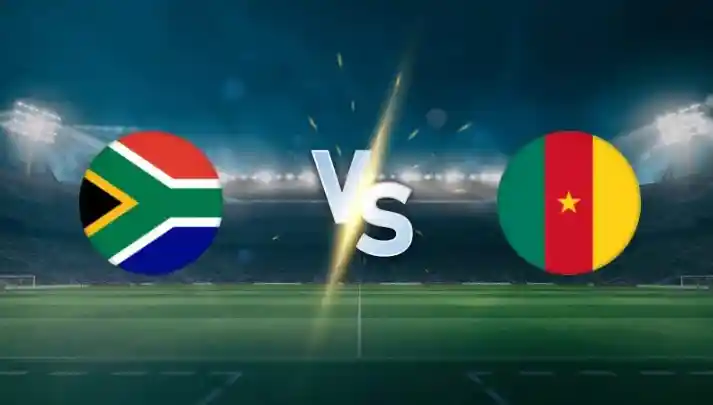
    Cameroon has defeated South Africa 2-1 in the Round of 16 at the 2025 Africa Cup of Nations (AFCON), securing a place in the quarterfinals where they will face hosts Morocco on January 9. The match, played at Al Medina Stadium in Rabat, Morocco, delivered a high-paced encounter that saw South Africa dominate possession but fail to convert early chances, while Cameroon capitalized on critical opportunities to advance.


    Ejes Gist News reports that despite South Africa pulling one back late in the game, Cameroon’s clinical finishing proved decisive in ensuring their progression to the next stage of the tournament.


    Final Score

    South Africa 1–2 Cameroon

    Goals:

    • Cameroon: Jean Tchamadeu (34’), C. Kofane (47’)
    • South Africa: Makgopa (88’)

    Assists: S. Kotto (34’), A. Nagida (47’)


    Match Timeline & Live Updates

    88’ – GOAL! South Africa 1-2 Cameroon
    Makgopa scores for South Africa, pulling one back late in the game. The goal injects some drama but is not enough to alter the outcome.

    88’ – South Africa Wins Corner
    Mokoena delivers from the left; Cameroon clears the danger.

    85’ – Score Update: South Africa 0-2 Cameroon

    49’ – GOAL! Cameroon 2-0 South Africa
    C. Kofane doubles Cameroon’s lead. A corner initially cleared by South Africa is recovered quickly, with Kofane heading a precise ball from A. Nagida into the far post.

    47’ – Second Half Begins
    Cameroon kicks off the second half following a 0-1 halftime lead.

    46’ – Half-Time Review: South Africa 0-1 Cameroon

    • Jean Tchamadeu scored at 34’
    • Assist by S. Kotto
    • Cameroon’s defense maintained control despite South Africa’s dominance in possession.

    45+1’ – South Africa Wins Corner
    Appollis delivers from the right; cleared by Cameroon’s defense.

    43’ – Rain Intensifies
    Wet weather adds pace to the match, affecting passing and ball control.

    40’ – South Africa Wins Free Kick
    Mokoena’s long-range shot is blocked by Cameroon.

    39’ – Cameroon Free Kick
    Mbeumo delivers from the right; cleared by South Africa’s defense.

    36’ – GOAL! South Africa 0-1 Cameroon
    Jean Tchamadeu opens the scoring after a precise pass from Baleba. The goal is confirmed by VAR.

    34’ – Goal Review Complete
    VAR validates Tchamadeu’s opener.

    32’ – Cameroon Free Kick
    Awarded after a foul on Ngezana; delivered from 30 meters out.

    29’ – South Africa Wins First Corner
    Appollis delivers the ball into the box; cleared by Cameroon.

    26’ – Cameroon Growing Into Match
    Mbeumo pushes down the right flank; Cameroon shows attacking intent.

    22’ – Cameroon Substitution
    Yongwa exits with injury; Mahmadou Nagida replaces him.

    19’ – South Africa Pressing
    Bafana Bafana dominate possession but fail to convert early chances.

    12’ – Halftime Observations
    South Africa dominated early, but Tchamadeu’s goal gave Cameroon control, and the team gradually increased confidence.

    0’ – Kickoff
    The match begins at Al Medina Stadium, Rabat.


    Tactical Summary

    • Cameroon: Counter-attacks, disciplined defense, clinical finishing.
    • South Africa: Possession-based approach, strong midfield, inefficient finishing.
    • Conditions: Rain added speed and unpredictability to passing and shots.

    Venue

    Al Medina Stadium, Rabat, Morocco – The stadium witnessed a lively atmosphere with fans from both nations. Rain intermittently affected ball control and passing throughout the match.


    Implications for the Tournament

    Cameroon’s victory ensures a quarterfinal clash with host nation Morocco on January 9. South Africa’s late goal could not alter the result, ending Bafana Bafana’s campaign in the Round of 16. The win reinforces Cameroon’s reputation as a strong knockout-stage contender in AFCON 2025.


    Next Match:

    • Cameroon vs Morocco – Quarterfinals
    • Date: January 9, 2026


  • South Africa vs Cameroon – AFCON 2025 Last 16 Full Score (1-2)

    South Africa vs Cameroon – AFCON 2025 Last 16 Full Score (1-2)

    South Africa and Cameroon are battling in the Round of 16 at the 2025 Africa Cup of Nations (AFCON), with Cameroon currently leading 2-1 at Al Medina Stadium in Rabat, Morocco. The winner will face hosts Morocco in the quarterfinals on January 9.


    Ejes Gist News reports that the match has been fast-paced, with South Africa dominating possession early but failing to convert chances, while Cameroon has been clinical in front of goal.


    South Africa vs Cameroon ( 1-2)

    GOAL! Makgopa scores. South Africa 1-2 Cameroon

    With time running out, South Africa pull one back to add some much needed intrigue!

    88 mins: South Africa 1-2 Cameroon 

    South Africa win corner

    It is delivered from the left side into the box by Mokoena.


    But it is underhit as Cameroon are soon able to dispatch the ball away from danger.


    85 mins: South Africa 0-2 Cameroon


    Live Match Updates

    49’ – GOAL! Cameroon 2-0 South Africa
    C. Kofane doubles Cameroon’s lead. A corner initially cleared by South Africa is quickly recovered by Cameroon. Kofane heads a precise ball from A. Nagida into the far post.

    47’ – Second Half Begins
    Cameroon kicks off the second half.

    46’ – Half-Time Review:
    South Africa 0-1 Cameroon

    • Jean Tchamadeu scored the first goal at 34’
    • Assist by S. Kotto
    • Cameroon’s defensive discipline kept South Africa from scoring despite multiple chances

    45+1’ – South Africa Wins Corner
    Appollis takes the corner from the right. Cleared by Cameroon’s defense.

    43’ – Rain Intensifies
    Wet weather adds pace to the ball, affecting passing and control.

    40’ – South Africa Wins Free Kick
    Mokoena’s long shot from outside the box is blocked.

    39’ – Cameroon Free Kick
    Mbeumo delivers a free kick from the right; cleared by South African defenders.

    36’ – GOAL! South Africa 0-1 Cameroon
    Jean Tchamadeu scores after a well-placed cross from Baleba. The goal is confirmed by VAR.

    34’ – Goal Review Complete
    VAR confirms Tchamadeu’s opener.

    32’ – Cameroon Free Kick
    After a foul on Ngezana, Cameroon is awarded a free kick 30 meters out.

    29’ – South Africa Wins First Corner
    Appollis delivers the ball into the box; cleared by Cameroon.

    26’ – Cameroon Growing Into Match
    Indomitable Lions show attacking intent; Mbeumo pushes down the right flank.

    22’ – Cameroon Substitution
    Yongwa exits due to injury; Mahmadou Nagida replaces him.

    19’ – South Africa Pressing
    Bafana Bafana are forcing Cameroon deeper but struggling to convert chances.

    12’ – Halftime Observations
    South Africa dominated early possession but fell behind after Tchamadeu’s goal. Cameroon grew into the match and maintained the advantage.

    0’ – Kickoff
    The match begins at Al Medina Stadium, Rabat.


    Key Match Stats So Far

    • Score: South Africa 0-2 Cameroon
    • Goals: Tchamadeu (34’), Kofane (47’)
    • Assists: S. Kotto (34’), A. Nagida (47’)
    • Venue: Al Medina Stadium, Rabat, Morocco

    Tactical Summary

    • Cameroon: Counter-attacks, disciplined defense, clinical finishing.
    • South Africa: Possession-based football, strong midfield pressure, but finishing remains inefficient.
    • Conditions: Wet weather adds speed and unpredictability to passes and shots.

    AFCON 2025 Round of 16 Fixtures: Knockout Stage Dates & Kickoff Times


    Implications for the Tournament

    The winner will meet Morocco in the quarterfinals on January 9. A Cameroonian victory reinforces their knockout-stage strength, while South Africa must overcome a two-goal deficit to advance.

  • BREAKING: FG Drops Criminal Defamation Charges Against Senator Natasha

    BREAKING: FG Drops Criminal Defamation Charges Against Senator Natasha

    The Federal Government of Nigeria has formally withdrawn the criminal defamation case instituted against Senator Natasha Akpoti-Uduaghan, representing Kogi Central Senatorial District in the 10th National Assembly.


    Court filings obtained from the Federal High Court confirm that the prosecution has been discontinued, bringing an end to one of the criminal proceedings arising from allegations involving the Senate President, Godswill Akpabio, and a former governor of Kogi State, Yahaya Bello.

    The withdrawal marks a significant development in a legal dispute that has drawn national attention, raised questions about the use of criminal defamation laws, and highlighted tensions between political office holders and freedom of expression within Nigeria’s democratic framework. Ejes Gist News reports that the notice of discontinuance was filed by the Office of the Attorney General of the Federation, acting on behalf of the Federal Government.

    Background to the Criminal Case Against Senator Akpoti-Uduaghan

    Senator Natasha Akpoti-Uduaghan became the subject of criminal prosecution following public statements she made during a televised political programme. The comments were aired on Politics Today, a current affairs programme hosted by Seun Okinbaloye, where the senator alleged that Senate President Godswill Akpabio and former Kogi State Governor Yahaya Bello were involved in a plot to eliminate her.

    The statements triggered petitions from the individuals named in the allegations. These petitions were subsequently forwarded to law enforcement agencies, culminating in criminal charges filed by the Federal Government against the senator. The charges bordered on criminal defamation and cyber-related offences, anchored on Nigeria’s existing legal framework governing defamatory statements and online communication.

    The senator maintained that her remarks were made in the context of expressing concerns over threats to her personal safety. She also disclosed that she had earlier submitted a petition to the Inspector General of Police, alleging threats to her life, but claimed that the petition was ignored before criminal charges were filed against her.

    Legal Basis of the Withdrawn Case

    The discontinued criminal case was initiated by the Federal Government, acting through the Office of the Attorney General of the Federation, rather than by Senate President Akpabio in his personal capacity. This distinction became central to public discussions, as criminal defamation cases in Nigeria are often prosecuted by the state, even when they originate from private complaints.

    A notice of discontinuance, dated December 12, 2025, was formally filed before the Federal High Court. The document notified the court of the government’s intention to terminate the proceedings against Senator Akpoti-Uduaghan. Under Nigerian law, the Attorney General of the Federation possesses constitutional authority to discontinue criminal prosecutions at any stage before judgment, a power commonly referred to as nolle prosequi.

    By filing the notice, the Federal Government effectively brought the criminal case to an end, relieving the senator of further obligation to stand trial on those specific charges.

    Profile of Senator Natasha Akpoti-Uduaghan

    Senator Natasha Akpoti-Uduaghan is a first-term lawmaker in the 10th National Assembly, representing Kogi Central Senatorial District. She is one of the prominent female voices in Nigeria’s Senate and has been known for her outspoken positions on governance, accountability, and security-related issues.

    Her political career has been shaped by previous legal battles, electoral disputes, and public advocacy. As a senator, she has remained visible in national discourse, particularly on matters affecting her constituency and broader national concerns.

    The criminal defamation case added to a series of legal challenges that have intersected with her political activities, reinforcing her prominence in Nigeria’s political landscape.

    Witnesses Listed Before the Discontinuance

    Prior to the withdrawal of the case, several high-profile individuals were listed as witnesses for the prosecution. These included:

    • Governor Usman Ododo of Kogi State
    • Senator Ekpenyong Asuquo
    • Ambassador Reno Omokri
    • Sandra Duru

    Their inclusion underscored the political weight attached to the case and suggested that the trial, if it had proceeded, would have involved testimonies from influential political and public figures.

    The discontinuance of the proceedings meant that these witnesses were no longer required to testify in relation to that specific criminal charge.

    One of Two Criminal Cases Filed Against the Senator

    The withdrawn charge was one of two criminal cases instituted by the Federal Government against Senator Akpoti-Uduaghan. Court records indicate that a second criminal case, also initiated by the government, remains pending.

    According to information available from the court registry, the second case is scheduled to come up for hearing on a Monday following the filing of the notice of discontinuance in the first matter. Legal observers have indicated that the second case may also be withdrawn, although no formal notice has been filed at the time of reporting.

    Both cases share a similar origin, having emerged from the same set of allegations and petitions involving the senator’s televised statements.

    Relationship Between the Criminal Case and Civil Defamation Actions

    In addition to the criminal proceedings, Senate President Godswill Akpabio has been involved in civil litigation connected to the dispute. In December 2025, he filed a ₦200 billion defamation lawsuit against Senator Akpoti-Uduaghan at the High Court of the Federal Capital Territory.

    In that suit, Akpabio accused the senator of publishing malicious allegations, including claims of sexual harassment, which he asserted were false and damaging to his reputation. Court documents show that he is seeking extensive reliefs, including:

    • Monetary damages amounting to ₦200 billion
    • Formal retractions of the alleged defamatory statements
    • Nationwide broadcast apologies

    The civil case remains distinct from the criminal proceedings, as it was filed by Akpabio in his personal capacity and seeks private remedies rather than criminal sanctions.

    Akpabio’s Public Commitment to Withdraw Defamation Cases

    The withdrawal of the criminal case against Senator Akpoti-Uduaghan followed a public announcement by Senate President Godswill Akpabio, in which he stated that he had directed his legal team to discontinue all defamation cases he had instituted against individuals.

    On January 1, a report indicated that Akpabio made the announcement during a church programme, attributing his decision to a sermon delivered by a cleric. He disclosed that he had multiple cases in court against individuals he accused of defaming him but had resolved to withdraw them.

    “I had almost nine cases in court against some individuals who defamed me, who lied against me, who slandered my name,” Akpabio stated. He explained that the message he received during the sermon prompted him to reconsider his legal actions.

    Although he did not provide a comprehensive list of the affected cases, prior reporting had established that his legal confrontation with Senator Akpoti-Uduaghan was among the most prominent.

    Criminal Defamation Laws in Nigeria: Context and Debate

    The case against Senator Akpoti-Uduaghan has reignited discussions about the relevance and application of criminal defamation laws in Nigeria. Criminal defamation remains part of Nigeria’s legal system, inherited from colonial-era statutes and retained in various forms under federal and state laws.

    Critics argue that criminal defamation provisions are often used to suppress dissent, intimidate journalists, and silence political opponents. Advocates of reform have repeatedly called for the decriminalisation of defamation, urging that disputes over reputation be resolved through civil litigation rather than criminal prosecution.

    Supporters of criminal defamation laws, however, maintain that they serve as a deterrent against reckless and damaging falsehoods, particularly in an era of rapid information dissemination through broadcast and digital platforms.

    The withdrawal of the case against a sitting senator has therefore been viewed by some observers as a notable moment in the ongoing debate over free speech and accountability in Nigeria.

    Role of the Attorney General of the Federation

    Under Nigeria’s Constitution, the Attorney General of the Federation holds wide-ranging powers over criminal prosecutions. These powers include initiating, taking over, and discontinuing criminal proceedings in the public interest.

    In this case, the filing of a notice of discontinuance reflects the exercise of that constitutional authority. Legal practitioners note that such decisions may be influenced by considerations such as:

    • The sufficiency of evidence
    • Public interest concerns
    • Policy considerations
    • The broader implications for justice administration

    The absence of a detailed public explanation leaves room for interpretation, but the procedural legality of the withdrawal remains firmly grounded in constitutional provisions.

    Political Implications of the Withdrawal

    The discontinuance of the criminal case carries political implications for all parties involved. For Senator Akpoti-Uduaghan, it removes the immediate burden of defending herself against criminal charges while continuing her legislative duties.

    For the Senate President, it aligns with his publicly stated intention to step back from defamation-related litigation, at least in the criminal sphere. For the Federal Government, the decision reflects prosecutorial discretion in a politically sensitive matter involving senior office holders.

    Within the National Assembly, the development has been closely watched as an indicator of how legal disputes between lawmakers and other political actors may be handled going forward.

    Pending Developments and the Second Criminal Case

    Attention has now shifted to the second criminal case filed by the Federal Government against Senator Akpoti-Uduaghan. Court schedules indicate that the matter is due for hearing, raising expectations that a similar notice of discontinuance may be filed.

    If withdrawn, it would effectively bring an end to all criminal prosecutions arising from the senator’s televised statements. Until then, the case remains technically active, although legal precedent suggests that prosecutorial consistency may be maintained.

  • Nigeria ‘Worse Than Venezuela,’ US Lobbyist Tells Bashir Ahmad in Heated Exchange

    Nigeria ‘Worse Than Venezuela,’ US Lobbyist Tells Bashir Ahmad in Heated Exchange

    Abuja, Nigeria – A public exchange on social media between former presidential aide Bashir Ahmad and a United States lobbyist has drawn international attention, sparking debate over governance and security comparisons between Nigeria and Venezuela.


    Ejes Gist News reports that the discussion unfolded on X (formerly Twitter) on January 3, highlighting sharp contrasts in political rhetoric.

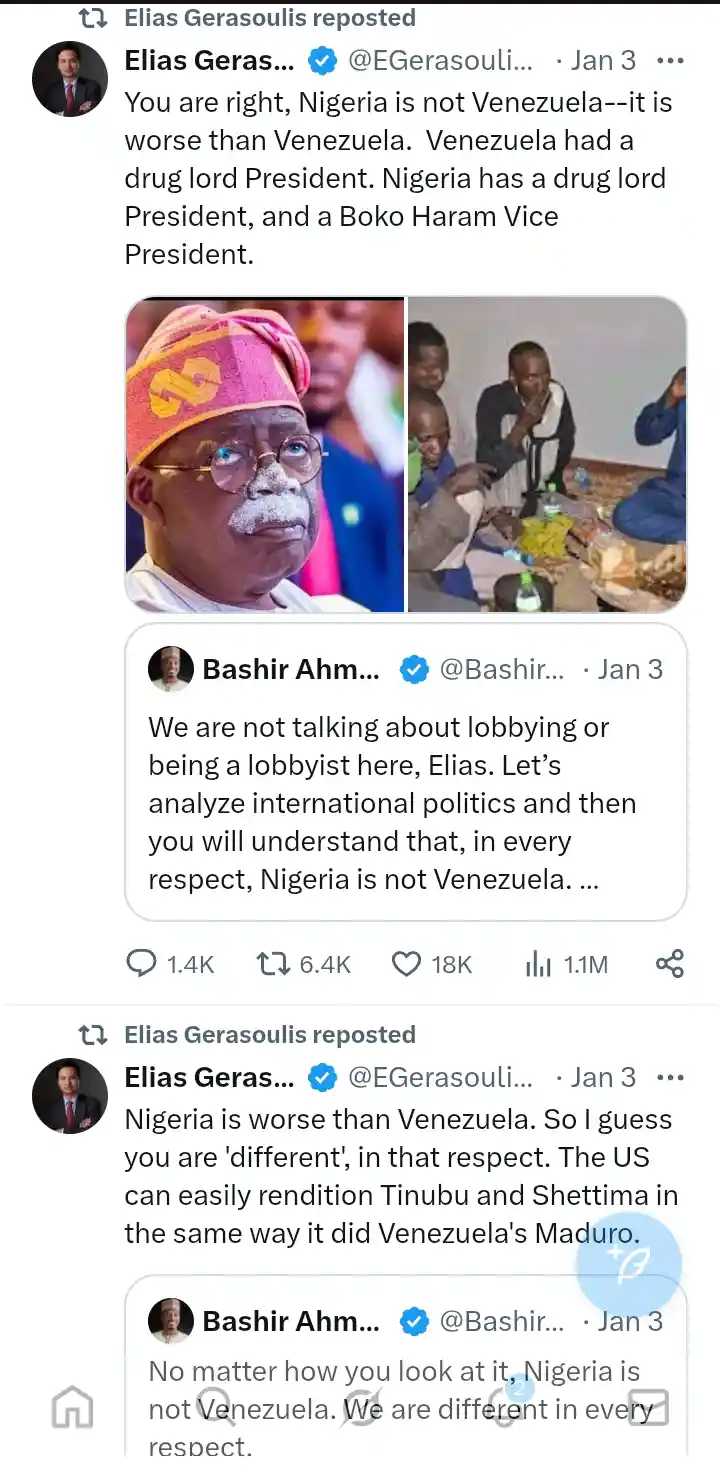
    Bashir Ahmad (@BashirAhmaad) initially responded to commentary about international politics, stating: “No matter how you look at it, Nigeria is not Venezuela. We are different in every respect.” Ahmad emphasised that Nigeria and Venezuela operate under distinct political systems and face different national challenges.


    In reply, Elias Gerasoulis (@EGerasouli35992), a lobbyist at Moran Global Strategies who describes himself as an International Freedom Fighter”, argued that Nigeria faces more severe challenges than Venezuela. Gerasoulis posted: You are right, Nigeria is not Venezuela—it is worse than Venezuela. Venezuela had a drug lord President. Nigeria has a drug lord President, and a Boko Haram Vice President.”


    Also Read Russia Condemns US Military Action in Venezuela, Cites Ideological Hostility


    Ahmad responded by urging a more structured discussion: “We are not talking about lobbying or being a lobbyist here, Elias. Let’s analyze international politics and then you will understand that, in every respect, Nigeria is not Venezuela….”


    The exchange escalated as Gerasoulis reposted, writing: “Nigeria is worse than Venezuela. So I guess you are ‘different’, in that respect. The US can easily rendition Tinubu and Shettima in the same way it did Venezuela’s Maduro.” The conversation drew thousands of likes, retweets, and replies, with the final post generating over a million impressions.

    Nigeria “Worse Than Venezuela,” US Lobbyist Says in Social Media Exchange


    Context: Nigeria and Venezuela

    Nigeria operates a federal presidential system with elected leadership and a multi-party democracy. The country faces significant security challenges, particularly in the northeast, where Boko Haram remains active, and in the northwest, which contends with armed banditry. Economically, Nigeria is Africa’s largest economy, though structural issues such as inflation, unemployment, and dependence on oil revenue persist.

    Venezuela has faced political and economic crises over the past decade, including hyperinflation, humanitarian emergencies, and mass migration. The governance of President Nicolás Maduro has drawn international scrutiny, with sanctions and diplomatic disputes complicating domestic and regional stability.

    Experts note that while both countries face governance challenges, the contexts differ significantly, and direct comparisons can be misleading without nuanced analysis.


    Social Media Reactions

    The exchange has prompted discussions among journalists, political analysts, and civil society actors. Many caution against treating social media statements as factual, especially those involving criminal or terrorist allegations. Others have used the conversation to highlight public frustration over governance, accountability, and security in Nigeria.


    Ejes Gist News can authoritatively report that the dialogue underscores how social media can influence public perceptions of national governance. It also highlights the potential for international commentators to enter discussions about domestic political affairs in a highly visible manner.

  • Sheikh Gumi Cries Out as Trump Marks Him Terrorist

    Sheikh Gumi Cries Out as Trump Marks Him Terrorist

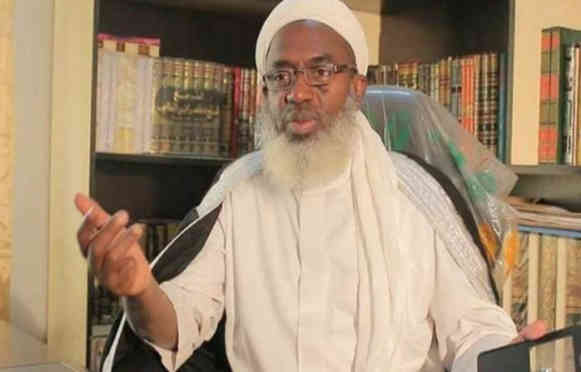
    Sheikh Ahmad Abubakar Gumi, a controversial Islamic cleric based in northern Nigeria, has claimed that the United States government has marked him as part of an Islamic terrorist network allegedly responsible for killings of Christians in Nigeria, a development that has intensified national debate over security, religion, and foreign involvement in the country’s counter-terrorism efforts.


    The cleric made the claim while addressing his congregation, asserting that he received information from security-linked sources in Abuja indicating that his name had surfaced during high-level security discussions connected to United States military operations.


    Ejes Gist News reports that Gumi presented the alleged development as part of a wider crackdown following renewed U.S. counter-terrorism actions in Nigeria.

    The allegation comes against the backdrop of U.S. airstrikes carried out on December 25, 2025, in parts of Sokoto State, targeting armed extremist groups linked to Islamic State affiliates. Those strikes, which drew mixed reactions across Nigeria, have continued to shape political, religious, and security discourse into the new year.

    Gumi’s Claim of Being “Marked”

    Speaking publicly, Sheikh Gumi told worshippers that he was informed during an early-morning phone call that he had been “marked for elimination” as a Boko Haram figure. According to the cleric, the caller claimed that his name appeared on a list discussed during a security meeting in Abuja.


    Also Read : APC Chairman Nentawe Yilwatda Sets Conditions for Fubara’s Second Term Amid Rivers Crisis

    “They called me from Abuja, that there was a security meeting,” Gumi said during the address. “They said I have been marked; that I will be eliminated. And who are Boko Haram?”

    Gumi asserted that the alleged designation was tied to American counter-terrorism actions, suggesting that U.S. forces were targeting individuals identified as terrorists without, in his view, a proper understanding of Nigeria’s complex security environment.

    According to him, the unnamed source warned that the alleged plan involved potential elimination through an American airstrike, a claim that has not been independently confirmed by Nigerian or U.S. authorities.

    Reaction to U.S. Military Operations

    The cleric has been a vocal critic of foreign military intervention in Nigeria. Following the December 25, 2025, U.S. airstrike in Sokoto, Gumi publicly opposed the operation, arguing that military force alone would not resolve Nigeria’s long-running insurgency and banditry crises.

    He questioned the definition of “terrorists” used by foreign powers, stating that the labeling process itself could be politicized and misused. In his remarks to followers, he suggested that the United States bore responsibility for the emergence and evolution of extremist groups in parts of the region, a position that has drawn strong criticism from security analysts and civil society groups.

    “Even the Americans, they say they came to fight terrorists,” Gumi said. “So who are the terrorists? They are the ones.”

    Longstanding Controversy Over Engagement With Armed Groups

    Sheikh Gumi is widely known in Nigeria for his role as a negotiator and intermediary in talks involving armed bandit groups operating across the northwest and parts of the north-central region. Over the years, he has advocated dialogue and amnesty for bandits as a strategy to reduce violence, a stance that has sharply divided public opinion.

    On several occasions, Gumi has publicly called on the administration of President Bola Ahmed Tinubu to consider granting amnesty to armed groups willing to lay down their weapons. Supporters of this approach argue that it could reduce bloodshed and facilitate reintegration, while critics maintain that it legitimizes criminal violence and undermines justice for victims.


    Human rights groups, Christian associations, and some political actors have repeatedly accused the cleric of sympathizing with extremists. They argue that his rhetoric minimizes the suffering of communities affected by attacks attributed to Boko Haram, Islamic State West Africa Province (ISWAP), and bandit factions, many of which have disproportionately affected Christian populations in parts of northern Nigeria.

    Allegations of Support for Extremist Groups

    Gumi’s critics frequently cite his statements describing some militants as “misguided” rather than inherently criminal, as well as his willingness to engage directly with armed groups in their camps. These actions have fueled accusations that he serves as an advocate or apologist for Islamist militants and bandits.

    The cleric has consistently rejected such characterizations, insisting that his engagement is driven by a desire to reduce violence and protect civilian lives. He maintains that negotiation is a pragmatic response to a security crisis that has overwhelmed military and law enforcement institutions.

    Despite these defenses, calls for his arrest or investigation have emerged periodically from advocacy groups, particularly following mass abductions, village raids, and attacks on Christian communities in Kaduna, Zamfara, Niger, and Plateau states.

    Claims of Religious Targeting and Division

    In his latest remarks, Gumi framed the alleged U.S. action against him as part of a broader narrative that, in his view, unfairly portrays Christians as the sole victims of Nigeria’s insecurity while marginalizing Muslim suffering.

    He argued that such framing deepens religious division and fuels mistrust between communities. According to the cleric, Nigeria’s crisis has been worsened by what he described as foreign-backed narratives and financial interests that exploit religious identity for strategic ends.

    “Because of lies, you brought violence,” Gumi said. “But where are the leaders? What did they do? What about the scholars? Everyone has gone to hide in their corners.”

    He accused both political and religious elites of retreating from meaningful engagement, leaving ordinary Nigerians to bear the consequences of insecurity, poverty, and social fragmentation.

    Sovereignty and Foreign Influence

    Gumi further argued that no sovereign nation should accept external interference that risks dividing its population along religious or social lines. He questioned the legitimacy of foreign military actions conducted without broad national consensus and warned that such interventions could exacerbate existing tensions.

    “Which country would agree to bring something in just to divide its people?” he asked. “There is no country that would accept that.”

    His comments echo a wider national debate over Nigeria’s cooperation with foreign powers in counter-terrorism operations, particularly amid concerns about sovereignty, civilian casualties, and accountability.

    Silence From Authorities

    As of the time of reporting, neither the United States government nor Nigerian security agencies have publicly confirmed that Sheikh Gumi has been designated as a terrorist or placed on any official elimination list. No formal documentation has been released indicating that he has been classified under U.S. terrorism sanctions frameworks.

    Security experts note that official U.S. terrorist designations typically involve public announcements by the Department of State or the Department of the Treasury. In the absence of such confirmation, analysts caution against treating the cleric’s claims as established fact.

    Nevertheless, the allegation has already gained traction on social media, where it has been amplified alongside broader narratives about religious persecution, U.S. foreign policy, and Nigeria’s internal conflicts.

    Broader Security Context

    Nigeria continues to face multiple, overlapping security threats, including jihadist insurgency in the northeast, banditry in the northwest, farmer-herder violence in the Middle Belt, and separatist agitation in the southeast. These crises have resulted in thousands of deaths and mass displacement over the past decade.

    The United States has identified Boko Haram and ISWAP as terrorist organizations and has periodically supported Nigerian counter-terrorism efforts through intelligence sharing, training, and, in rare cases, direct military action.

    The December 25, 2025, airstrike in Sokoto marked a significant escalation in U.S. involvement and has since intensified scrutiny of individuals perceived as influential voices in the region’s security discourse..

  • 2027 Power Shift: Kwankwaso, Atiku, Peter Obi in Secret Talks Over ADC Alliance

    2027 Power Shift: Kwankwaso, Atiku, Peter Obi in Secret Talks Over ADC Alliance

    Former Kano State Governor and leader of the New Nigeria People’s Party (NNPP), Rabiu Musa Kwankwaso, is reportedly engaged in discussions with former Vice President Atiku Abubakar and the Labour Party’s 2023 presidential candidate, Peter Obi, over a possible political coalition ahead of the 2027 general elections.


    Ejes Gist News reports that the talks are centred on the African Democratic Congress (ADC) as opposition figures explore the formation of a united front capable of challenging the ruling All Progressives Congress (APC).

    Kwankwaso Weighs ADC Option Amid APC Pressure

    Although Kwankwaso’s political structure in Kano State appears to be drifting toward the APC, sources say the former governor is holding consultations with the ADC alongside key members of the Kwankwasiyya movement, his long-standing political base.


    Multiple sources familiar with the discussions disclosed that negotiations are being conducted discreetly as the political heavyweights assess the feasibility of a broad opposition alliance ahead of 2027.

    Kano Governor’s Planned Defection Sparks Rift

    The coalition talks are unfolding amid strong indications that Kano State Governor Abba Kabir Yusuf, the only NNPP-controlled governor in the country, is set to defect to the APC.

    Governor Yusuf’s reported defection has been openly opposed by Kwankwaso and has triggered sharp internal divisions within the Kwankwasiyya movement, with loyalists split over the future political direction of the group.

    Sources close to the Kano State Government revealed that Vice President Kashim Shettima, APC National Chairman Nentawe Yilwatda, former Kano State Governor Abdullahi Ganduje, and the party’s state chairman, Abdullahi Abbas, are expected to attend a brief ceremony in Abuja marking Yusuf’s formal entry into the ruling party.

    Potential Impact on Opposition Politics

    Political analysts believe that a successful alliance involving Atiku Abubakar, Peter Obi, and Rabiu Kwankwaso could significantly reshape Nigeria’s opposition politics and alter electoral calculations ahead of the 2027 polls.


    APC Chairman Nentawe Yilwatda Sets Conditions for Fubara’s Second Term Amid Rivers Crisis

    The three politicians finished second, third, and fourth respectively in the 2023 presidential election, collectively commanding millions of votes across different regions of the country.

    ADC Gains Momentum as Opposition Platform

    Peter Obi recently defected to the ADC alongside several supporters, opposition figures, and lawmakers from both the National Assembly and state legislatures.

    He has joined a growing list of prominent politicians within the ADC, including Atiku Abubakar, David Mark, Aminu Tambuwal, Emeka Ihedioha, Rauf Aregbesola, Nasir El-Rufai, Rotimi Amaechi, and Abubakar Malami, all positioning themselves ahead of the 2027 elections.

    An ADC chieftain, Dr Ladan Salihu, said Obi’s defection had transformed the party’s standing, describing the ADC as an emerging force capable of mounting a serious challenge to the APC.

    APC Consolidates Power as Defections Continue

    Despite opposition regrouping efforts, the APC has continued to strengthen its grip on power, boasting the support of 28 state governors.

    Plateau State Governor Caleb Mutfwang formally defected to the ruling party on Friday, further consolidating APC dominance at the sub-national level.

    PDP Calls for Opposition Unity

    Meanwhile, the Peoples Democratic Party (PDP) said its immediate focus remains on resolving internal leadership and legal disputes. However, party officials acknowledged that opposition parties would eventually need to work together to challenge the APC’s hold on power.


    With realignments accelerating across party lines, Nigeria’s political landscape remains fluid as preparations for the 2027 general elections gather momentum.

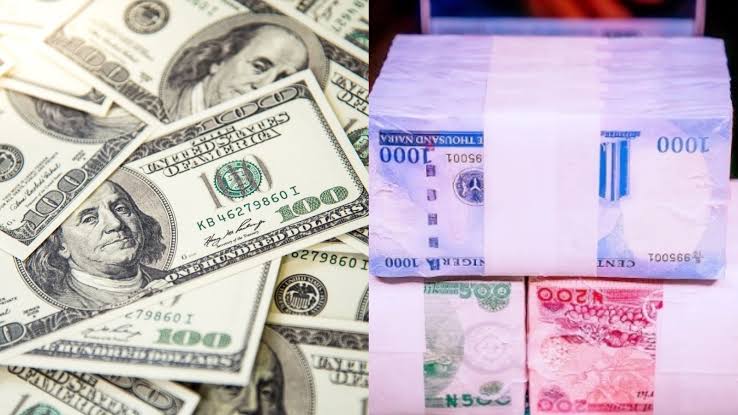
  • Dollar to Naira Exchange Rate Today Saturday, January 3, 2026

    Dollar to Naira Exchange Rate Today Saturday, January 3, 2026

    The Nigerian Naira continued to face pressure against the United States Dollar on Saturday, January 3, 2026, reflecting ongoing dynamics in the foreign exchange market.


    Ejes Gist News reports that the naira’s performance remains influenced by global currency trends, domestic liquidity conditions, and central bank policies.

    Official Exchange Rate

    According to mid-market data, the official rate of the naira against the dollar is approximately:

    • ₦1,453.77 – ₦1,457.14 per 1 USD

    This range represents the interbank or mid-market rate, which is used as a benchmark for transactions between banks and large corporates. The Central Bank of Nigeria (CBN) continues to maintain a relatively stable official rate to guide market expectations.

    Alternative Market Rates

    Outside the official channels, alternative market rates, including those from currency converters such as Wise, place 1 USD at roughly ₦1,468 NGN. This reflects slightly higher rates observed in the parallel and online trading markets.


    Also Read: Dollar to Naira Today Thursday January 2, 2026: Exchange Rates Show Relative Stability Across Markets

    Key Observations:

    • The naira’s value in commercial banks generally tracks the official rate but may include minor premiums.
    • Bureau de Change (BDC) and black-market rates often differ significantly, typically trading at a higher rate for the dollar due to supply-demand imbalances.
    • Market analysts note that increased dollar demand from importers and reduced foreign inflows have contributed to ongoing naira volatility.

    Factors Influencing the Naira

    Several factors are influencing the naira-dollar exchange rate in early 2026:

    1. Central Bank Policy: The CBN has maintained interventions to stabilize the naira at official windows, including the Investors and Exporters (I&E) forex market.
    2. Global Dollar Strength: International trends, including US interest rates and global liquidity conditions, impact the naira’s relative value.
    3. Foreign Trade Dynamics: Nigeria’s import and export balances, particularly in oil revenues, affect the availability of foreign currency.
    4. Speculative Activity: Increased market speculation in parallel markets contributes to fluctuations beyond official rates.

    Market Outlook

    Financial analysts suggest that the naira’s trajectory in the coming weeks will depend on sustained foreign inflows and central bank interventions. While the official rate remains relatively stable, pressure in alternative markets may continue to widen the gap between official and parallel exchange rates.

    Investors and businesses are advised to monitor both official and alternative market rates when conducting foreign exchange transactions. The differences between interbank, BDC, and black-market rates can significantly affect the cost of imports, foreign remittances, and investment decisions.

    Historical Context

    The naira has experienced a fluctuating performance over the last decade, reflecting changes in oil prices, foreign reserves, and domestic policy measures. In recent years, the CBN has introduced multiple policy measures to manage exchange rate pressures, including the establishment of the Investors & Exporters window and foreign exchange restrictions on certain goods.

    Key Takeaways

    • Official naira-dollar rate: ₦1,453.77 – ₦1,457.14 per 1 USD
    • Alternative market rate: ~₦1,468 NGN per 1 USD
    • Rates vary between banks, BDCs, and parallel markets
    • Central Bank interventions continue to guide market stability

    Ejes Gist News will continue to monitor and report on developments in Nigeria’s foreign exchange markets, providing timely updates for investors, businesses, and the general public.

  • APC Chairman Nentawe Yilwatda Sets Conditions for Fubara’s Second Term Amid Rivers Crisis

    APC Chairman Nentawe Yilwatda Sets Conditions for Fubara’s Second Term Amid Rivers Crisis

    The National Chairman of the All Progressives Congress (APC), Nentawe Yilwatda, has addressed the escalating political tensions in Rivers State, clarifying the party’s position regarding Governor Siminalayi Fubara and former Governor Nyesom Wike.


    Ejes Gist News reports that Yilwatda formally recognized Governor Fubara as the leader of the APC in Rivers State, while emphasizing that leadership must remain inclusive and aligned with the party’s internal democratic processes.


    Fubara’s Leadership in APC Rivers State

    Speaking during an interview on Channels Television’s Hard Copy, Yilwatda stated:

    “Governor Fubara is the leader of the APC in Rivers State, but he would need to coordinate with every other person in the state.”

    The APC chairman stressed that no individual can control the party in isolation, signaling that Fubara’s authority is acknowledged but not absolute.

    Context of the Rivers Crisis

    The ongoing political tension in Rivers State is rooted in the fallout between Governor Fubara and his predecessor, Nyesom Wike. Fubara’s move to the APC intensified the dispute, especially after he declared himself the “001” of the party in the state.

    Wike, however, rejected Fubara’s claim, insisting that he continues to control the state’s political structure. The former governor also alleged cooperation between the APC and the Peoples Democratic Party (PDP) to advance President Bola Tinubu’s 2027 re-election bid in Rivers State.

    APC Chairman on Primaries and Party Loyalty

    Yilwatda clarified his position regarding the party’s upcoming primaries, emphasizing impartiality:

    “I don’t choose who to support in the state’s primary election. If Fubara emerges as the APC candidate, I’ll support him.”

    He added that the APC would back whichever candidate wins the primary, irrespective of personal loyalty or preference:

    “If he loses the primary, I’ll sympathize with him and go with the person who wins the primary election.”

    This approach underscores the APC’s commitment to internal democracy, while leaving Fubara’s political future dependent on the outcome of the primaries.

    Implications for the 2027 Elections

    Yilwatda’s remarks highlight that Fubara’s path to a second term under the APC will require navigating both party politics and internal consensus. The Rivers State political landscape remains highly contested, with both Fubara and Wike actively shaping alliances ahead of the 2027 elections.

    Political analysts note that the chairman’s statement seeks to maintain party cohesion in a state where tensions could otherwise escalate, while signaling that leadership claims must align with formal party procedures.

    Why you should know

    The Rivers crisis illustrates broader challenges for the APC in consolidating influence in states with complex political histories. Yilwatda’s statements clarify the party’s approach to leadership recognition and candidate support, emphasizing coordination, internal democracy, and adherence to party primaries.

    Observers suggest that the coming months will be crucial, as the APC navigates internal dynamics in Rivers State and positions itself for the 2027 electoral cycle.

  • Russia Condemns US Military Action in Venezuela, Cites Ideological Hostility

    Russia Condemns US Military Action in Venezuela, Cites Ideological Hostility

    Russia has strongly condemned the United States’ military operation in Venezuela, describing the action as unjustified and accusing Washington of letting “ideological hostility” override diplomacy.


    Ejes Gist News reports that the Russian Foreign Ministry issued a statement on Sunday, emphasizing that the rationale provided by the United States for the attack was “untenable” and lacked credible justification.

    Also Read : US Unveils Drug Trafficking, Terrorism Charges Against Venezuela’s President Nicolas Maduro

    Russia’s Position on the US Action

    “This morning, the United States committed an act of armed aggression against Venezuela. This is deeply troubling and deserves condemnation,” the Russian Foreign Ministry said. The ministry highlighted that pragmatic engagement had been abandoned in favor of ideological confrontation.


    While Venezuela remains a strategic ally for Moscow in South America, the Kremlin has not indicated any immediate plans to intervene directly in the event of further escalation with the United States. Analysts note that Russia’s measured response seeks to balance support for Caracas with avoidance of direct military conflict with Washington.

    Lack of Reference to Nicolás Maduro

    The official statement did not mention Venezuelan President Nicolás Maduro, who US authorities claimed was captured during the military operation. Instead, the focus remained on condemning the US conduct and reaffirming support for the Venezuelan people.

    Solidarity with Venezuelans

    The Russian Foreign Ministry stated: “We reaffirm our solidarity with the Venezuelan people,” while also confirming that there were no reports of Russian citizens affected by the US strikes. This reiterates Moscow’s longstanding diplomatic position in Latin America, emphasizing political alignment over military engagement.

    Geopolitical Implications

    Experts suggest that Russia’s response signals a potential intensification of the diplomatic standoff between Moscow and Washington, particularly in regions where Venezuela holds strategic influence. The statement reflects Russia’s ongoing efforts to assert itself as a counterweight to US policy in the Western Hemisphere without escalating into direct confrontation.

    Observers are closely monitoring both US and Venezuelan reactions, as well as statements from other regional powers, to gauge whether this incident will trigger broader international tensions.

    Historical Context

    Venezuela has historically relied on Russia for economic and military support, especially under the leadership of Nicolás Maduro. Past collaborations include arms deals, energy sector partnerships, and political backing in international forums. Moscow’s condemnation of the US strikes aligns with its previous defense of Venezuelan sovereignty against external pressures.

    Editorial Note

    The situation remains fluid. Russia’s position underscores its willingness to support Caracas diplomatically while avoiding immediate military engagement. International stakeholders are awaiting further developments from Washington, Caracas, and regional organizations regarding the impact and legality of the US operation.

  • US Unveils Drug Trafficking, Terrorism Charges Against Venezuela’s President Nicolas Maduro

    US Unveils Drug Trafficking, Terrorism Charges Against Venezuela’s President Nicolas Maduro

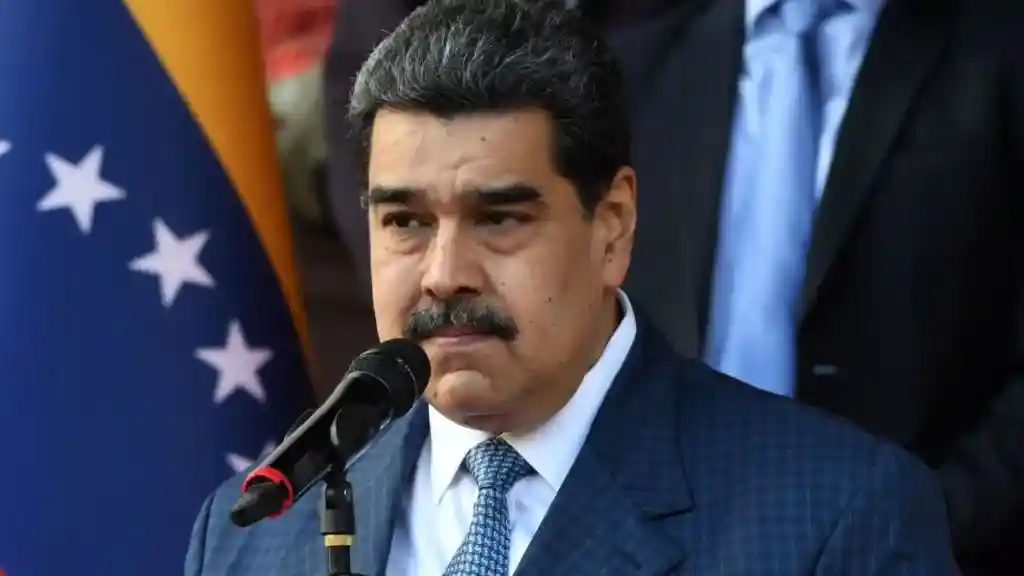
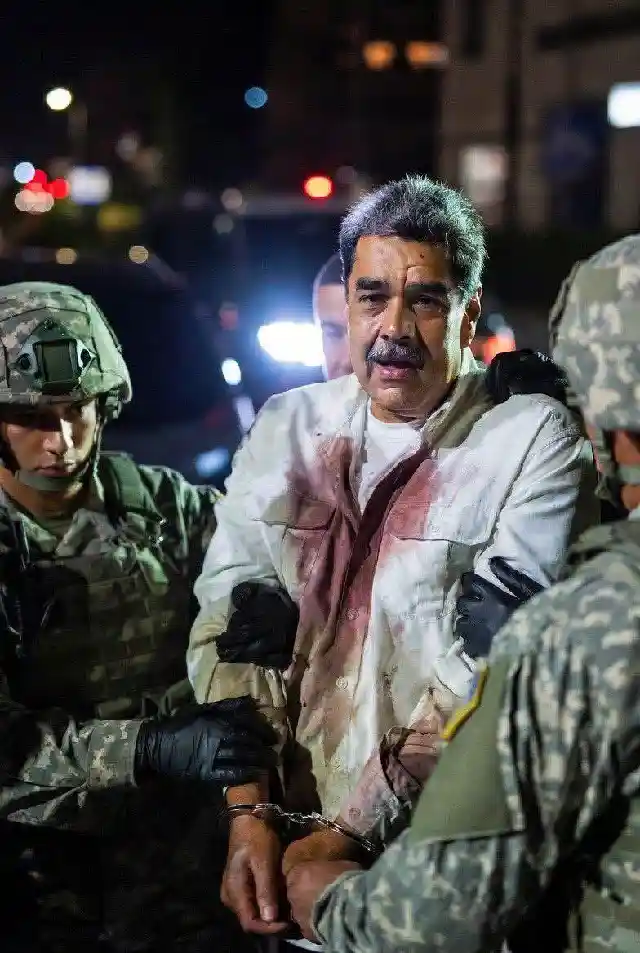
    The United States government has announced drug trafficking and terrorism-related charges against Venezuela’s President, Nicolás Maduro, marking a significant escalation in Washington’s long-running confrontation with the South American leader. The announcement follows claims by former US President Donald Trump that American forces carried out a large-scale military operation in Venezuela and took Maduro into custody.

    The development has triggered widespread international attention due to its geopolitical implications, the gravity of the allegations, and uncertainty surrounding the circumstances described by US political authorities. While elements of the announcement are formally documented within existing US legal frameworks, other aspects remain subject to verification and official confirmation from multiple parties.


    Ejes Gist News reports that the charges were publicly referenced after statements attributed to Donald Trump, who said US forces captured President Maduro and transported him out of Venezuela during a coordinated operation involving American law enforcement agencies.

    Also Read: Outrage as Three Brothers Die After Being Trapped for Seven Days in Lagos Building Fire Amid Government Inaction

    What the United States Announced

    US authorities announced that Nicolás Maduro faces criminal charges linked to international drug trafficking networks and alleged cooperation with terrorist organizations. These charges build on earlier US indictments, which have for years accused senior Venezuelan officials of participating in narcotics smuggling operations intended to destabilize the region.

    According to US government statements, the latest announcement reflects an expansion or reinforcement of existing legal actions against Maduro, rather than a sudden initiation of a new case. American prosecutors have previously alleged that Maduro and other officials were part of what US authorities described as a network facilitating cocaine trafficking into North America and Europe.

    Background to the Charges Against Nicolás Maduro

    The United States first formally indicted Nicolás Maduro in 2020, when the US Department of Justice accused him and several Venezuelan officials of narcoterrorism. The indictment alleged collaboration with Colombian rebel groups designated as terrorist organizations by Washington.


    US officials claimed the alleged activities were designed to flood the United States with illegal drugs and undermine American security interests. At the time, the Venezuelan government rejected the accusations, describing them as politically motivated and part of a broader campaign to destabilize the country.

    Since then, the charges have remained active within the US legal system, though Maduro continued to govern Venezuela while dismissing US jurisdiction over his office.

    Claims of a US Military Operation in Venezuela

    The current announcement gained additional attention after Donald Trump stated that US forces conducted a large-scale military strike within Venezuela and captured President Maduro and his wife. Trump made the statement on his Truth Social platform, asserting that the operation was executed in conjunction with US law enforcement agencies.

    He further indicated that Maduro had been flown out of Venezuela following the operation. Trump also announced plans to address the issue during a scheduled press conference at his Mar-a-Lago residence in Florida.

    It is important to distinguish between confirmed legal actions and claims that remain unverified. As of the time of reporting, no independent confirmation has been issued by the Pentagon, the US Department of Defense, or the Venezuelan government acknowledging the execution of such a military operation or the detention of the Venezuelan president.

    Official US Institutions and Verification Status

    Historically, major US military operations and foreign detentions involving heads of state are accompanied by formal briefings from the White House, the Department of Defense, or the State Department. At present, no comprehensive official statement detailing the alleged operation has been released through these institutional channels.

    Security analysts note that any confirmed US military strike inside Venezuela would represent a dramatic shift in US foreign policy and could trigger immediate diplomatic and security consequences across Latin America and beyond.

    As such, international observers and governments are closely monitoring for corroboration from official US agencies and responses from Caracas.

    Venezuela’s Position on US Charges

    The Venezuelan government has consistently rejected US indictments against Nicolás Maduro, maintaining that Washington has no legal authority over Venezuelan affairs. Venezuelan officials have previously described the charges as part of what they characterize as economic warfare and political pressure.

    Caracas has argued that sanctions, indictments, and diplomatic isolation are intended to force regime change rather than enforce international law. Venezuelan authorities have also accused the United States of ignoring drug trafficking issues within its own borders while targeting political adversaries abroad.

    No immediate official response was issued by the Venezuelan presidency following the latest announcement, further contributing to uncertainty surrounding the claims.

    International Law and Head-of-State Immunity

    Under international law, sitting heads of state generally enjoy immunity from prosecution by foreign courts. The United States has maintained that such immunity does not apply in cases involving narcoterrorism and transnational criminal activity, particularly when US citizens or national security interests are affected.

    Legal scholars note that this position remains contested and depends largely on political recognition and enforcement capabilities rather than settled international consensus.

    The US stance toward Maduro has been shaped in part by Washington’s recognition of opposition figures as legitimate representatives of Venezuela during periods of political crisis, a move that Caracas and several allied nations rejected.

    Regional Implications for Latin America

    Any confirmed detention or forced removal of Venezuela’s president would have immediate repercussions across Latin America. Regional organizations such as the Organization of American States and blocs like CELAC have historically opposed foreign military intervention in sovereign states.

    Countries with close political or economic ties to Venezuela, including Cuba, Nicaragua, and Bolivia, are likely to condemn any such action if confirmed. Meanwhile, governments aligned with US policy may call for restraint, transparency, and adherence to international law.

    The situation also raises concerns about regional stability, particularly given Venezuela’s ongoing economic challenges and internal political divisions.

    US–Venezuela Relations Over the Years

    Relations between Washington and Caracas have been strained for more than two decades. Tensions intensified during the administrations of Hugo Chávez and later Nicolás Maduro, as Venezuela pursued policies that directly challenged US influence in the region.

    Sanctions imposed by the United States targeted Venezuela’s oil sector, financial institutions, and senior officials. The US government argued that these measures were intended to pressure authorities to restore democratic governance, while Venezuelan leaders blamed sanctions for worsening economic conditions.

    Despite periodic diplomatic engagements, relations have remained largely adversarial.

    The Role of Drug Trafficking Allegations

    Drug trafficking allegations have played a central role in US policy toward Venezuela. American authorities have repeatedly accused elements within the Venezuelan state of facilitating narcotics transit routes from South America to international markets.

    US agencies have cited intelligence reports, intercepted communications, and testimony from informants to support their claims. Venezuelan officials have denied state involvement and accused the United States of relying on unreliable sources.

    The allegations continue to form the legal basis for US indictments and international arrest warrants issued by American courts.

    Terrorism-Related Accusations Explained

    The terrorism-related charges referenced by US officials are tied to alleged cooperation between Venezuelan officials and armed groups designated as terrorist organizations by Washington. These claims focus primarily on historical ties to Colombian insurgent groups.

    The Venezuelan government has acknowledged diplomatic contacts with regional actors but denies providing material support to terrorist organizations. Independent verification of such claims has remained difficult due to limited access and competing political narratives.

  • Repeated Truck Accidents: Oborevwori Directs Safety-First Response on Ogwashi-Uku–Asaba Road

    Repeated Truck Accidents: Oborevwori Directs Safety-First Response on Ogwashi-Uku–Asaba Road

    Delta State Governor Sheriff Oborevwori, has reaffirmed his administration’s preference for comprehensive road safety measures over punitive sanctions in addressing the recurring accidents involving articulated trucks along the Ogwashi-Uku–Asaba corridor, particularly around the Ubu Bridge axis on the newly constructed Ughelli–Asaba dual carriageway.


    The position of the state government was disclosed by the Commissioner for Works (Highways and Urban Roads), Comrade Reuben Izeze, who stated that the administration’s response is driven by a safety-first philosophy designed to reduce accidents without disrupting the free movement of goods and services across the state and the wider South-South region.


    Ejes Gist News reports that the Oborevwori administration has resolved to implement decisive, evidence-based interventions that strengthen compliance with traffic regulations, improve driver discipline, and address operational risks associated with heavy-duty vehicles on the busy corridor.


    Commissioner Izeze explained that while the frequency of accidents involving articulated trucks has raised legitimate public concern, the state government is determined to avoid knee-jerk policies that could negatively affect commerce, logistics, and regional connectivity.


    He noted that the administration’s approach aligns with global best practices, which emphasise preventive safety enforcement rather than outright bans or restrictive sanctions that often shift problems elsewhere without addressing root causes.

    According to the Commissioner, the government believes that sustained safety interventions, when properly enforced, are more effective in reducing accidents than punitive restrictions that may encourage non-compliance or economic bottlenecks.

    Planned Safety Interventions on the Corridor

    The Delta State Government has outlined a range of safety-focused measures aimed at curbing the recurring incidents involving articulated trucks along the Ogwashi-Uku–Asaba stretch.

    These measures include:

    • Stricter enforcement of existing traffic regulations governing speed limits and vehicle conduct
    • Enhanced speed control mechanisms along critical sections of the corridor
    • Routine operational and mechanical checks on articulated trucks plying the route
    • Increased monitoring by traffic and road safety agencies at identified risk points

    Commissioner Izeze emphasised that these interventions are designed to improve driver behaviour and vehicle roadworthiness, rather than punish operators indiscriminately.


    The renewed safety push follows a spate of accidents involving articulated trucks on the corridor, which has generated concern among motorists and residents, particularly because the road was recently completed and is widely praised for its quality.


    The Ogwashi-Uku–Asaba road features smooth pavement, modern drainage systems, and improved road markings, elements that ordinarily support safe and efficient traffic flow.


    Despite these features, articulated truck crashes have continued to occur, raising questions about driver behaviour, vehicle condition, and operational practices rather than the structural integrity of the road itself.

    Seventeenth Recorded Accident Since Road Completion

    Commissioner Izeze disclosed that the most recent accident occurred in the early hours of Tuesday, December 30, 2025, bringing the total number of recorded articulated truck incidents on the Ogwashi-Uku–Asaba stretch to seventeen since the road was completed.

    The latest incident took place near the Ubu Bridge, an area that has become a focal point of public attention due to repeated crashes involving heavy-duty vehicles.

    Eyewitnesses reported that the articulated truck lost control while approaching the bridge, tilted, and partially obstructed the carriageway. No fatalities or serious injuries were recorded, a development the Commissioner described as fortunate given the potential severity of such accidents.

    Driver’s Account and Public Reaction

    According to information provided by authorities at the scene, the truck driver attributed the accident to mechanical failure, stating that the gear selector failed to engage a lower gear while navigating the approach to the bridge.

    The driver reportedly dismissed suggestions of fatigue and described the incident as an act of destiny. However, this explanation has done little to reassure the public, particularly in light of the frequency of similar incidents occurring at the same location.

    Residents and regular users of the corridor have continued to express concern that repeated mechanical failure claims point to deeper issues related to vehicle maintenance, pre-trip inspections, and regulatory enforcement.

    Warning Signs and Speed Limit Compliance

    Commissioner Izeze noted that the state government had previously taken proactive steps to improve safety at the Ubu Bridge axis, including the installation of clearly visible warning signs and speed limit notices on both approaches to the bridge.

    These installations were carried out months earlier at the directive of Governor Oborevwori, following earlier incidents involving articulated trucks.

    Despite these measures, the Commissioner observed that many articulated truck drivers continue to disregard posted warnings and speed limits, significantly increasing the risk of accidents, particularly on approach to the bridge.


    Governor Oborevwori, according to Izeze, has consistently maintained that Delta State must avoid policies that could be interpreted as restricting the free movement of goods and services.

    The Ogwashi-Uku–Asaba corridor serves as a major artery for commercial transport, linking multiple regions and supporting economic activity across state lines.

    Outright restrictions on articulated trucks, the Commissioner explained, could have unintended consequences, including increased transport costs, supply chain disruptions, and economic strain on businesses that rely on road-based logistics.

    Importance of Driver Discipline and Enforcement

    Central to the state government’s strategy is the belief that improved driver discipline, backed by consistent enforcement, can significantly reduce accidents without resorting to blanket bans.

    The Commissioner stressed that compliance with speed limits, adherence to warning signs, and proper vehicle maintenance are non-negotiable responsibilities for operators of heavy-duty vehicles.

    He added that enforcement agencies would intensify their presence and oversight on the corridor to ensure that safety rules are observed and that violations are addressed promptly.

    Strategic Role of the Ogwashi-Uku–Asaba Corridor

    The Ogwashi-Uku–Asaba road has emerged as one of the busiest interstate routes in the South-South region, serving as a critical transit link for articulated trucks moving goods from the North, East, and South-West.

    From Asaba and Ughelli, the corridor provides access to major commercial destinations, including Effurun, Yenagoa, Port Harcourt, Akwa Ibom, and Calabar.

    This strategic importance has resulted in heavy daily traffic, placing sustained pressure on the road and underscoring the need for robust safety management tailored to high-volume, heavy-duty vehicle use.

  • BREAKING: Trump Announces Capture of Venezuelan President Nicolás Maduro, Wife

    BREAKING: Trump Announces Capture of Venezuelan President Nicolás Maduro, Wife

    The United States President Donald Trump has announced what he described as the capture of Venezuelan President Nicolás Maduro and his wife, Cilia Flores, following a purported United States operation in Venezuela.

    Trump made the announcement on Saturday via a post on his Truth Social media platform, claiming that the operation involved a large-scale U.S. strike and the subsequent removal of the Venezuelan leader from the country.


    Ejes Gist News reports, that the operation was carried out in coordination with U.S. law enforcement agencies, with further details promised at a press conference scheduled to hold at Mar-a-Lago later the same day.


    In his statement, Trump wrote that the United States had “successfully carried out a large-scale strike against Venezuela and its leader,” adding that President Maduro and his wife had been “captured and flown out of the country.” He did not specify the location where the couple was taken, nor did he provide operational details to support the claim.

    Trump also announced that additional information would be released during a formal news conference, stating that the public should expect clarification on the circumstances surrounding the alleged capture.

    Background: U.S.–Venezuela Tensions

    Relations between the United States and Venezuela have remained strained for more than a decade, marked by sanctions, diplomatic isolation, and legal actions against senior Venezuelan officials.

    In 2020, during Trump’s first term as president, the U.S. Department of Justice unsealed indictments against Nicolás Maduro and several top members of his government. The charges accused them of narcotics trafficking, corruption, and involvement in what U.S. prosecutors described as a “narco-terrorism” conspiracy.

    At the time, U.S. authorities alleged that Maduro had worked with armed groups to flood the United States with cocaine, accusations that the Venezuelan government strongly denied, dismissing them as politically motivated.

    Increased Reward for Maduro’s Arrest

    The latest claim comes months after the United States government increased the reward for information leading to the arrest or conviction of Nicolás Maduro.

    The reward was reportedly doubled to $50 million, with U.S. officials citing alleged links to international drug trafficking and organized crime networks. Similar bounties were placed on other senior Venezuelan figures, including the country’s defense minister.

    Washington has maintained that the legal actions are part of broader efforts to combat transnational crime, while Venezuela has consistently accused the United States of attempting to undermine its sovereignty and force regime change.

    Political and Diplomatic Implications

    If confirmed, the capture of a sitting head of state would represent an unprecedented escalation in U.S.–Venezuela relations and could trigger significant diplomatic fallout across Latin America and beyond.

    International law experts have previously noted that the apprehension of a foreign president outside a declared armed conflict would raise complex legal questions involving sovereignty, extradition, and the use of force.

    At this stage, however, the claim remains based solely on Trump’s social media statement, with no supporting evidence released publicly.

    Awaiting Official Statements

    Observers are now awaiting statements from U.S. federal agencies, the Venezuelan government, and international bodies to clarify the situation and determine whether Trump’s announcement reflects an actual operation or a political declaration.

    Further updates are expected following the announced press conference, where Trump indicated that more details would be provided regarding the alleged capture and its circumstances.

  • If not Adeboye that Saved my Life – Oyedepo

    If not Adeboye that Saved my Life – Oyedepo

    How Adeboye Saved Me From Death in Plane Crash – Oyedepo Recounts Near-Fatal Air Mishap.

    The Presiding Bishop of the Living Faith Church Worldwide (LFCWW), Bishop David Oyedepo, has given a detailed account of how he narrowly escaped death during a recent air incident, attributing his survival to divine intervention following prayers by the General Overseer of the Redeemed Christian Church of God (RCCG), Pastor Enoch Adejare Adeboye.

    The cleric made the disclosure during a church service at the Living Faith Church headquarters, where he narrated events leading up to, during, and after the incident, describing it as his third near air mishap in his lifetime.

    According to the senior pastor, the experience reaffirmed his long-held belief in spiritual covering, prophetic fatherhood, and divine preservation, principles he said have guided his life and ministry over the decades.


    Ejes Gist News reports that the account was delivered during a Friday service attended by thousands of worshippers.

    Oyedepo Speaks on the Incident During Church Service

    Bishop Oyedepo explained that the incident occurred during an international flight, adding that the situation was serious enough to have resulted in a fatal crash if not for the swift response of the aircraft’s pilot.

    While speaking from the pulpit, he said the events surrounding the journey were unusual, beginning with an unexpected visit by Pastor Adeboye shortly before the trip.

    According to Oyedepo, Adeboye arrived unannounced very early in the morning and prayed for him, an action he later interpreted as divinely inspired.

    Adeboye’s Unannounced Visit Before the Journey

    Oyedepo told the congregation that the RCCG General Overseer visited him around 6:30 a.m. on the Friday preceding the journey.

    He said the visit was neither planned nor discussed beforehand and came as a surprise.

    According to him, Adeboye explained that he had experienced a spiritual prompting that led him to seek him out and pray for him before the trip.

    Oyedepo described the moment as significant, noting that nothing else was discussed during the visit beyond prayers.

    Third Near Air Mishap in Oyedepo’s Life

    During his message, Bishop Oyedepo disclosed that this was the third time he had been involved in a near air accident.

    He did not provide extensive details of the earlier incidents but emphasized that the most recent one was particularly severe.

    He explained that the aircraft experienced a technical problem mid-flight, which caused turbulence and panic inside the cabin.

    Pilot’s Report Read to the Congregation

    To give clarity to what happened during the flight, a pastor of the church, identified as Pastor Adebisi, read an official report submitted by the aircraft’s pilot, Captain Samuel Adegoga.

    The report provided a technical explanation of the incident and outlined the mechanical challenges encountered during the flight.

    According to the pilot’s account, the aircraft suffered a stabilizer twin-motor failure while en route on the Cyprus-Israel route.

    Details of the Aircraft Malfunction

    The pilot explained that the malfunction affected the aircraft’s autopilot system, preventing it from maintaining the required altitude for stable flight.

    He stated that due to the failure, the autopilot could no longer exert the necessary pressure to keep the aircraft steady.

    As a result, the captain disengaged the autopilot and manually took control of the aircraft.

    During this process, the aircraft was reportedly out of trim, causing it to pitch abruptly with significant force.

    Turbulence and Cabin Disturbance

    Captain Adegoga’s report further stated that the sudden pitch movement required immediate counteraction.

    The pilot applied a pitch-down force to stabilize the aircraft, leading to strong turbulence and noticeable movement within the cabin and cargo hold.

    Heavy items stored in the cargo section reportedly fell from their compartments, producing loud noises that alarmed those on board.

    The report indicated that similar mechanical failures in past aviation incidents had resulted in fatal outcomes when pilots failed to respond promptly.

    Church Acknowledges Pilot’s Swift Response

    While reading the report, Pastor Adebisi expressed gratitude that the pilot reacted quickly and professionally.

    He noted that the timely response played a crucial role in preventing a disaster.

    According to him, aviation history has recorded cases where similar stabilizer failures led to crashes due to delayed or incorrect pilot actions.

    Oyedepo Disagrees With Purely Technical Explanation

    Despite the pilot’s technical explanation, Bishop Oyedepo told the congregation that he believed the incident went beyond mechanical failure.

    He described the averted crash as a spiritual attack rather than a routine technical malfunction.

    According to him, divine intervention, triggered by prophetic covering and prayer, was responsible for the safe outcome.

    Oyedepo Cites Biblical Perspective

    In his sermon, Oyedepo referenced biblical teachings to explain his interpretation of the incident.

    He spoke about what he described as the restoration of fatherhood and sonship within the body of Christ, linking it to spiritual protection.

    According to him, prophetic fatherhood carries spiritual inheritance and covering that goes beyond human relationships.

    Interpretation of Adeboye’s Visit

    Oyedepo said Adeboye later explained that he had experienced a vision and a strong spiritual prompting that compelled him to come and pray.

    He quoted Adeboye as saying words interpreted as a warning and divine intervention before the journey.

    According to Oyedepo, the visit was not coincidental but a deliberate act of spiritual defense.

    Teaching on Spiritual Fatherhood

    While addressing the congregation, Oyedepo used the incident to teach on the concept of spiritual fatherhood.

    He explained that spiritual fathers provide inheritance, covering, and defense, unlike teachers or mentors who may only impart knowledge.

    He argued that spiritual inheritance is rooted in covenant relationships rather than professional or instructional ones.

    Reference to Biblical Examples

    Oyedepo cited the biblical relationship between Prophet Elijah and Elisha to support his teaching.

    He noted that Elisha referred to Elijah as “my father,” despite not being biologically related.

    According to Oyedepo, the example illustrates how prophets are divinely positioned as fathers to those sent to them.

    Claim of Lifelong Spiritual Covering

    The Living Faith Church leader said he had enjoyed what he described as spiritual covering throughout his life.

    He attributed many of his past escapes and successes to this principle, which he said has consistently worked for him.

    He emphasized that the recent air incident reinforced his conviction in the reality of spiritual defense.

    Public Reactions and Religious Context

    Oyedepo’s account has generated discussion within religious circles, particularly among followers of Pentecostal Christianity in Nigeria.

    Many adherents view such testimonies as affirmations of faith, divine intervention, and the power of prayer.

    Others have focused on the technical explanation provided by the pilot, emphasizing aviation safety and mechanical factors.

    Aviation Experts’ Perspective

    In general aviation practice, stabilizer and autopilot malfunctions are considered serious safety concerns.

    Industry experts often stress the importance of pilot training, redundancy systems, and rapid response in managing such situations.

    While the pilot’s report focused on mechanical and operational aspects, Oyedepo’s account highlighted the spiritual interpretation of the same event.

    Intersection of Faith and Technical Reality

    The incident illustrates the broader intersection between faith narratives and technical explanations in religious testimonies.

    For many religious leaders and followers, divine intervention and professional expertise are not seen as mutually exclusive.

    In this case, the pilot’s technical response and Oyedepo’s spiritual interpretation were both acknowledged during the church service.

    Oyedepo’s Message to Worshippers

    Beyond recounting the incident, Oyedepo encouraged worshippers to value spiritual relationships and remain grounded in faith.

    He urged members of the church to recognize what he described as divine order within spiritual leadership.

    According to him, understanding spiritual principles provides believers with confidence and assurance, even in life-threatening situations.

    Broader Significance Within Nigerian Christianity

    Both Bishop Oyedepo and Pastor Adeboye are widely regarded as influential figures in Nigerian Christianity.

    Their ministries command millions of followers across Nigeria and beyond.

    Testimonies involving such figures often attract national attention due to their prominence and influence.

    Continuing Emphasis on Faith and Safety

    While the account focused on divine intervention, it also indirectly highlighted the importance of aviation safety standards and professional competence.

    The pilot’s swift reaction, as documented in the report, played a central role in preventing loss of life.

    The incident, as presented during the church service, combined spiritual interpretation with documented technical details.

    Context of Religious Testimonies in Public Discourse

    Religious testimonies of survival are common in faith-based settings and often serve instructional and inspirational purposes.

    Such accounts typically emphasize gratitude, divine protection, and lessons for believers.

    Oyedepo’s narration followed this pattern, using the experience to reinforce doctrinal teachings within his ministry.

  • How Donald Trump Was Impeached: A Comprehensive Account of the Two Historic Impeachments

    How Donald Trump Was Impeached: A Comprehensive Account of the Two Historic Impeachments

    Donald Trump remains the only president in the history of the United States to have been impeached twice by the U.S. House of Representatives. The impeachments, which occurred during his first term in office, marked unprecedented moments in American constitutional and political history. They stemmed from two separate controversies, involved distinct articles of impeachment, and raised fundamental questions about presidential power, accountability, and the limits of executive authority.

    This article provides a detailed, factual, and evergreen account of how Donald Trump was impeached, why the impeachment processes were initiated, how Congress conducted the proceedings, and how the U.S. Senate ultimately handled both cases.

    Understanding Impeachment in the United States

    Impeachment is a constitutional process outlined in Article I and Article II of the U.S. Constitution. It is the mechanism by which Congress can formally accuse and potentially remove a sitting president, vice president, or other federal officials for serious misconduct.

    What Impeachment Means

    Impeachment does not automatically remove a president from office. Instead, it involves two stages:

    • Impeachment by the House of Representatives, which functions like an indictment.
    • Trial by the Senate, which determines whether to convict and remove the official from office.

    A simple majority vote in the House is required to impeach, while a two-thirds majority in the Senate is required for conviction and removal.

    The Constitution specifies that impeachment may apply in cases of “treason, bribery, or other high crimes and misdemeanors,” a phrase that has been subject to legal and historical interpretation.

    Background to Donald Trump’s Presidency

    Donald Trump was inaugurated as the 45th president of the United States in January 2017 after winning the 2016 presidential election. His presidency was marked by sharp political polarization, frequent confrontations with Congress and the media, and ongoing debates over executive power.

    From the early stages of his administration, Trump faced investigations into his conduct, business dealings, and interactions with foreign governments. Two of these controversies eventually led to formal impeachment proceedings.

    Ejes Gist News reports that the impeachments were driven by separate events and legal theories, making Trump’s case unique in modern U.S. political history.

    First Impeachment of Donald Trump (2019)

    The Ukraine Controversy

    The first impeachment arose from allegations that President Trump abused his office by pressuring Ukraine to investigate a domestic political rival ahead of the 2020 U.S. presidential election.

    In 2019, a whistleblower complaint alleged that Trump had engaged in a phone call with Ukrainian President Volodymyr Zelensky in which he requested investigations into:

    • Joe Biden, a former vice president and potential 2020 election opponent
    • Hunter Biden, Joe Biden’s son, and his business dealings in Ukraine

    The complaint also alleged that U.S. military aid approved by Congress had been withheld from Ukraine around the same period.

    House Investigation and Hearings

    The U.S. House of Representatives, controlled at the time by the Democratic Party, launched a formal impeachment inquiry in September 2019.

    The investigation involved:

    • Closed-door depositions
    • Public hearings
    • Testimony from U.S. diplomats, national security officials, and civil servants

    Witnesses testified about concerns that U.S. foreign policy toward Ukraine had been used for personal political gain.

    Articles of Impeachment (2019)

    In December 2019, the House Judiciary Committee approved two articles of impeachment against Donald Trump:

    Article I: Abuse of Power

    This article alleged that Trump:

    • Used the powers of the presidency to solicit foreign interference in a U.S. election
    • Conditioned official acts on Ukraine announcing investigations that could benefit him politically

    Article II: Obstruction of Congress

    This article alleged that Trump:

    • Directed executive branch officials not to comply with House subpoenas
    • Refused to provide documents or testimony during the impeachment inquiry

    House Vote on Impeachment

    On December 18, 2019, the full House of Representatives voted on the articles of impeachment.

    • Trump was impeached on both articles.
    • The vote largely followed party lines.
    • Donald Trump became the third U.S. president to be impeached, after Andrew Johnson and Bill Clinton.

    Senate Trial and Acquittal (2020)

    Senate Proceedings

    The impeachment trial moved to the U.S. Senate in January 2020. Senators took an oath to serve as jurors, while House managers presented the case for conviction and Trump’s legal team presented his defense.

    Key issues debated during the trial included:

    • Whether Trump’s actions constituted “high crimes and misdemeanors”
    • Whether additional witnesses should be called
    • The scope of presidential authority in foreign policy

    Final Senate Vote

    In February 2020, the Senate voted on both articles:

    • Trump was acquitted on the abuse of power charge.
    • Trump was acquitted on the obstruction of Congress charge.

    The Senate did not reach the two-thirds majority required for conviction. Trump remained in office and completed his first term.

    Second Impeachment of Donald Trump (2021)

    Events Leading to the Second Impeachment

    The second impeachment followed events connected to the certification of the 2020 U.S. presidential election.

    After losing the election to Joe Biden, Trump repeatedly claimed, without judicial confirmation, that the election results were fraudulent. These claims were rejected by multiple courts, state election officials, and federal agencies.

    On January 6, 2021, a large group of Trump supporters gathered in Washington, D.C., where Trump addressed them at a rally. Later that day, a crowd breached the U.S. Capitol building as Congress met to certify the electoral results.

    The incident disrupted the constitutional process and led to injuries, deaths, and extensive damage to the Capitol.

    House Response

    In the aftermath of the Capitol breach, House lawmakers moved quickly to initiate a second impeachment process.

    The House concluded that Trump’s actions before and during January 6 contributed to the violence and posed a threat to democratic governance.

    Article of Impeachment (2021)

    Unlike the first impeachment, the second impeachment involved a single article:

    Article: Incitement of Insurrection

    This article alleged that Trump:

    • Repeatedly made false claims about election fraud
    • Encouraged supporters to challenge the election outcome
    • Used rhetoric that contributed to the January 6 violence at the Capitol

    House Vote on Second Impeachment

    On January 13, 2021, the House of Representatives voted to impeach Trump for a second time.

    • The vote included members from both major political parties.
    • Donald Trump became the first U.S. president to be impeached twice.

    Second Senate Trial and Outcome

    Post-Presidency Trial

    By the time the Senate trial began, Trump had already left office following the inauguration of President Joe Biden. This raised constitutional questions about whether a former president could be tried and convicted.

    The Senate ultimately determined that it had jurisdiction to proceed with the trial.

    Arguments Presented

    House impeachment managers argued that:

    • Trump’s conduct endangered the constitutional order
    • Failure to convict would set a dangerous precedent

    Trump’s defense team argued that:

    • His speech was protected under the First Amendment
    • He was no longer in office and therefore not subject to conviction

    Senate Vote and Acquittal

    In February 2021, the Senate voted on the article of impeachment.

    • A majority of senators voted to convict.
    • The vote fell short of the required two-thirds threshold.

    Trump was acquitted for the second time.

    Historical Significance of Donald Trump’s Impeachments

    Donald Trump’s impeachments are historically significant for several reasons:

    • He is the only U.S. president impeached twice.
    • The impeachments addressed different types of alleged misconduct.
    • Both cases tested constitutional interpretations of executive accountability.
    • The proceedings deepened political divisions within Congress and the electorate.

    Historians and constitutional scholars continue to analyze the long-term implications of these events for the American presidency.

    Key Differences Between the Two Impeachments

    Nature of Allegations

    • First impeachment focused on foreign policy and election interference.
    • Second impeachment focused on domestic unrest and constitutional order.

    Timing

    • First impeachment occurred during Trump’s presidency.
    • Second impeachment occurred at the end of his term and continued after he left office.

    Number of Articles

    • First impeachment included two articles.
    • Second impeachment included one article.

    Bipartisan Support

    • Second impeachment saw more bipartisan support in the House compared to the first.

    Impeachment vs. Criminal Liability

    It is important to distinguish impeachment from criminal prosecution.

    • Impeachment is a political and constitutional process.
    • It does not determine criminal guilt or innocence.
    • Acquittal in the Senate does not prevent other legal proceedings under state or federal law.

    The Constitution explicitly states that impeachment judgments do not preclude subsequent legal accountability.

    Why the Trump Impeachments Matter

    The impeachments of Donald Trump have become central reference points in discussions about:

    • Limits of presidential power
    • Congressional oversight
    • Election integrity
    • The resilience of democratic institutions

    They also underscore the role of impeachment as a tool of constitutional governance rather than a criminal mechanism.

  • AFCON 2025 Round of 16 Fixtures: Knockout Stage Dates & Kickoff Times

    AFCON 2025 Round of 16 Fixtures: Knockout Stage Dates & Kickoff Times

    AFCON 2025 Round of 16 Fixtures: Knockout Stage, Dates and Kickoff Times


    Morocco — The Africa Cup of Nations (AFCON) 2025 moves into the Round of 16, setting the stage for high-stakes knockout matches as teams advance from the group stage.


    Ejes Gist News reports that fans and football enthusiasts across Africa are eagerly anticipating the upcoming clashes, with matches scheduled over four consecutive days in early January 2026.

    The knockout stage marks the first elimination round, where each team must secure victory to progress to the quarter-finals. This year’s tournament, hosted in Morocco, features matches at multiple stadiums, combining world-class infrastructure with a vibrant football atmosphere.

    AFCON 2025 Group Stage Standings

    Group A

    Team GP W D L F A GD P
    Morocco 3 2 1 0 6 1 +5 7
    Mali 3 0 3 0 2 2 0 3
    Comoros 3 0 2 1 0 2 -2 2
    Zambia 3 0 2 1 1 4 -3 2

    Group B

    Team GP W D L F A GD P
    Egypt 3 2 1 0 3 1 +2 7
    South Africa 3 2 0 1 5 4 +1 6
    Angola 3 0 2 1 2 3 -1 2
    Zimbabwe 3 0 1 2 4 6 -2 1

    Group C

    Team GP W D L F A GD P
    Nigeria 3 3 0 0 8 4 +4 9
    Tunisia 3 1 1 1 6 5 +1 4
    Tanzania 3 0 2 1 3 4 -1 2
    Uganda 3 0 1 2 3 7 -4 1

    Group D

    Team GP W D L F A GD P
    Senegal 3 2 1 0 7 1 +6 7
    Congo DR 3 2 1 0 5 1 +4 7
    Benin 3 1 0 2 1 4 -3 3
    Botswana 3 0 0 3 0 7 -7 0

    Group E

    Team GP W D L F A GD P
    Algeria 3 3 0 0 7 1 +6 9
    Burkina Faso 3 2 0 1 4 2 +2 6
    Sudan 3 1 0 2 1 5 -4 3
    Equatorial Guinea 3 0 0 3 2 6 -4 0

    Group F

    Team GP W D L F A GD P
    Ivory Coast 3 2 1 0 5 3 +2 7
    Cameroon 3 2 1 0 4 2 +2 7
    Mozambique 3 1 0 2 4 5 -1 3
    Gabon 3 0 0 3 4 7 -3 0

    Teams Advancing to the AFCON Round of 16

    • Top two teams from each group: Morocco, Mali, Egypt, South Africa, Nigeria, Tunisia, Senegal, Congo DR, Algeria, Burkina Faso, Ivory Coast, Cameroon

    • Four best third-placed teams: Comoros (Group A), Tanzania (Group C), Benin (Group D), Mozambique (Group F)

    These sixteen teams now enter the knockout stage, beginning on 3 January 2026.


    AFCON 2025 Knockout Stage Fixtures: 

    Round of 16 Fixtures: Dates and Kickoff Times.

    The Round of 16 will take place from Saturday, January 3 to Tuesday, January 6, 2026, with matches scheduled in the evening to maximize viewership across the continent.

    Saturday, 3 January 2026

    • Senegal vs Sudan — 18:00 local time (16:00 GMT) at Grand Stade de Tangier
    • Mali vs Tunisia — 21:00 local time (19:00 GMT) at Stade Mohammed V, Casablanca

    Sunday, 4 January 2026

    • Morocco vs Tanzania — 18:00 local time (16:00 GMT) at Prince Moulay Abdellah Stadium, Rabat
    • South Africa vs Cameroon — 21:00 local time (19:00 GMT) at Al Barid Stadium, Rabat

    Monday, 5 January 2026

    • Egypt vs Benin — 18:00 local time (16:00 GMT) at Stade Adrar, Agadir
    • Nigeria vs Mozambique — 21:00 local time (19:00 GMT) at Fez Stadium, Fez

    Tuesday, 6 January 2026

    • Algeria vs DR Congo — 18:00 local time (16:00 GMT) at Stade Prince Heritier Moulay El Hassan, Rabat
    • Côte d’Ivoire vs Burkina Faso — 21:00 local time (19:00 GMT) at Marrakech Stadium, Marrakech

    Key Matches to Watch

    Several fixtures stand out as highly anticipated due to the competitive pedigree of the teams involved:

    • Nigeria vs Mozambique: The Super Eagles enter the Round of 16 as one of Africa’s historically strongest teams. Fans expect a decisive performance as Nigeria seeks to return to AFCON glory.
    • Morocco vs Tanzania: Host nation Morocco aims to leverage home advantage to secure a quarter-final berth, while Tanzania hopes to produce an upset.
    • Senegal vs Sudan: Senegal, led by internationally recognized stars, will aim for a dominant display against Sudan, which has shown resilience in the group stage.


    AFCON Quarter-finals

    Friday, 9 January 2026

    • Round of 16 2 Winner vs Round of 16 1 Winner — 16:00, Stade Ibn-Batouta, Tangier
    • Round of 16 4 Winner vs Round of 16 3 Winner — 19:00, Stade Prince Moulay Abdallah, Rabat

    Saturday, 10 January 2026

    • Round of 16 7 Winner vs Round of 16 6 Winner — 16:00, Stade de Marrakech, Marrakech
    • Round of 16 5 Winner vs Round of 16 8 Winner — 19:00, Le Grand Stade Agadir, Agadir

    Morocco 2025 AFCON knockout schedule: Semi-finals

    Wednesday, 14 January 2026

    • Quarter-final 1 Winner vs Quarter-final 4 Winner — 17:00, Stade Ibn-Batouta, Tangier
    • Quarter-final 3 Winner vs Quarter-final 2 Winner — 20:00, Stade Prince Moulay Abdallah, Rabat

    Third-place Play-off

    Saturday, 17 January 2026

    • Semi-final 1 Loser vs Semi-final 2 Loser — 16:00, Stade Mohamed V, Casablanca

    Final

    Sunday, 18 January 2026

    • Semi-final 1 Winner vs Semi-final 2 Winner — 19:00, Stade Prince Moulay Abdallah, Rabat

    Key Matches to Watch

    • Nigeria vs Mozambique: The Super Eagles are expected to advance strongly from the Round of 16, leveraging squad depth and experience.
    • Morocco vs Tanzania: Host nation Morocco will rely on home advantage, while Tanzania aims for a historic upset.
    • Senegal vs Sudan: Senegal’s international stars make them favourites, but Sudan has shown resilience in the group stage.

    Analysts note that tactical discipline, player fitness, and psychological resilience will be decisive in the knockout stages. With each round being single-elimination, teams must perform at their peak to progress.


    Analysis and Highlights

    • Nigeria tops Group C with a perfect record (3 wins, 8 goals scored, 4 conceded).

    • Algeria and Ivory Coast remain unbeaten, demonstrating strong tournament form.

    • Mali and Tanzania advance without winning a match, showing the impact of draws in tournament strategy.

    • Competitive balance is evident, particularly in Groups D and F, with goal difference deciding third-place qualifications.

    The knockout stage promises intense, high-stakes football, with traditional powerhouses and emerging teams vying for Africa’s continental crown. Fans can anticipate tactical battles, dramatic finishes, and memorable performances as the tournament progresses to the final on 18 January 2026.

    Tournament Context

    The 2025 edition of AFCON has seen intense competition, with traditional powerhouses such as Nigeria, Senegal, and Egypt demonstrating strong form. The group stage produced several surprises, with underdogs qualifying for the knockout rounds, highlighting the growing parity in African football.

    The Round of 16 is crucial as it transitions the tournament from group play to single-elimination football, where one loss ends the journey for the defeated team. Analysts suggest that tactical flexibility, squad depth, and mental resilience will determine which teams advance to the quarter-finals.

    Broadcast and Fan Engagement

    Fans across Africa and beyond can follow the matches via official broadcasters, streaming platforms, and social media updates. Match timings have been scheduled to accommodate viewers in multiple time zones, maximizing accessibility and engagement.

    The knockout stage is expected to bring heightened emotions, packed stadiums, and dramatic finishes, reflecting the growing popularity of AFCON as a premier continental football competition.

    Looking Ahead

    Following the Round of 16, the quarter-finals are scheduled for mid-January, with the tournament ultimately concluding later in the month with the semi-finals and final. The knockout phase will test the tactical acumen of coaches, the stamina of players, and the passion of fans as Africa’s finest compete for continental supremacy.

  • Dollar to Naira Today Thursday January 2, 2026: Exchange Rates Show Relative Stability Across Markets

    Dollar to Naira Today Thursday January 2, 2026: Exchange Rates Show Relative Stability Across Markets

    Lagos — The Dollar to Naira exchange rate opened trading on Thursday, January 2, 2026, with both official and parallel currency markets in Nigeria showing relative stability amid ongoing foreign exchange reforms and macroeconomic shifts.


    Ejes Gist News reports that market watchers are closely monitoring these early 2026 movements as sentiment stabilises following the holiday period.

    Foreign exchange rates in Nigeria continue to be influenced by Central Bank of Nigeria (CBN) policies, liquidity conditions, and broader economic indicators including inflation and external reserves. These factors shape how the Naira trades against the United States dollar across official and informal channels.

    Official Exchange Rate: Steady Start to 2026

    On Thursday morning, the official Naira to USD exchange rate remained firm at approximately ₦1,446.62 per US dollar in the Nigerian Foreign Exchange Market (NFEM). This rate reflects the price at which banks and authorised market participants trade foreign currency through official mechanisms.


    Also Read: Outrage as Three Brothers Die After Being Trapped for Seven Days in Lagos Building Fire Amid Government Inaction


    Analysts note that this level follows recent gains by the Naira, which has appreciated modestly over recent months due in part to improved foreign exchange liquidity and policy measures aimed at narrowing the gap between official and parallel markets.

    Parallel (Black Market) Exchange Rate: Slight Premium Persists

    Despite the official stability, the parallel market — often referred to as the black market or Aboki FX — continues to command a higher rate for the US dollar. As of January 2, 2026, dollar selling rates in the parallel market were around ₦1,480 per dollar, with buying rates slightly below that figure.

    Parallel market rates remain significant because many individuals and small businesses continue to rely on these informal channels for immediate access to foreign currency, especially where official supply is limited or subject to allocation frameworks. The parallel rate’s persistence above the official rate underscores continuing supply–demand tensions even as markets remain calmer in early 2026.

    Also Read: Dollar to Naira Today January 1, 2026: NGN Ends 2025 Stronger After Gradual Recovery

    What Drives the Dollar–Naira Exchange Rate

    1. Central Bank Policy and Liquidity Management

    The CBN’s ongoing reforms, including efforts to promote price discovery and harmonise exchange rates across market segments, have played a role in reducing volatility. Policy interventions to improve liquidity through authorised channels have helped sustain the official exchange rate level.

    2. External Reserves and Macro Indicators

    Nigeria’s external reserves have seen growth in recent months, which supports foreign exchange stability. Data from late December 2025 showed that reserves rose by more than 11 percent year‑on‑year, a development that analysts say helps defend the Naira and support measured market confidence.

    3. Market Demand and Supply Dynamics

    Demand for dollars for trade, school fees, travel, and import payments typically rises at the start of each year. These seasonal pressures can influence parallel market rates more sharply than official ones, where supply allocation mechanisms may temper short‑term demand surges.

    Comparison With Recent Trends

    The exchange rate movement in early January 2026 reflects a continuation of patterns observed in late 2025, when the Naira showed signs of firming after periods of depreciation. Over the course of 2025, the Naira gained roughly 7.4 percent against the dollar on the official window compared with the same period in the previous year.

    Previous months saw the spread between official and parallel rates narrow, a trend policymakers have sought through active FX market reforms. While the spread remains, it is not as wide as historical peaks, suggesting incremental progress amid a still challenging FX landscape.

    What This Means for Nigerians

    The current exchange rates carry several implications for households, businesses, and the broader economy:

    • Import Costs: A relatively stable official rate can help businesses better plan for import expenses and budgeting.
    • Remittances: Nigerians receiving remittances may benefit when informal rates are higher than official rates, though these gains are tempered by risks of parallel market transactions.
    • Inflation and Prices: Exchange rate levels influence prices of imported goods, which in turn affect inflation dynamics. Continued stability helps limit abrupt price shocks.
    • Policy Confidence: Stability early in the year can bolster market confidence in CBN strategies aimed at unifying segments of the FX market.

    Jada Pollock Biography, Net Worth, Wiki, Real Name, Husband, Wizkid Manager

    Outlook for the Near Term

    Economists and market participants remain attentive to how government policy, oil prices, global capital flows, and domestic demand for dollars will shape the Naira’s performance throughout 2026. Analysts emphasise that while current rates indicate stability, exchange rates can shift quickly in response to changes in Nigeria’s macroeconomic environment, commodity markets, and global financial conditions.

    For individuals and businesses, staying informed through reputable financial platforms, official CBN communications, and authorised market indicators will be crucial in navigating FX exposures in the months ahead.


    Key Exchange Rates on January 2, 2026:

    • Official market: ~₦1,446.62 per US dollar
    • Parallel (black) market: ~₦1,480 per US dollar
  • Outrage as Three Brothers Die After Being Trapped for Seven Days in Lagos Building Fire Amid Government Inaction

    Outrage as Three Brothers Die After Being Trapped for Seven Days in Lagos Building Fire Amid Government Inaction

    Lagos – The tragic deaths of three brothers in a collapsed building in Lagos have sparked widespread outrage across Nigeria, highlighting concerns about emergency response and government accountability. Steve, Kenechukwu, and Casmir Omatu were trapped for seven days in the rubble of Nigeria House following a devastating fire on December 24, 2025, before their bodies were recovered.


    Ejes Gist News reports that despite repeated alarms and pleas for urgent intervention, no immediate rescue efforts were undertaken. Social media users, community members, and human rights advocates have decried the lack of government action, describing the tragedy as preventable and symptomatic of broader systemic failures in emergency management in the country.

    The Incident: Fire and Collapse

    The fire at Nigeria House occurred in the early hours of December 24. Initial reports suggest that the blaze was intense and rapidly spread throughout the building. Steve, Kenechukwu, and Casmir Omatu were among residents who became trapped following partial structural collapse.

    Also Read: Serving Senator Godiya Akwashiki Dies in Indian Hospital, Cause of Death Emerges

    Eyewitnesses stated that the brothers were alive in the rubble for several days, but no visible government-led rescue operation was mounted. Local residents and volunteers attempted to alert authorities and initiate rescue measures, but these efforts reportedly did not receive immediate official support.

    Social Media Reaction and Public Outrage

    The deaths of the Omatu brothers have triggered a wave of grief and anger on social media platforms. Nigerians expressed frustration over perceived government negligence. Some of the reactions include:

    • ADAEZE👩‍🍳👸-THE BLUEPRINT/ODOGWU OF BANANA BREAD: “The death of those 3 brothers hurts me so much. God. I hate this country so much.”
    • Mariposa 🦋 (@Ebi_Sani): “I hate that those 3 brothers died. I’m extremely pained. They didn’t have to. Kai.”
    • Everest (@novieverest): “So heartbreaking. The 3 brothers in the rubble died. What can one tell that sister who has been crying for days? The evil that people go through in Nigeria.”
    • Ijeoma Miriam #Nigerianlivesmatter# (@ijeoma_miriam): “Losing three sons on the same day is the nightmare for any mother. There was a clear window to rescue them, but the government chose inaction. Their deaths were not inevitable; they were the result of neglect. May their souls rest in peace.”
    • Nesa’s Place (@Nesas_cocktails): “It’s painful that Nigeria would not help them. They were alive but trapped for days. Instead of stealing funds, can our leaders do the right thing? May their souls rest in peace, Amen.”
    • THRIFT_EDGE (@thriftbutclassy): “To lose three grown-up sons at the same time is something I wouldn’t even wish on my enemy. May God console the family.”

    These reactions underscore a national sentiment of grief, frustration, and anger over systemic neglect and insufficient emergency preparedness.

    Emergency Response in Nigeria: Systemic Concerns

    Analysts have highlighted that Nigeria’s emergency response mechanisms remain underdeveloped in many urban areas. Lagos, despite being the country’s commercial hub, has faced repeated criticism for delayed responses to fires, building collapses, and other disasters.

    • Delayed Response: In many incidents, local authorities and first responders are slow to mobilize, sometimes relying on volunteer rescue teams.
    • Infrastructure Limitations: Lagos Fire Service and emergency medical services often cite inadequate equipment and personnel as limiting factors in effective disaster response.
    • Regulatory Oversight: Buildings across Lagos are frequently criticized for poor safety compliance, including inadequate fire exits, faulty electrical systems, and lack of emergency protocols.

    Experts argue that proactive disaster management, including early warning systems, building inspections, and rapid emergency deployment, could prevent tragedies like the Omatu brothers’ deaths.

    Community Response and Calls for Accountability

    In the aftermath of the incident, local communities and advocacy groups have called for immediate accountability. Civil society organizations emphasize the need for:

    1. Thorough Investigation: Authorities must examine why the brothers were left trapped for seven days without rescue.
    2. Government Transparency: Clear disclosure of resource availability, emergency response timelines, and decision-making protocols during the crisis.
    3. Reform in Emergency Services: Investment in training, equipment, and disaster preparedness strategies to ensure rapid intervention in future incidents.

    Residents in the vicinity of Nigeria House staged vigils and memorials for the Omatu brothers, urging the Lagos State Government to implement lessons from the tragedy.

    International Attention and Human Rights Perspective

    Human rights observers have noted that the deaths reflect a broader issue of government accountability and citizens’ rights to safety. The prolonged entrapment of the Omatu brothers, despite being alive initially, raises serious ethical and legal questions regarding negligence in public service obligations.

    Some international NGOs have recommended independent audits of Nigeria’s emergency response protocols and improved urban safety standards. These measures are considered crucial to prevent repeat incidents in densely populated cities like Lagos.

    Implications for Urban Safety in Lagos

    The Nigeria House fire tragedy highlights persistent urban safety challenges:

    • High Population Density: Lagos buildings often house multiple families in confined spaces, exacerbating risks during emergencies.
    • Aging Infrastructure: Many commercial and residential buildings have structural deficiencies that magnify the impact of fires or collapses.
    • Limited Public Awareness: Residents may lack knowledge of emergency procedures or access to resources during disasters.

    Experts stress that a combination of regulatory enforcement, community engagement, and government investment in emergency services is critical to reducing fatalities in similar scenarios.

    Family Loss and Emotional Toll

    The Omatu family now faces the devastating loss of three sons within a single week. Community members report that family members are in deep mourning, grappling with the emotional trauma of preventable deaths. Mental health professionals note that such events can have long-term psychological impacts on surviving relatives, particularly parents and siblings.

    Social media commentary reflects a collective sense of helplessness and grief, with many users calling for systemic reforms to prevent future tragedies.

    The Road Ahead

    The deaths of Steve, Kenechukwu, and Casmir Omatu have reignited debates on government responsiveness, emergency preparedness, and urban safety in Nigeria. While Lagos authorities have yet to release a detailed statement, the incident has amplified calls for immediate reforms in disaster management and accountability mechanisms.

    Civil society groups continue to advocate for policy changes, urging the government to prioritize human life over bureaucratic inertia. Experts suggest that transparent investigations and tangible reforms could serve as a deterrent against future negligence.

  • Islamic Terrorists to Christians: Convert to Islam or Die as They Burn Villages in Adamawa

    Islamic Terrorists to Christians: Convert to Islam or Die as They Burn Villages in Adamawa

    The Islamic State of West Africa Province (ISWAP), one of the most lethal jihadist groups operating in the Lake Chad Basin, has intensified its campaign of violence against civilian communities in Northeast Nigeria, with a fresh attack targeting a Christian village in Adamawa State.


    Security sources and open-source intelligence analysts confirmed that ISWAP fighters set ablaze a rural Christian settlement in Adamawa, issuing threats that residents must either convert to Islam or face death. The incident underscores the group’s continued use of religious coercion, mass intimidation, and scorched-earth tactics to assert territorial influence and ideological dominance.


    Ejes Gist News reports that images and video footage released by ISWAP show burning homes and destroyed property, accompanied by statements declaring Christians in Nigeria “legitimate targets” unless they submit to conversion or pay a so-called jizyah tax imposed by the terrorist group.


    ISWAP and Its Ideological Campaign Against Civilians

    ISWAP emerged in 2016 as a splinter faction of Boko Haram after internal disputes over leadership, strategy, and treatment of Muslim civilians. While Boko Haram under Abubakar Shekau became notorious for indiscriminate violence, ISWAP positioned itself as a more “structured” insurgent group aligned with the global Islamic State network.


    Also Read: Serving Senator Godiya Akwashiki Dies in Indian Hospital, Cause of Death Emerges

    Despite this narrative, multiple reports by the United Nations, Amnesty International, and Nigerian security agencies have documented ISWAP’s systematic targeting of civilians, religious minorities, and perceived collaborators.

    Key Characteristics of ISWAP Operations

    ISWAP’s operational pattern includes:

    • Attacks on rural villages with limited security presence
    • Forced displacement of civilian populations
    • Extortion through illegal taxation, including jizyah
    • Destruction of homes, churches, and community infrastructure
    • Use of propaganda videos to amplify fear and recruitment

    The attack in Adamawa State reflects these established tactics, particularly the use of religious threats to compel compliance.


    What Happened in Adamawa State

    According to security analyst Brant Philip, who shared details of the incident on social media platform X, ISWAP released images showing a Christian village engulfed in flames in Adamawa State.

    In the accompanying statement, the group warned that Christians across Nigeria are considered lawful targets under its extremist interpretation of Islamic law. The statement claimed civilians could “spare their blood” only by converting to Islam or paying jizyah to ISWAP.

    Significance of the Adamawa Attack

    Adamawa State has historically experienced lower levels of insurgent violence compared to Borno State, the epicenter of Boko Haram and ISWAP activity. However, security experts note that insurgent groups have increasingly expanded operations into Adamawa and parts of Yobe State as military pressure intensifies elsewhere.

    The burning of a Christian village in Adamawa signals:

    • A geographic expansion of ISWAP’s terror campaign
    • Increased vulnerability of minority communities
    • Renewed emphasis on religiously framed violence

    Religious Coercion and the Use of Jizyah

    ISWAP’s reference to jizyah—a historical tax imposed on non-Muslims in some pre-modern Islamic states—has been widely condemned by Islamic scholars, civil society groups, and human rights organizations.

    Why ISWAP’s Claim Is Rejected by Scholars

    Mainstream Islamic authorities argue that:

    • Armed non-state actors have no legitimacy to impose taxes
    • Forced conversion violates Islamic principles
    • Targeting civilians contradicts Islamic law and ethics

    The Nigerian Supreme Council for Islamic Affairs and other clerical bodies have repeatedly denounced Boko Haram and ISWAP as criminal groups that misrepresent Islam for violent ends.


    Possible Retaliation for Joint Military Airstrikes

    Security analysts believe the Adamawa attack may be linked to recent military operations targeting terrorist enclaves in Northwest Nigeria.

    Five days before the ISWAP video surfaced, the President of the United States, Donald Trump, announced that U.S. forces had carried out airstrikes against terrorist hideouts in Sokoto State. Nigerian military officials later confirmed coordination with international partners in counterterrorism operations.

    Strategic Context of the Airstrikes

    The reported airstrikes were aimed at:

    • Disrupting terrorist logistics and training camps
    • Targeting senior commanders and operational planners
    • Weakening networks linking insurgents across regions

    Analysts suggest ISWAP’s attack on a civilian village may be intended to demonstrate resilience, intimidate local populations, and send a message to both Nigerian authorities and international partners.


    Nigeria’s Northeast Insurgency: A Protracted Crisis

    Nigeria’s insurgency crisis, which began in 2009, has resulted in one of Africa’s longest-running humanitarian emergencies.

    Humanitarian Impact by the Numbers

    According to data from the United Nations Office for the Coordination of Humanitarian Affairs (OCHA):

    • Over 35,000 civilians have been killed since 2009
    • More than 2 million people remain internally displaced
    • Thousands of villages have been destroyed or abandoned
    • Food insecurity affects millions across Borno, Adamawa, and Yobe States

    Christian and Muslim communities alike have suffered severe losses, contradicting extremist claims that their violence serves religious interests.


    Adamawa State’s Security Challenges

    Adamawa State shares borders with Borno State and Cameroon, making it strategically significant in the fight against insurgency.

    Key Vulnerabilities

    Security assessments identify several factors contributing to instability in Adamawa:

    • Vast rural terrain with limited military presence
    • Porous borders facilitating cross-border movement
    • Economic hardship and youth unemployment
    • Weak early-warning systems in remote communities

    The latest attack reinforces long-standing concerns that insufficient protection leaves rural settlements exposed to militant raids.


    International and Domestic Reactions

    While official statements regarding the Adamawa incident are still emerging, similar attacks have historically drawn condemnation from:

    • The Federal Government of Nigeria
    • International human rights organizations
    • Religious leaders across faiths
    • Foreign governments supporting counterterrorism efforts

    The United States, United Kingdom, and European Union have consistently designated ISWAP as a terrorist organization and pledged support to Nigeria’s counterinsurgency operations.


    The Role of Propaganda in ISWAP Operations

    ISWAP’s release of images and statements following attacks forms part of a deliberate propaganda strategy.

    Objectives of Terrorist Media Releases

    Such materials are used to:

    • Amplify fear beyond the immediate area of attack
    • Attract recruits through displays of power
    • Undermine public confidence in state security
    • Influence international media narratives

    Security experts caution against sharing such content without context, noting that extremist groups rely on visibility to extend their reach.


    Legal and Human Rights Implications

    Under Nigerian law and international humanitarian law, the deliberate targeting of civilians constitutes a war crime.

    Organizations such as Human Rights Watch and Amnesty International have documented repeated violations by ISWAP, including:

    • Forced displacement
    • Destruction of civilian property
    • Religious persecution
    • Extrajudicial killings

    These actions fall under crimes against humanity when carried out as part of a widespread or systematic attack on civilian populations.

  • Serving Senator Godiya Akwashiki Dies in Indian Hospital, Cause of Death Emerges

    Serving Senator Godiya Akwashiki Dies in Indian Hospital, Cause of Death Emerges

    Senator Godiya Akwashiki, who represented Nasarawa North Senatorial District in the Nigerian Senate, has died at the age of 52 after a prolonged illness. His death marks the end of a prominent legislative career defined by sustained electoral success, constituency-focused development, and leadership roles at both state and federal levels.

    The lawmaker reportedly passed away in an Indian hospital on Wednesday, December 31, 2025, where he had been undergoing medical treatment. A family source confirmed the incident on Thursday in Nassarawa Eggon, describing his death as a major loss to Nasarawa State and the political class.

    Serving Senator Godiya Akwashiki Dies in Indian Hospital, Cause of Death Emerges
    Serving Senator Godiya Akwashiki Dies in Indian Hospital, Cause of Death Emerges


    Ejes Gist News reports that the late senator’s passing has sent shockwaves across Nasarawa North, with political leaders, traditional rulers, and constituents mourning the loss of a legislator widely regarded as one of the most effective representatives the zone has produced.


    Confirmation of Death and Circumstances

    According to the family source, who spoke on condition of anonymity, Senator Akwashiki died following a long battle with illness. He had been receiving specialised medical care in India, a common destination for Nigerians seeking advanced treatment not readily available domestically.


    Also Read: How Bayelsa Deputy Governor Lawrence Ewhrudjakpo Slumped and Died After Refusing to Defect to APC

    Senator Nwaoboshi Dies, Cause of Death Emerges as Delta Gov Mourns

    The source described the death as a “big blow” to the senatorial district, noting that Akwashiki’s absence would leave a significant leadership vacuum given his deep involvement in constituency affairs and empowerment programmes.

    No official statement had been released by the family at the time of reporting regarding burial arrangements or memorial activities.


    Who Was Senator Godiya Akwashiki?

    Godiya Akwashiki was a seasoned Nigerian legislator and grassroots politician whose career spanned over a decade of continuous public service. He was best known for his representation of Nasarawa North Senatorial District, a zone comprising several local government areas, including Nassarawa Eggon, Akwanga, and Wamba.

    Born on August 3, 1973, in Angba Iggah, Nassarawa Eggon Local Government Area of Nasarawa State, Akwashiki rose from state-level politics to become one of the most electorally successful senators in the history of the district.


    Educational and Early Political Background

    Although comprehensive details of his academic background are limited in public records, Akwashiki was widely recognised among peers as a legislator with strong institutional understanding of parliamentary processes.

    His early political career was rooted in state politics, where he built influence through legislative leadership and constituency engagement, laying the foundation for his eventual transition to national office.


    Leadership Roles in Nasarawa State House of Assembly

    Before his election into the National Assembly, Akwashiki served in the Nasarawa State House of Assembly, where he held key leadership positions that elevated his political profile.

    Positions Held at State Level

    He served as:

    • Majority Leader of the Nasarawa State House of Assembly
    • Deputy Speaker of the Assembly

    In these roles, he was involved in legislative coordination, policy debates, and oversight responsibilities, earning a reputation as a disciplined and strategic lawmaker.


    Election to the Nigerian Senate

    Senator Akwashiki was first elected to the Nigerian Senate in 2019, representing Nasarawa North Senatorial District under the platform of the Social Democratic Party (SDP).

    His victory was considered notable, as it demonstrated the growing influence of alternative political platforms in a landscape traditionally dominated by larger parties.


    Re-election in 2023 and Electoral Significance

    In 2023, Akwashiki was re-elected for a second term as Senator representing Nasarawa North, a development that further cemented his political standing in the zone.

    His re-election was historically significant for several reasons:

    • He became one of the few senators from Nasarawa North to secure consecutive terms
    • His victory reinforced sustained voter confidence in his leadership
    • It underscored the strength of his grassroots political structure

    Political observers noted that his ability to win re-election reflected consistent constituency engagement rather than reliance on party dominance alone.


    Legislative Focus and Senate Contributions

    During his time in the Senate, Akwashiki prioritised issues affecting rural and semi-urban communities in Nasarawa North.

    Key Areas of Advocacy

    His legislative interests were associated with:

    • Rural infrastructure development
    • Education and school rehabilitation projects
    • Agricultural support initiatives
    • Youth and women empowerment programmes
    • Engagement with federal agencies to attract constituency projects

    While he maintained a relatively low national media profile, he was regarded locally as an accessible and responsive senator.


    Constituency Projects Across Nasarawa North

    Residents across the senatorial district consistently pointed to the visibility of Akwashiki’s constituency projects as a defining feature of his tenure.

    Projects attributed to his legislative periods reportedly included:

    • Construction and renovation of classroom blocks
    • Boreholes and water supply projects
    • Distribution of empowerment materials to youths and women
    • Skills acquisition and vocational training initiatives

    Community leaders described his projects as spread across multiple communities within the district, reflecting deliberate constituency coverage.


    Reputation Among Constituents

    Supporters and associates often described Akwashiki as a purposeful leader with a constituency-first approach. His leadership style was characterised by negotiation, consistency, and regular engagement with local stakeholders.

    Within Nasarawa North, he was frequently described as:

    • One of the most impactful senators the zone had produced
    • A lawmaker with strong grassroots connections
    • A representative whose performance translated into electoral continuity

    Party Affiliation and Political Context

    Akwashiki’s affiliation with the Social Democratic Party (SDP) placed him among a small group of senators elected on platforms outside Nigeria’s dominant political parties.

    His electoral success under the SDP banner was often cited by analysts as evidence of:

    • Strong personal political capital
    • Effective local mobilisation
    • Growing voter openness to non-mainstream parties

    His career remains relevant in discussions about political pluralism and electoral dynamics in Nigeria.


    Illness and Treatment Abroad

    Details of the illness that led to his death were not publicly disclosed, in keeping with family wishes. However, multiple sources confirmed that the senator had been ill for an extended period before travelling abroad for treatment.

    He eventually died while receiving care in an Indian hospital, a development that reignited conversations about medical tourism among Nigerian public officials.


    Reactions From Nasarawa North

    News of Akwashiki’s death was met with widespread mourning across Nasarawa North.

    Early reactions described him as:

    • A dedicated public servant
    • A consistent advocate for constituency development
    • A lawmaker whose absence would be deeply felt

    Political associates, party supporters, and community members were reported to be making arrangements for condolence visits to his family in Nassarawa Eggon.


    Biographical Summary

    Full Name: Godiya Akwashiki
    Date of Birth: August 3, 1973
    Place of Birth: Angba Iggah, Nassarawa Eggon LGA, Nasarawa State
    Political Party: Social Democratic Party (SDP)

    Political Offices Held:

    • Majority Leader, Nasarawa State House of Assembly
    • Deputy Speaker, Nasarawa State House of Assembly
    • Senator, Nasarawa North Senatorial District (Elected 2019, Re-elected 2023)

    Date of Death: December 31, 2025
    Age: 52


    Political Implications of His Death

    The death of a sitting senator-elect with an active political structure is expected to trigger discussions around:

    • Succession within the senatorial district
    • Party strategies ahead of future elections
    • Representation continuity for Nasarawa North

    Formal announcements regarding next steps were still awaited at the time of reporting.


    Place in Nasarawa State Political History

    From a historical standpoint, Akwashiki’s career stands out for:

    • Sustained legislative leadership from state to federal level
    • Consecutive electoral victories in a competitive zone
    • Emphasis on constituency-driven representation

    For observers of Nasarawa State politics, his career represents a model of grassroots-anchored legislative service.


    Ongoing Developments

    As of the time of filing this report, official statements from the Senate, the Social Democratic Party, and the Nasarawa State Government were still expected. Burial arrangements and memorial plans are anticipated to be announced by the family in due course.

  • We’ll Declare War if Tinubu’s Government Uses EFCC to Force Defection – Bauchi Governor Bala Mohammed

    We’ll Declare War if Tinubu’s Government Uses EFCC to Force Defection – Bauchi Governor Bala Mohammed

    Governor of Bauchi State, Bala Mohammed, has accused the President Bola Tinubu-led Federal Government of using the Economic and Financial Crimes Commission (EFCC) to intimidate, harass, and persecute him and members of his administration over their refusal to defect to the All Progressives Congress (APC).


    Ejes Gist News reports that the Bauchi governor made the allegation on Wednesday at the Government House in Bauchi while receiving an Ambassadorial Award for Safety from the Institute of Safety Professionals in Nigeria.

    Mohammed’s remarks came a day after the EFCC arraigned Yakubu Adamu, the Bauchi State Commissioner for Finance, over alleged N5.79 billion money laundering charges.

    ‘EFCC Being Used for Political Persecution’

    The governor lamented that despite enjoying constitutional immunity as a sitting governor, his name has allegedly been mentioned in EFCC court filings targeting officials of his administration.


    Also Read: Happy New Year 2026: Wishes, Messages, Greetings, and Images

    “As a governor and the head of the opposition, my commissioner has been kept and will not be released by the EFCC,” Mohammed said.

    “Even when I have immunity as a governor, my name was stupendously mentioned in a motion in a court of law in Nigeria — me, Bala Mohammed.”

    He further claimed that he was recently linked to serious allegations without justification.

    “I woke up to a notification where I was told I am being accused of terrorism. I don’t have to say anything. I don’t even have to go to the public court. But certainly, politics has become something else in Nigeria,” he stated.

    Mohammed accused the APC-led federal government of weaponising state institutions to silence political opponents.

    “The APC-led federal government thinks they can use the courts and institutions of government, like the EFCC, to persecute and prosecute Nigerians who are not within their own party,” he said.

    Refusal to Join APC

    Mohammed, who also serves as Chairman of the Peoples Democratic Party (PDP) Governors’ Forum, said he would not succumb to alleged pressure to defect to the ruling APC.

    According to him, the prosecution of members of his cabinet is politically motivated and aimed at forcing him into the ruling party.

    “I have stayed silent in the interest of peace and security,” the governor said, “but I will not continue to keep quiet if these actions do not stop.”

    ‘We Will Declare War’

    In a strongly worded warning, the Bauchi governor said he would no longer tolerate what he described as attempts to criminalise him for remaining in the opposition.

    “If they don’t stop, we are going to declare war. I assure you, we are not going to keep quiet any longer,” Mohammed warned.

    “I won’t allow anybody to criminalise me because I’m not in their party, and I refuse to join their party, and I will not join their party.”

    Claims of Federal Neglect in Bauchi

    Mohammed also criticised the federal government for what he described as neglect of Bauchi State, despite controlling substantial national resources.

    “In my state, they have not provided one kilometre of road or water,” he said.

    “Even the security agencies — I’m the one paying them to work for us — and they still have the guts to talk.”

    Tax Law Controversy

    The governor further faulted the federal government over its planned implementation of new tax laws, alleging that concerns about alterations in the gazetted copy of the legislation had not been addressed.

    He insisted that transparency and fairness must guide governance, especially in matters affecting states and citizens nationwide.

    As of the time of filing this report, the Presidency and the EFCC have not officially responded to Governor Mohammed’s allegations.