
You Are a Bad Child’ — Wike Blasts Fubara as Rivers Political Crisis Deepens

Advertisements
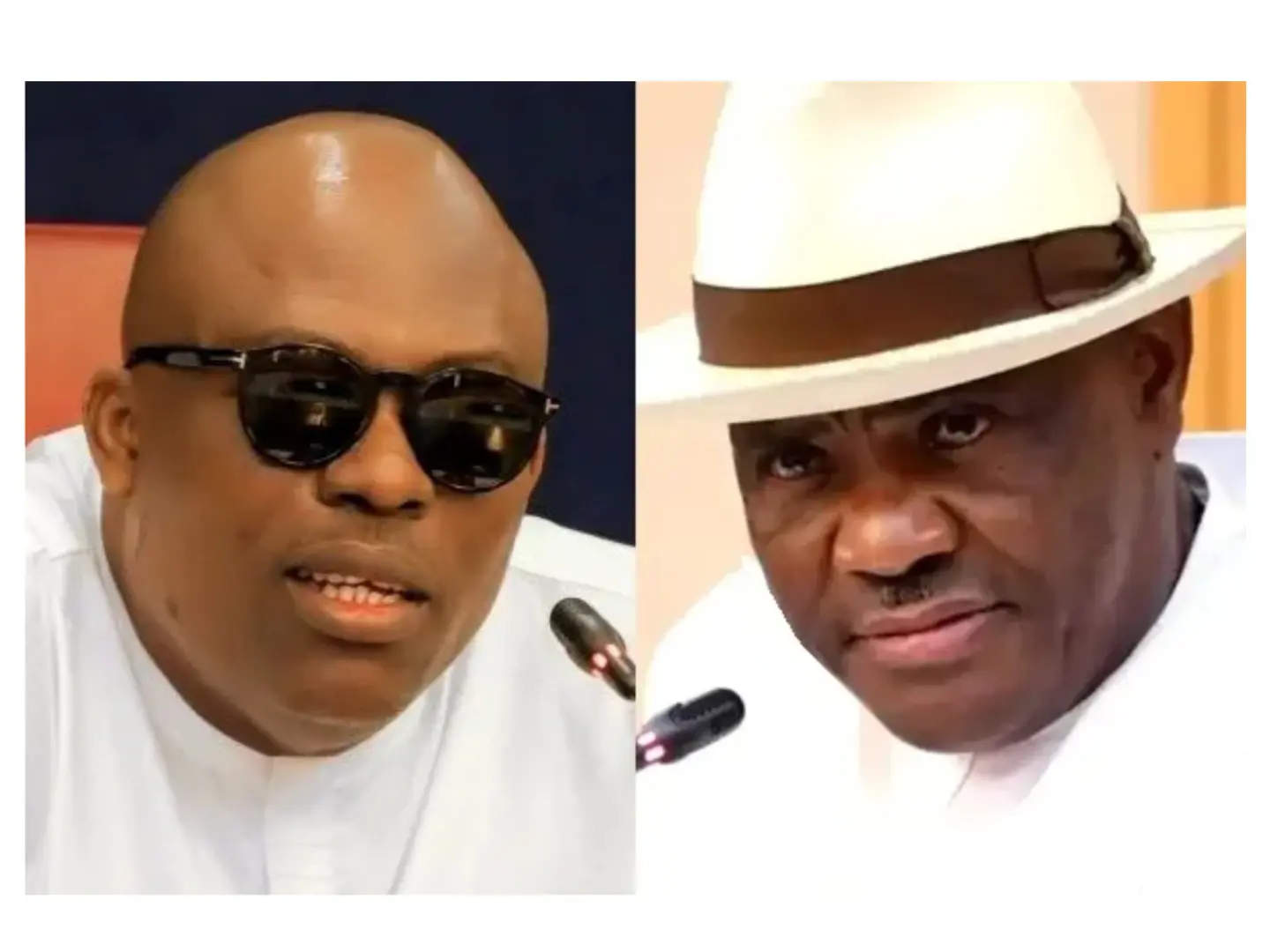
The political crisis in Rivers State has taken a fresh turn following sharp remarks by the Minister of the Federal Capital Territory (FCT), Nyesom Wike, who publicly described the state governor, Siminalayi Fubara, as “a bad child.” The statement, made during a political gathering in Ahoada East Local Government Area, has intensified an already prolonged power struggle that continues to shape governance, party cohesion, and public administration in the oil-rich state.
The comments came amid mounting tension between Wike, a former two-term governor of Rivers State, and his successor, Governor Fubara, whose administration has been locked in a sustained political confrontation with forces loyal to the former governor.
Ejes Gist News reports that Wike used the occasion to accuse Fubara of reversing key policies and projects initiated under his administration, including a large-scale youth employment programme and major road infrastructure projects.
Advertisements
Also Read : Malami Breaks Silence on Alleged Attempt to Bribe Judge
The latest exchange highlights deeper structural issues within Rivers State politics, particularly the fragile transition of power, contested political loyalties, and the broader implications for governance and development.
Advertisements
What Wike Said About Governor Fubara
Speaking during the “Renewed Hope Family Thank You Visit” held at Ahoada Main Town, Wike criticised Governor Fubara’s leadership approach, accusing him of dismantling foundational programmes established during the previous administration.
Wike alleged that Fubara cancelled an employment initiative that engaged 10,000 youths across various sectors of the state economy. According to the former governor, the beneficiaries were recruited into roles designed to stimulate economic activity, reduce unemployment, and strengthen public service delivery.
He asserted that the disengagement of the workers undermined policy continuity and affected thousands of households that had relied on the jobs for economic stability.
Allegations Over Cancellation of 10,000 Youth Jobs
One of the central issues raised by Wike was the alleged termination of an employment programme targeting 10,000 young people in Rivers State.
Key claims made by Wike include:
- The employment exercise was completed before the end of his tenure as governor.
- Beneficiaries were deployed across multiple sectors of the state economy.
- The programme was funded and structured to be sustainable.
- The Fubara administration allegedly disengaged the workers after assuming office.
Employment generation has historically been a sensitive policy area in Rivers State, where youth unemployment remains a significant socio-economic challenge. Data from Nigeria’s National Bureau of Statistics (NBS) has consistently identified youth joblessness as a driver of insecurity and economic vulnerability in the Niger Delta region.
The allegation of mass disengagement, if sustained, raises questions about governance continuity and the political costs of policy reversals.
Infrastructure Dispute: Ahoada–Omoku and Emohua–Kalabari Roads
Beyond employment, Wike also criticised Governor Fubara for allegedly taking credit for ongoing road projects that he claimed were substantially funded under his administration.
The former governor specifically referenced the dualisation of the Ahoada–Omoku Road and the Emohua–Kalabari Road, two major infrastructure corridors linking key economic and administrative zones in Rivers State.
Wike’s claims on the road projects
Wike stated that:
- He initiated the dualisation of the Ahoada Road, which many initially considered impractical.
- Phase one of the project was completed during his tenure.
- Phase two, extending to Omoku, was formally flagged off before he left office.
- Both road projects were awarded to Julius Berger Nigeria Plc, a construction firm with a long history of handling large-scale infrastructure in Nigeria.
According to Wike, the state government entered into an agreement with Julius Berger that allowed the contractor to receive N4 billion monthly from the state’s internally generated revenue (IGR).
He further claimed that:
- The combined cost of the Ahoada–Omoku and Emohua–Kalabari roads was estimated at over N80 billion.
- At least 70 per cent of the project funding had already been committed before the transition to the Fubara administration.
Infrastructure development has been a defining feature of Wike’s political brand, both as governor and later as a federal minister. His remarks appear aimed at reinforcing authorship of projects amid competing narratives over credit and accountability.
The Language of Power: Why the ‘Bad Child’ Comment Matters
Wike’s description of Governor Fubara as “a bad child” is significant beyond its rhetorical weight. In Nigerian political culture, such language often reflects deeper power dynamics between political godfathers and protégés.
The phrase underscores:
- A breakdown in mentor-protégé relationships.
- A struggle for political independence by a sitting governor.
- The persistence of informal power structures even after electoral transitions.
Political analysts note that Rivers State has long been characterised by dominant political figures who exert influence beyond formal office. The public nature of Wike’s comment suggests that reconciliation between both camps remains unlikely in the near term.
Background: The Roots of the Rivers State Crisis
The current crisis did not emerge overnight. Tensions between Wike and Fubara began shortly after the latter assumed office as governor.
Key background factors include:
- Disputes over control of the Rivers State House of Assembly.
- Conflicts over party structure and loyalty within the Peoples Democratic Party (PDP).
- Divergent approaches to governance and political appointments.
- Allegations of attempts to undermine executive authority.
These disputes have occasionally escalated into legislative paralysis, legal battles, and intervention by national party leaders.
Impact on Governance and Public Administration
The prolonged political standoff has had tangible implications for governance in Rivers State.
Observed effects include:
- Delays in legislative processes and budget implementation.
- Uncertainty surrounding policy direction and administrative continuity.
- Heightened political polarisation at the local government level.
- Disruption to public confidence in democratic institutions.
Governance experts warn that sustained elite conflict often diverts attention from service delivery, particularly in states with complex development needs like Rivers.
Youth Employment and Political Accountability
The allegation surrounding the disengagement of 10,000 youths has renewed debate over employment policy and political accountability.
Employment programmes in Nigeria are frequently politicised, with transitions between administrations leading to:
- Discontinuation of predecessor initiatives.
- Replacement of beneficiaries based on political loyalty.
- Loss of institutional memory and programme sustainability.
Civil society organisations have consistently called for legal frameworks that protect public employment schemes from partisan interference, arguing that policy continuity should outweigh political rivalry.
Infrastructure Credit and Public Perception
Disputes over infrastructure ownership are common in Nigerian politics, where projects often span multiple administrations.
Experts in public finance stress that:
- Infrastructure projects are funded by public resources, not individual officeholders.
- Clear documentation of project timelines and funding phases is essential.
- Transparent communication can reduce political misinformation.
However, public perception remains a powerful political tool, and claims of authorship often shape voter sentiment and historical narratives.
National Implications of the Rivers Crisis
The Rivers political crisis has implications beyond the state level.
Rivers State remains:
- One of Nigeria’s largest oil-producing states.
- A major contributor to national revenue.
- A strategic political stronghold within the South-South region.
Persistent instability in the state has the potential to affect national party dynamics, federal–state relations, and investor confidence, particularly in sectors linked to energy and infrastructure.
Reactions and Political Silence
While Wike’s remarks have generated widespread public discussion, formal responses from Governor Fubara’s camp have remained measured.
Political observers note that:
- Silence or restrained responses may be strategic.
- Escalation could further entrench divisions.
- Legal and institutional avenues may be preferred over public confrontation.
Historically, Rivers politics has oscillated between open confrontation and behind-the-scenes negotiations, with outcomes often shaped by national political calculations.
The Role of Political Transitions in Nigerian Democracy
The ongoing dispute highlights broader challenges associated with political transitions in Nigeria.
These include:
- Managing the influence of former officeholders.
- Establishing clear boundaries between past and present administrations.
- Strengthening institutions over personalities.
- Ensuring continuity without compromising reform.
Governance scholars argue that Nigeria’s democratic consolidation depends largely on resolving such transition-related conflicts through institutional norms rather than personal authority.
Rivers State at a Crossroads
The public exchange between Nyesom Wike and Governor Siminalayi Fubara reflects more than personal disagreement. It underscores structural tensions within Nigerian politics, where power, loyalty, and legacy often collide.
As the crisis continues, attention remains focused on how Rivers State navigates governance amid political rivalry, and whether institutional stability can prevail over personalised conflict.
