
I Met the Survivors: US Congressman Details Brutal Killings, Says 600,000 Christians Displaced in Benue

Advertisements
U.S. Congressman Riley Moore Alleges Christian Genocide in Benue After Meetings With Nigerian Security Chiefs, Governor, and Traditional Rulers
A United States lawmaker, Rep. Riley M. Moore, who represents West Virginia’s 2nd Congressional District, has accused armed groups of carrying out what he described as genocidal violence against Christians in Nigeria’s Benue State following a fact-finding mission to the country.
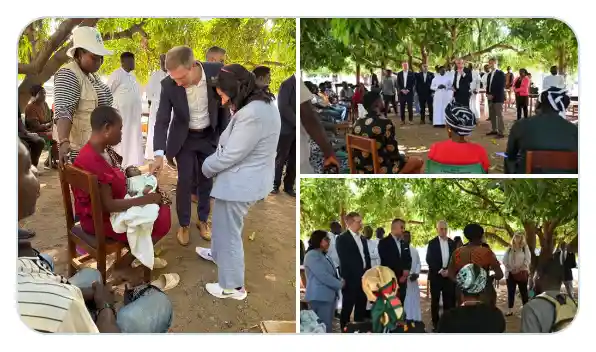
Moore made the remarks after visiting internally displaced persons (IDP) camps and holding meetings with top Nigerian officials and stakeholders, including the National Security Adviser, Nuhu Ribadu, the Governor of Benue State, the Paramount Ruler of the Tiv people, and other community leaders.
Advertisements
Ejes Gist News reports that the congressman said the visit exposed him to firsthand testimonies of extreme violence, mass displacement, and killings directed at Christian communities.
Visit to Benue State and IDP Camps
During the visit to Benue State, Moore said he met with dozens of displaced Christians who were forced to flee their ancestral homes after violent attacks on their villages. According to him, the displaced persons now live in IDP camps under harsh conditions after losing family members, homes, and means of livelihood.
Advertisements
Also Read: 7 Women Killed as Nigerian Soldiers Escorting Brigade Commander Open Fire on Protesters
The U.S. lawmaker said the individuals he spoke with described attacks that involved direct assaults on civilians, including women and children, leaving entire communities destroyed. He stated that the stories shared by survivors were graphic and deeply disturbing.
Moore said the encounters provided clarity on what he believes is happening on the ground, describing the situation as systematic and sustained violence against Christian populations in rural Benue communities.
Graphic Testimonies From Survivors
In a statement following the mission, Moore said survivors shared accounts of extreme brutality that he said would remain with him permanently.
He said one woman told him she was forced to watch as attackers killed her husband and five children. According to Moore, the woman escaped with her life while pregnant, narrowly surviving the attack along with her unborn child.
Moore further stated that another woman told him her family was murdered in front of her and that her baby was ripped from her womb during the attack.
He also recounted the testimony of a man who said his family was hacked to death before his eyes, leaving him with permanent physical injuries, including a mangled arm.
The congressman said these stories were not isolated incidents but part of what he described as a repeated pattern of attacks that have emptied villages and driven residents into displacement.
Direct Statement on Scale of Displacement
Addressing the scale of the humanitarian crisis in Benue State, Moore used precise language to describe the extent of displacement and fear among affected Christians.
“There are more than 600,000 Christians in IDP camps in Benue State alone. These Christians should be able to live in their ancestral homeland without fear of genocidal Fulani,” Moore stated.
The remark reflects Moore’s position that the violence is directed at Christian communities and that those displaced should not be living in camps years after fleeing their homes.
Meetings With Nigerian Authorities and Stakeholders
As part of the fact-finding mission, Moore also met with Nigeria’s National Security Adviser, Nuhu Ribadu, to discuss the security situation in Benue and other parts of the Middle Belt.
According to Moore, discussions with the NSA focused on ongoing attacks, displacement, and the steps being taken by the Nigerian government to address insecurity. He said he raised concerns about the safety of Christian communities and the ability of displaced persons to return to their villages.
The U.S. lawmakers also met with the Governor of Benue State, who briefed him on the state government’s assessment of the security crisis, the humanitarian burden created by mass displacement, and the challenges faced in protecting rural communities.
Moore and his team further held discussions with traditional rulers, including the Benue King, who provided local perspectives on the conflict, historical land issues, and the impact of violence on indigenous communities.
Stakeholder meetings also included community leaders and representatives of affected groups, who, according to Moore, emphasized the scale of destruction suffered by farming communities and the long-term consequences of continued displacement.
Benue as a Conflict Hotspot
Benue State has been one of the Nigerian states most affected by violent attacks on rural communities over the years, resulting in the destruction of villages and the displacement of hundreds of thousands of residents.
Large areas of farmland have been abandoned, contributing to food shortages and economic hardship. Many displaced families have remained in camps for extended periods, relying on humanitarian assistance for survival.
The presence of over 600,000 internally displaced persons has placed additional pressure on the state’s resources and worsened living conditions in camps across Benue.
Moore’s Position on the Crisis
Moore stated that his visit was aimed at understanding the situation directly rather than relying solely on secondhand reports or official statements.
He said the testimonies he heard in Benue IDP camps reinforced his view that Christians are being targeted and forced out of their ancestral lands through violence.
The congressman stressed that the displaced population he met expressed a strong desire to return home but feared renewed attacks if they attempted to do so.
He said the situation represents a failure to protect civilians and questioned why entire communities remain unable to live safely in areas they have occupied for generations.
Wider Attention to Nigeria’s Security Challenges
Moore’s comments have added to ongoing international attention on Nigeria’s security problems, particularly in the Middle Belt, where violence has led to repeated waves of displacement.
Nigeria also faces insecurity in other regions, including insurgency in the North-East, banditry in the North-West, and widespread kidnappings in several parts of the country.
Analysts have noted that the situation in Benue stands out because of the scale of displacement and the persistent inability of displaced residents to return to their homes safely.
Humanitarian Situation in IDP Camps
Conditions in Benue IDP camps remain difficult, with many camps lacking adequate shelter, sanitation, healthcare, and education facilities.
Women and children make up a large proportion of camp residents, and humanitarian agencies have warned about long-term consequences, including trauma, poverty, and disrupted education.
Moore said many of the people he met had been living in camps for years, with little confidence that their communities would be secured anytime soon.
The Nigerian authorities have often described the conflict in terms of criminality, land disputes, and resource competition, Moore’s statements reflect a sharply different interpretation based on his meetings with displaced Christians.
His visit, statements, and meetings with Nigeria’s top security officials, political leaders, and traditional rulers are likely to further spotlight Benue State in international discussions on security, displacement, and civilian protection.
As of now, tens of thousands of families remain displaced, entire villages remain deserted, and the question of when displaced Christians can safely return to their ancestral homeland remains unanswered.
