
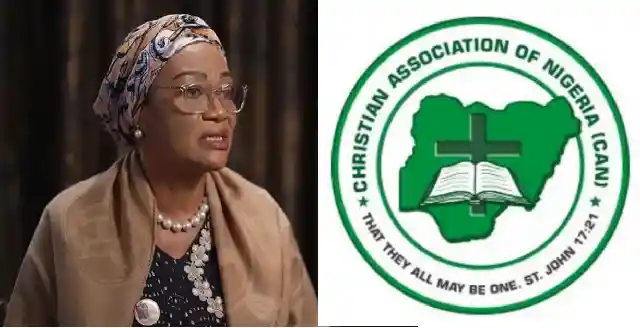
The Oluremi Tinubu Bombshell: How First Lady’s CBN News Interview Became the Final Nail in CAN’s Coffin as Northern Christians Dump Umbrella Body, Register NCA

Advertisements
By Ejes Gist News Nigeria Investigative Desk
The Christian Association of Nigeria (CAN), the umbrella body that has for decades claimed to speak for all Christians in Nigeria, is bleeding. And this time, the wound may be fatal.
In a move that has sent shockwaves through the Nigerian Christian community, Northern Christian leaders have officially dumped CAN and registered a new body—the Northern Christian Association (NCA) . The development, confirmed by multiple sources, marks the end of an era and the beginning of what many are calling the greatest schism in Nigerian Christianity since independence.
Advertisements
But why now? Why did Christians in the North, who have suffered decades of relentless persecution, decide that they could no longer remain under the CAN umbrella?
Ejes Gist News Nigeria went deep into the heart of the matter, speaking with church leaders, displaced Christians in Northern IDP camps, and Southern clerics who preferred to speak off the record. What we found is a tale of two completely different churches operating under one name—one fighting for survival, the other fighting for relevance in a prosperity-driven entertainment industry.
Advertisements
The Two Churches: One Name, Two Realities
To understand the schism, you must first understand that there are two distinct Christian experiences in Nigeria.
The Northern Christian Experience:
For Christians in the North, particularly in the Middle Belt and far North, faith is a matter of life and death—literally. Over the past two decades, thousands of Christians have been massacred by Boko Haram terrorists, Islamic State West Africa Province (ISWAP) fighters, and Fulani extremist militias. Churches have been razed. Entire communities have been wiped off the map. Women have been raped. Children have been orphaned.
In Adamawa, Borno, Plateau, Kaduna, and Benue states, Christians gather for worship under armed guard—if they gather at all. Many now worship in the ruins of their bombed-out churches or in squalid Internally Displaced Persons (IDP) camps, where they depend on meager rations to survive.
For these Christians, the church is a refuge, a source of comfort in the face of annihilation, and a voice crying out for justice in the wilderness of silence.
The Southern Christian Experience:
Meanwhile, in the South, Christianity has taken a radically different trajectory. Here, the church has become big business. Mega-churches with auditoriums seating tens of thousands dot the Lagos-Ibadan expressway. Pastors have become celebrities—flying in private jets, wearing designer clothing, and commanding fees for “prophetic consultations” that could feed an IDP camp for a year.
Sunday services have become entertainment spectacles. The sermon is often less about the cross and more about financial breakthroughs, marital settlement, and “breaking generational curses.” Social media is awash with arguments about what women should wear to church, whether tattoos are sinful, and which pastor “bought” the latest private jet.
Twitter (X) fights between celebrity pastors and their followers generate more engagement than the news that 20 Christians were slaughtered in a village in Kaduna State the previous weekend.
The Breaking Point: When Silence Became Complicity
For years, Northern Christians endured the silence of their Southern brethren. They watched as CAN national leadership—dominated by Southern clerics—issued weak, predictable press releases after major massacres, only to return to business as usual.
But the breaking point came when the silence began to feel like complicity.
Multiple sources within the now-defunct Northern CAN told Ejes Gist News that Southern church leaders actively avoided discussing the persecution of Northern Christians in their sermons. In the South, life went on as if nothing was happening. Crusades were held. Millions were raised for building projects. Thanksgiving services with politicians accused of overseeing the killings continued unabated.
“Even when churches were burning in the North, pastors in the South were busy prophesying about who would have a baby boy this year,” a Northern church leader, who pleaded anonymity for fear of reprisals, told our reporter. “They never once mentioned our suffering. It was as if we were not part of the same body of Christ.”
The Oluremi Tinubu Controversy: The Final Straw
If there was a single event that sealed the fate of CAN’s unity, it was the decision by the CAN Lagos Chapter to honor the wife of President Bola Tinubu, Senator Oluremi Tinubu.
To Northern Christians, Oluremi Tinubu represented the ultimate betrayal. During an interview with CBN News in the United States—a global Christian television network—the First Lady was asked directly about the widespread killings of Christians in Northern Nigeria. Instead of acknowledging their suffering, she reportedly denied that Christians were being persecuted, downplaying the severity of the attacks that have left thousands dead and entire communities displaced.
For Christians in the North who have buried loved ones, watched their churches burn, and now languish in IDP camps, her words on international Christian television were not just a disappointment—they were a declaration that their blood did not matter.
“She looked the world in the eye and told them we were lying,” one Northern pastor, who lost seven members of his congregation in a single attack, told Ejes Gist News. “She stood before Christians globally and denied our reality. And then she came back home, and CAN honored her.”
Yet, upon returning to Nigeria, the CAN Lagos Chapter welcomed her with open arms, hosted her at a high-profile event, and named their secretariat after her—the same woman who had just told the global Christian community that the persecution of their Northern brethren was exaggerated or non-existent.
“It was a slap on the face of every Christian who lost a loved one to the violence,” another Northern pastor fumed. “They honored a woman who went on Christian television and called us liars. They built a monument to someone who built a monument to our denial. That was the moment we realized that CAN was not our body. It was their social club—a place where networking with power matters more than standing with the persecuted.”
The Diversion of Foreign Aid
Perhaps the most damning allegation fueling the split is the claim that foreign aid meant for persecuted Christians in the North was diverted to Southern churches for “development projects.”
Ejes Gist News gathered that international Christian organizations, particularly from the United States and Europe, have for years sent millions of dollars in aid specifically designated for persecuted Christians in Nigeria’s violence-torn regions. However, Northern Christian leaders allege that much of this money never reached the IDP camps.
Instead, they claim, it was channeled through CAN structures and ended up funding mega-church building projects, purchasing equipment for television ministries, and supporting the lavish lifestyles of prosperity gospel pastors.
“We were in the camps, eating once a day if we were lucky, while churches in the South were using ‘persecution funds’ to buy new cars and broadcast equipment,” a displaced Christian from Borno State told our correspondent. “They told us the money was for us. We never saw a dime.”
While these allegations remain largely unproven, they have gained widespread acceptance among Northern Christians, who point to the opulence of Southern churches as circumstantial evidence.
The North’s Frustration: Why We Had to Leave
In a rare moment of candor, a Northern Christian leader who was part of the negotiations leading to the NCA’s formation explained the decision to break away.
“We did not wake up one day and decide to leave CAN. We loved CAN. We built CAN. But CAN stopped loving us,” he said.
He described the Southern-dominated national leadership as “a collection of selfish, politically compromised, cowardly, pretentious, ignorant, and arrogant people who openly associated with the same individuals responsible for the plight of Christians in the North.”
“We watched them carry on as if the persecution and killings were not happening. They attended dinners with killers. They took money from oppressors. They honored those who denied our suffering. How long could we remain in that fellowship?”
The leader also lamented what he called the “rockstar Christianity” of the South—a faith centered on spectacle, celebrity, and materialism rather than the core tenets of the gospel.
“In the South, Christianity has become a competition—who has the biggest church, who flies the biggest jet, who performs the most miracles, who argues best on Twitter. Meanwhile, we are burying our dead. We are burying children. We are burying entire families. And they couldn’t even mention our pain from their pulpits.”
The Birth of the Northern Christian Association (NCA)
The NCA is not merely a regional branch of CAN. It is a complete break. The new body has been formally registered with the Corporate Affairs Commission (CAC) and has its own constitution, leadership structure, and mandate.
Unlike CAN, which has become bogged down in national politics and internal power struggles, the NCA’s focus is laser-sharp: the survival and well-being of Christians in Northern Nigeria.
“We are not interested in who becomes president or governor,” an NCA founding member explained. “We are interested in why our people are being killed and why no one is being held accountable. We are interested in why foreign aid meant for us is being used to build cathedrals in Lagos. We are interested in why the international community hears our cries but sees only the spectacle of Nigerian prosperity gospel.”
The NCA has already begun reaching out directly to international Christian solidarity organizations, bypassing CAN entirely. They have also established partnerships with local security agencies and humanitarian organizations to ensure that aid reaches those who need it most.
CAN’s Response: Denial and Damage Control
When news of the split first emerged, CAN’s national leadership attempted to downplay the rift. In a press statement, they insisted that “there is nothing like Northern CAN or Southern CAN” and that the association remains united.
But sources within CAN tell a different story. Behind the scenes, there is panic. The loss of the Northern bloc means CAN has lost its moral authority to speak on persecution. It has lost a significant chunk of its membership. And it has lost the ability to claim that it represents all Nigerian Christians.
Some Southern church leaders have privately expressed regret over how Northern Christians have been treated. “We failed them,” one prominent Southern pastor admitted to Ejes Gist News on condition of anonymity. “We were so busy building our kingdoms that we forgot the kingdom of God includes our brothers in the North. We saw their suffering on the news, and we changed the channel. We have no one to blame but ourselves.”
What This Means for Nigerian Christianity
The formation of the NCA is more than just an organizational split. It is a theological referendum on the direction of Nigerian Christianity.
For decades, the global image of Nigerian Christianity has been shaped by the prosperity gospel, the mega-churches, and the celebrity pastors of the South. But the NCA represents a different narrative—a Christianity of the cross, of suffering, of perseverance in the face of annihilation.
If the NCA succeeds in building direct relationships with the global church and channeling resources to persecuted Christians, it could fundamentally alter the landscape of Nigerian Christianity. It could also expose uncomfortable truths about how foreign aid has been mismanaged and how the prosperity gospel has distracted the church from its core mission.
The Road Ahead
As of press time, CAN has not officially recognized the NCA, and it remains unclear whether the new body will seek formal affiliation with the global Christian community or operate independently.
What is clear, however, is that the schism is real, and it is deep. For Northern Christians, there is no going back. They have endured too much, lost too many, and waited too long for their Southern brethren to stand with them.
“We are not angry,” one Northern pastor said softly as he concluded our interview. “We are just tired. Tired of begging for attention. Tired of begging for prayers. Tired of begging for aid. Now, we will fend for ourselves. And we will trust God to do what man—and CAN—would not.”
Ejes Gist News Nigeria will continue to monitor this developing story. We reached out to CAN National Headquarters for comment but had not received a response as of the time of this publication.
Have a tip or reaction to this story? Contact our investigative desk at [email protected] or follow us on social media for updates
