
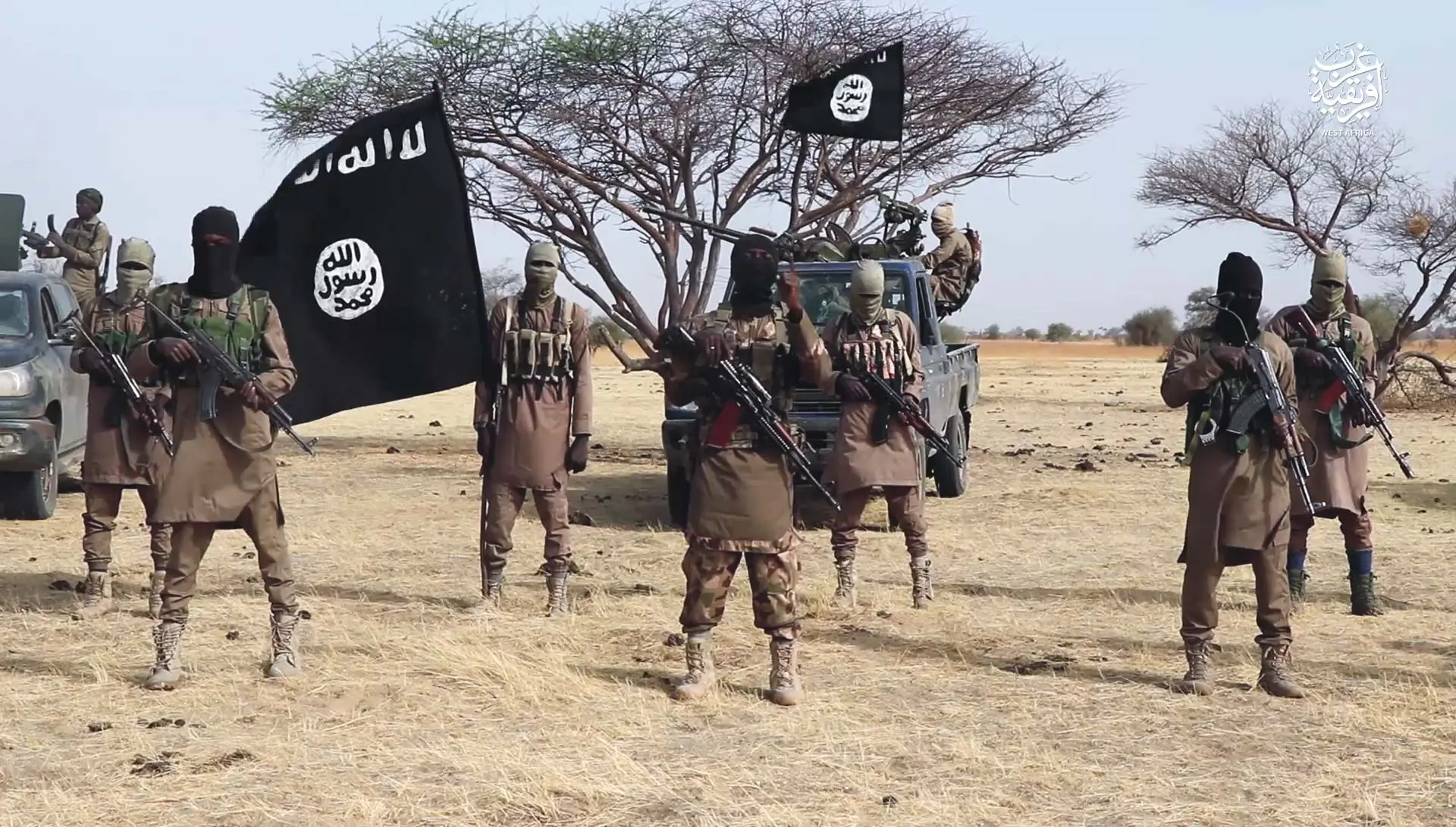
Islamic Terrorists to Christians: Convert to Islam or Die as They Burn Villages in Adamawa

Advertisements
The Islamic State of West Africa Province (ISWAP), one of the most lethal jihadist groups operating in the Lake Chad Basin, has intensified its campaign of violence against civilian communities in Northeast Nigeria, with a fresh attack targeting a Christian village in Adamawa State.
Security sources and open-source intelligence analysts confirmed that ISWAP fighters set ablaze a rural Christian settlement in Adamawa, issuing threats that residents must either convert to Islam or face death. The incident underscores the group’s continued use of religious coercion, mass intimidation, and scorched-earth tactics to assert territorial influence and ideological dominance.
Ejes Gist News reports that images and video footage released by ISWAP show burning homes and destroyed property, accompanied by statements declaring Christians in Nigeria “legitimate targets” unless they submit to conversion or pay a so-called jizyah tax imposed by the terrorist group.
Advertisements
ISWAP and Its Ideological Campaign Against Civilians
ISWAP emerged in 2016 as a splinter faction of Boko Haram after internal disputes over leadership, strategy, and treatment of Muslim civilians. While Boko Haram under Abubakar Shekau became notorious for indiscriminate violence, ISWAP positioned itself as a more “structured” insurgent group aligned with the global Islamic State network.
Also Read: Serving Senator Godiya Akwashiki Dies in Indian Hospital, Cause of Death Emerges
Advertisements
Despite this narrative, multiple reports by the United Nations, Amnesty International, and Nigerian security agencies have documented ISWAP’s systematic targeting of civilians, religious minorities, and perceived collaborators.
Key Characteristics of ISWAP Operations
ISWAP’s operational pattern includes:
- Attacks on rural villages with limited security presence
- Forced displacement of civilian populations
- Extortion through illegal taxation, including jizyah
- Destruction of homes, churches, and community infrastructure
- Use of propaganda videos to amplify fear and recruitment
The attack in Adamawa State reflects these established tactics, particularly the use of religious threats to compel compliance.
What Happened in Adamawa State
According to security analyst Brant Philip, who shared details of the incident on social media platform X, ISWAP released images showing a Christian village engulfed in flames in Adamawa State.
In the accompanying statement, the group warned that Christians across Nigeria are considered lawful targets under its extremist interpretation of Islamic law. The statement claimed civilians could “spare their blood” only by converting to Islam or paying jizyah to ISWAP.
Significance of the Adamawa Attack
Adamawa State has historically experienced lower levels of insurgent violence compared to Borno State, the epicenter of Boko Haram and ISWAP activity. However, security experts note that insurgent groups have increasingly expanded operations into Adamawa and parts of Yobe State as military pressure intensifies elsewhere.
The burning of a Christian village in Adamawa signals:
- A geographic expansion of ISWAP’s terror campaign
- Increased vulnerability of minority communities
- Renewed emphasis on religiously framed violence
Religious Coercion and the Use of Jizyah
ISWAP’s reference to jizyah—a historical tax imposed on non-Muslims in some pre-modern Islamic states—has been widely condemned by Islamic scholars, civil society groups, and human rights organizations.
Why ISWAP’s Claim Is Rejected by Scholars
Mainstream Islamic authorities argue that:
- Armed non-state actors have no legitimacy to impose taxes
- Forced conversion violates Islamic principles
- Targeting civilians contradicts Islamic law and ethics
The Nigerian Supreme Council for Islamic Affairs and other clerical bodies have repeatedly denounced Boko Haram and ISWAP as criminal groups that misrepresent Islam for violent ends.
Possible Retaliation for Joint Military Airstrikes
Security analysts believe the Adamawa attack may be linked to recent military operations targeting terrorist enclaves in Northwest Nigeria.
Five days before the ISWAP video surfaced, the President of the United States, Donald Trump, announced that U.S. forces had carried out airstrikes against terrorist hideouts in Sokoto State. Nigerian military officials later confirmed coordination with international partners in counterterrorism operations.
Strategic Context of the Airstrikes
The reported airstrikes were aimed at:
- Disrupting terrorist logistics and training camps
- Targeting senior commanders and operational planners
- Weakening networks linking insurgents across regions
Analysts suggest ISWAP’s attack on a civilian village may be intended to demonstrate resilience, intimidate local populations, and send a message to both Nigerian authorities and international partners.
Nigeria’s Northeast Insurgency: A Protracted Crisis
Nigeria’s insurgency crisis, which began in 2009, has resulted in one of Africa’s longest-running humanitarian emergencies.
Humanitarian Impact by the Numbers
According to data from the United Nations Office for the Coordination of Humanitarian Affairs (OCHA):
- Over 35,000 civilians have been killed since 2009
- More than 2 million people remain internally displaced
- Thousands of villages have been destroyed or abandoned
- Food insecurity affects millions across Borno, Adamawa, and Yobe States
Christian and Muslim communities alike have suffered severe losses, contradicting extremist claims that their violence serves religious interests.
Adamawa State’s Security Challenges
Adamawa State shares borders with Borno State and Cameroon, making it strategically significant in the fight against insurgency.
Key Vulnerabilities
Security assessments identify several factors contributing to instability in Adamawa:
- Vast rural terrain with limited military presence
- Porous borders facilitating cross-border movement
- Economic hardship and youth unemployment
- Weak early-warning systems in remote communities
The latest attack reinforces long-standing concerns that insufficient protection leaves rural settlements exposed to militant raids.
International and Domestic Reactions
While official statements regarding the Adamawa incident are still emerging, similar attacks have historically drawn condemnation from:
- The Federal Government of Nigeria
- International human rights organizations
- Religious leaders across faiths
- Foreign governments supporting counterterrorism efforts
The United States, United Kingdom, and European Union have consistently designated ISWAP as a terrorist organization and pledged support to Nigeria’s counterinsurgency operations.
The Role of Propaganda in ISWAP Operations
ISWAP’s release of images and statements following attacks forms part of a deliberate propaganda strategy.
Objectives of Terrorist Media Releases
Such materials are used to:
- Amplify fear beyond the immediate area of attack
- Attract recruits through displays of power
- Undermine public confidence in state security
- Influence international media narratives
Security experts caution against sharing such content without context, noting that extremist groups rely on visibility to extend their reach.
Legal and Human Rights Implications
Under Nigerian law and international humanitarian law, the deliberate targeting of civilians constitutes a war crime.
Organizations such as Human Rights Watch and Amnesty International have documented repeated violations by ISWAP, including:
- Forced displacement
- Destruction of civilian property
- Religious persecution
- Extrajudicial killings
These actions fall under crimes against humanity when carried out as part of a widespread or systematic attack on civilian populations.
