
Dangote Accuses Tinubu’s Appointee, Farouk Ahmed, of Paying $5m Swiss School Fees, Questions Source of Funds

Advertisements
Dangote Accuses NMDPRA MD, Farouk Ahmed of Paying $5m School Fees in Switzerland, Questions Source of Funds
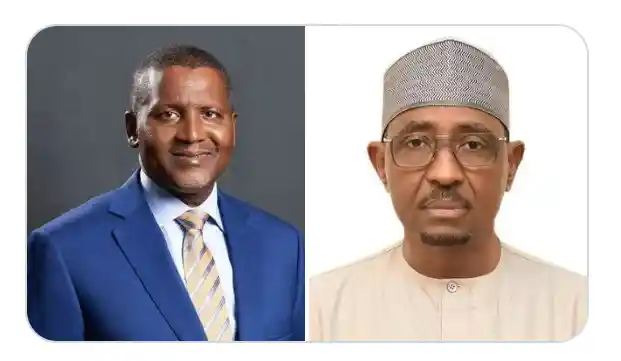
Africa’s richest man and Chairman of Dangote Group, Alhaji Aliko Dangote, has accused the Managing Director of the Nigerian Midstream and Downstream Petroleum Regulatory Authority (NMDPRA), Engr. Farouk Ahmed, of allegedly paying about $5 million in school fees to educate four of his children at a secondary school in Switzerland.
Dangote made the allegation publicly while criticising what he described as deep-seated accountability problems within Nigeria’s public service and regulatory institutions.
Advertisements
Ejes Gist News reports that Dangote contrasted the alleged expenditure with the harsh reality facing millions of Nigerian families who struggle to pay school fees of ₦10,000 or less for their children.
Pay Attention To Bandit Arrested in Kwara Accuses Officials of Supplying Vehicle, Weapons
Advertisements
Dangote Questions Wealth of Career Public Servant
According to Dangote, Farouk Ahmed has spent most of his professional career working in government institutions, raising serious questions about how such a large sum could have been legitimately accumulated.
Dangote openly asked how a lifelong public servant, without publicly known large-scale private business interests, could afford to pay millions of dollars for foreign secondary education. He argued that the issue goes beyond personal spending and touches on public trust, transparency, and ethical standards in governance.
Allegation Raises Governance and Transparency Concerns
The allegation has renewed public debate over unexplained wealth among senior government officials and the effectiveness of Nigeria’s asset declaration and oversight systems.
Under Nigerian law, public officers are required to declare their assets to the Code of Conduct Bureau (CCB). However, such declarations are not publicly accessible, which often fuels speculation and public suspicion when lifestyle or spending appears disproportionate to known income.
Dangote called on relevant authorities to scrutinise the matter, stressing that transparency is essential for restoring confidence in public institutions, especially in critical sectors such as oil and gas regulation.
No Official Response From NMDPRA Boss
As of the time of reporting, Farouk Ahmed has not issued a public statement directly addressing Dangote’s claim. The NMDPRA has also not released any official clarification regarding the allegation or the personal finances of its chief executive.
There has been no public announcement of a formal investigation by anti-corruption agencies such as the Economic and Financial Crimes Commission (EFCC) or the Independent Corrupt Practices and Other Related Offences Commission (ICPC) in relation to the specific claim.
Public Reaction and Civil Society Pressure
The allegation has generated widespread reactions across social media and public discourse. Many Nigerians have called for an independent probe, citing economic hardship, rising education costs, and the widening gap between public officials and ordinary citizens.
Some civil society organisations and legal groups have urged the federal government to ensure transparency by compelling public officials accused of unexplained wealth to provide clear explanations backed by verifiable records.
Others have cautioned against trial by public opinion, emphasising that allegations must be investigated thoroughly and fairly, in line with due process and the rule of law.
Wider Context in the Oil and Gas Sector
Dangote’s remarks come amid ongoing tensions between private sector operators and petroleum regulators over policy direction, licensing, and regulatory decisions in Nigeria’s downstream oil sector.
Observers note that the controversy underscores broader concerns about regulatory integrity, governance standards, and accountability in institutions tasked with overseeing one of Nigeria’s most strategic economic sectors.
Whether the allegation leads to formal investigation or official clarification remains to be seen, but it has once again placed the spotlight on wealth transparency and ethical conduct in Nigeria’s public service.
Our Sources
- ThisDay Live – Dangote: NMDPRA CEO Must Be Probed, Prosecuted for Graft, Economic Sabotage
- PM News Nigeria – $5m school fees: Dangote blows whistle on NMDPRA boss Farouk Ahmed
