
Tinubu’s IGP Appointment Triggers Forced Retirement of Eight DIGs – Full Profiles
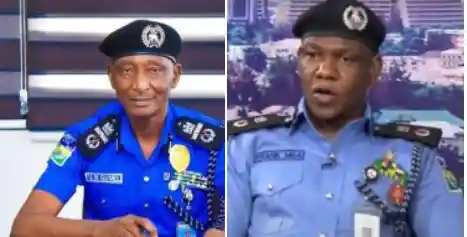
The appointment of Tunji Disu as Inspector-General of Police has triggered a wave of senior-level exits within the Nigeria Police Force, following the long-established institutional practice that compels officers senior to a newly appointed IGP to step aside.
President Bola Ahmed Tinubu appointed Disu as acting Inspector-General of Police after the resignation of Kayode Egbetokun from the apex office of the Force.
Ejes Gist News reports that the development has directly affected several Deputy Inspectors-General of Police (DIGs) who were senior to the new police chief and are now compelled to retire in line with policing tradition.
Although not expressly mandated by statute, the convention remains deeply rooted in the Force’s hierarchical structure and operational culture.
Why the DIGs Are Retiring
In Nigeria’s policing structure, the Inspector-General of Police is the most senior serving officer. Once a junior officer is elevated to that position, senior officers above him in the chain of command typically retire to preserve discipline, command authority, and institutional stability.
The Nigeria Police Force operates under a rigid command framework where seniority determines authority, postings, and operational command. The emergence of a former Assistant Inspector-General as IGP therefore places existing DIGs in a structurally subordinate position, making their continued service impracticable.
The following profiles outline the eight DIGs affected by the development.
Frank Mba
Frank Mba began his policing career as an Inspector and rose steadily through the ranks. He was promoted to Assistant Superintendent of Police in 1999, Deputy Superintendent of Police in 2003, Superintendent of Police in 2008, Chief Superintendent of Police in 2012, Assistant Commissioner of Police in 2014, Deputy Commissioner of Police in 2018, and Commissioner of Police in December 2020.
In March 2023, he was decorated as an Assistant Inspector-General of Police.
Mba served three separate terms as National Spokesman of the Nigeria Police Force. He received the United Nations Medal for his service with the Nigeria Police Contingent to the United Nations Mission in Liberia between 2006 and 2007.
Mohammed Gumel
Mohammed Gumel served as Deputy Inspector-General of Police in charge of the Force Intelligence Department at Force Headquarters, Abuja.
He assumed office in late 2025 after his promotion by the Police Service Commission. The Force Intelligence Department is the apex intelligence-gathering arm of the Nigeria Police Force, responsible for strategic intelligence coordination and threat assessment.
Gumel previously served as Commissioner of Police and was recognised as Community Policing Advocate of the Year in 2024. He holds professional distinctions including Fellow of the Institute of Professional Managers and Administrators (FIPMA) and Police Staff College (psc).
Ademola Hamzat
Ademola Hamzat served as Deputy Inspector-General of Police in charge of the Department of Logistics and Supply.
He was appointed and decorated as DIG in March 2025. As head of Logistics and Supply, he supervised procurement, works, housing, transport management, and Quarter-Master operations across the Force.
Before his elevation, Hamzat served as Assistant Inspector-General of Police in charge of Zone 16, Yenagoa, covering Bayelsa and Rivers States. He also served as Commissioner of Police for Oyo State and headed the Counter Terrorism Unit.
Yahaya Abubakar
Yahaya Abubakar most recently headed the Department of Finance and Administration at Force Headquarters, Abuja.
The department oversees budgeting, financial management, personnel administration, and institutional resource allocation within the Nigeria Police Force.
He was promoted by the Police Service Commission in 2024 and previously held senior roles including Assistant Inspector-General and Zone Commander.
Basil Idegwu
Basil Idegwu led the Department of Research and Planning at Force Headquarters.
Appointed in 2025, he oversaw strategic planning, policy formulation, performance evaluation frameworks, and modernization initiatives within the Force.
He holds a PhD in Peace and Security Studies and supervised reforms aimed at strengthening operational standards and institutional uniformity.
Bzigu Kwazhi
Bzigu Kwazhi served as Deputy Inspector-General of Police in charge of the Department of Operations.
The Operations Department coordinates tactical deployments, crime prevention strategies, joint security operations, election security management, riot control, and disaster response.
Kwazhi previously served as Commissioner of Police in Osun and Akwa Ibom States. He was involved in high-level security operations, including peace restoration efforts in Plateau and Adamawa States.
Idris Abubakar
Idris Abubakar joined the Nigeria Police Force as a Cadet Assistant Superintendent of Police on May 18, 1992.
He holds a Bachelor of Science degree in Education from Usmanu Danfodiyo University, Sokoto, a Master’s degree in Education (Psychology), and a PhD in Psychology from the University of Abuja.
He served in various command and administrative capacities before his elevation to the rank of Deputy Inspector-General.
Adebowale Williams
Adebowale Williams served as Deputy Inspector-General of Police and headed the Department of Information and Communication Technology at Force Headquarters.
The ICT Department manages digital policing systems, technological infrastructure, surveillance platforms, data management frameworks, and operational communication systems within the Force.
His role focused on modernising the Nigeria Police Force’s technological capabilities and strengthening digital integration in policing operations.
Institutional Implications
The retirement of the eight DIGs marks a significant transition within the senior leadership structure of the Nigeria Police Force.
Such transitions historically reshape command architecture, departmental leadership, and operational direction. The development clears the path for new promotions into the DIG cadre, subject to approval by the Police Service Commission.
The appointment of Tunji Disu as Inspector-General signals a generational shift within the Force hierarchy, with implications for intelligence operations, logistics management, finance administration, tactical operations, and ICT-driven policing reforms.