Outrage as Nigerians question how Nigeria’s tax chairman earns enough to afford ₦157 million luxury watches
Outrage as Nigerians Question How Much Nigeria’s Tax Chairman Earns to Afford 157 million Luxury Watches.
Public outrage has escalated following confirmation that luxury wristwatches valued at tens and hundreds of millions of naira are owned by the Chairman of the Nigeria Revenue Service (NRS), Zacch Adedeji. The confirmation has intensified nationwide debate over public sector remuneration, asset transparency, and ethical expectations of senior government officials.
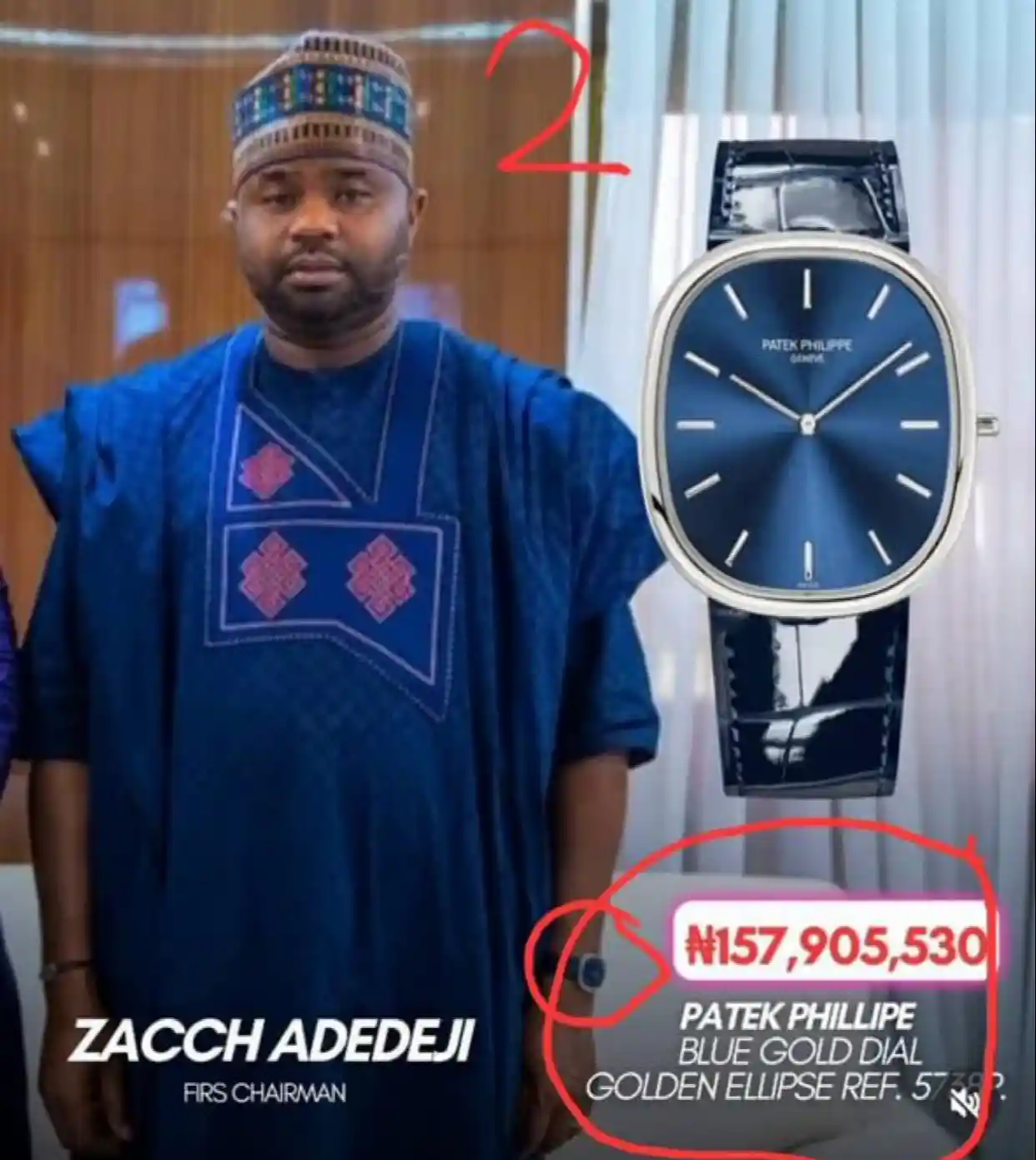
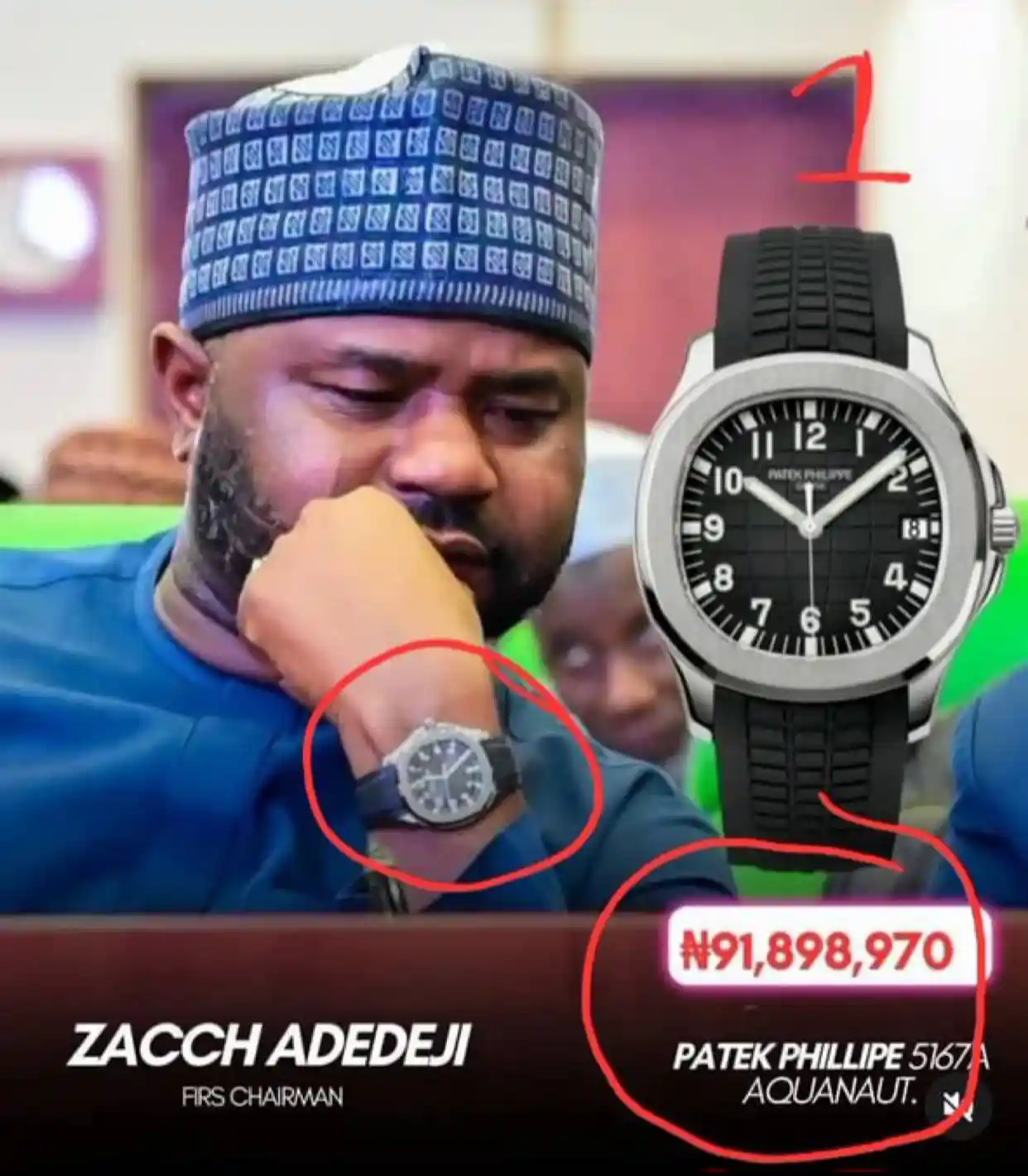
The controversy erupted after images circulated widely on social media showing the NRS chairman wearing high-end Swiss wristwatches, with accompanying claims that the timepieces are worth approximately ₦91 million and ₦157 million respectively. While initial reactions were marked by uncertainty over ownership, confirmation that the watches belong to the revenue chief has shifted the conversation from speculation to scrutiny.
Ejes Gist News reports that the development has triggered sustained public questioning of how a serving public official, whose income is tied to government pay structures, could lawfully acquire luxury items whose combined value far exceeds the annual earnings of most Nigerians and senior civil servants.
The Watches and Their Valuations
The watches identified in the circulating images are luxury models from Patek Philippe, a Swiss manufacturer widely regarded as one of the most prestigious watchmakers in the world. The brand’s watches often sell for substantial sums, particularly on the international secondary market, where scarcity, reference numbers, and condition significantly influence price.
Also Read: Senegal Defeat Morocco to Win Second AFCON Title After Dramatic Final
One of the watches is valued at about ₦91 million, while another, described as a gold elliptical model with a blue dial, carries an estimated value of ₦157 million. These figures align with prevailing international market prices for comparable models when converted to naira at prevailing exchange rates.
With ownership now confirmed, public attention has shifted to the financial implications and what they suggest about wealth accumulation by top public officials.
Who Is the NRS Chairman?
Zaccheus Adedeji is an economist and public finance professional who has held several senior positions within Nigeria’s fiscal and revenue administration architecture. Prior to his appointment as chairman, he served in advisory and executive roles related to taxation, budgeting, and economic policy.
As Chairman of the Nigeria Revenue Service, Adedeji heads the country’s apex tax authority, responsible for assessing, collecting, and accounting for federally collectible revenues. The office places him among the most powerful non-ministerial public officers in Nigeria, with oversight over trillions of naira in tax receipts annually.
Despite the prominence of the position, personal income details of the office holder are not publicly itemised beyond the general salary structures applicable to heads of federal agencies.
Public Sector Pay and the Central Question
Nigeria’s public service operates under a regulated remuneration framework approved by the Revenue Mobilisation Allocation and Fiscal Commission. Salaries and allowances for heads of agencies are fixed and significantly lower than earnings in the private sector.
Available open-source data on senior management remuneration within the revenue service and comparable agencies suggest that even the highest-ranking executives earn total annual compensation in the low tens of millions of naira when salary and allowances are combined.
Against this backdrop, the confirmed ownership of wristwatches valued at over ₦200 million collectively has become the focal point of public concern. Many Nigerians are asking how such assets could be acquired solely from public sector earnings, particularly in an economy marked by widespread hardship, high inflation, and declining purchasing power.
Online Reactions and Public Sentiment
Reaction across social media platforms has been swift and intense. Critics argue that the confirmed ownership reinforces perceptions of elite excess and deepens mistrust in public institutions, especially one charged with tax enforcement and revenue mobilisation.
Some commentators have framed the issue as a moral and symbolic one, contending that visible luxury by tax administrators undermines public willingness to comply voluntarily with tax obligations. Others have demanded explanations, insisting that confirmation of ownership creates a duty to clarify the source of funds used to acquire such high-value items.
At the same time, a minority of voices have urged caution, stressing that ownership of expensive assets is not inherently illegal and that public debate should distinguish between lawful wealth and corruption.
Legal Framework on Asset Ownership
Under Nigeria’s Code of Conduct for Public Officers, public officials are required to declare their assets to the Code of Conduct Bureau at the commencement and end of their tenure. The law, however, does not make these declarations public, except where they become relevant in judicial or quasi-judicial proceedings.
This legal structure means that even with confirmed ownership of luxury items, the public has no direct access to information about when the watches were acquired, whether they predate the official’s appointment, or how they were financed.
From a legal standpoint, possession of high-value assets does not constitute wrongdoing unless it can be shown that they were acquired unlawfully, improperly declared, or funded through proceeds of corruption.
Questions of Timing and Source of Wealth
A central issue in the unfolding debate is whether the watches were acquired before or after Adedeji assumed his current role. Analysts note that this distinction is critical, as assets accumulated prior to public office are treated differently under the law from those acquired while in office.
There has been no public disclosure regarding the timing of the purchases, nor any official statement outlining whether the assets were funded through pre-existing wealth, investments, loans, or gifts permissible under the law.
In the absence of such information, public discourse has been shaped largely by inference rather than verified financial records.
Implications for Public Trust and Tax Compliance
The controversy carries particular weight because it involves the head of the nation’s tax authority. Tax systems depend heavily on public confidence in fairness, integrity, and accountability. Perceptions that senior tax officials live far above the economic realities of the average citizen can erode trust and weaken compliance.
Revenue experts caution that even when wealth is lawfully acquired, lack of transparency can damage institutional credibility. They argue that tax authorities must not only enforce compliance but also embody restraint and integrity to maintain moral authority.
Civil society groups have seized on the episode to renew calls for greater openness in public service, including voluntary disclosure of assets by senior officials as a confidence-building measure.
Calls for Official Clarification
With ownership now confirmed, pressure is mounting for clarification from the Nigeria Revenue Service or from the chairman himself. Some stakeholders believe a clear explanation of the provenance of the watches would help calm public anger and prevent further speculation.
Others argue that responding to public pressure risks normalising a culture where officials are compelled to justify personal property, even when lawfully acquired. They maintain that any questions about asset legitimacy should be handled through established legal and oversight institutions, not social media debates.
A Recurring Pattern in Nigerian Governance
The episode reflects a familiar pattern in Nigerian public life, where confirmed or alleged displays of wealth by public officials become lightning rods for public frustration. Similar controversies in the past have centred on luxury vehicles, overseas properties, and private aircraft linked to public office holders.
In some instances, investigations later established that assets were lawfully acquired. In others, probes uncovered significant misconduct. This mixed history has shaped a public mood that oscillates between scepticism and suspicion.
What Is Now Established
What is now established is that the luxury watches belong to the Nigeria Revenue Service chairman and that their market value far exceeds what would be expected from official earnings alone. It is also established that Nigerian law does not automatically criminalise such ownership without evidence of illegality.
What remains unresolved is the source of funds used to acquire the watches, the timing of their purchase, and whether they were fully declared in accordance with asset declaration laws.
As the debate continues, the issue has become a broader test of transparency, accountability, and public trust in Nigeria’s revenue administration, highlighting the enduring tension between legal compliance and public expectations of modesty in public office.
Ejes Gist News stands for truth, responsible journalism, editorial integrity and fearless accountability.
You May Also Like


Trending Now