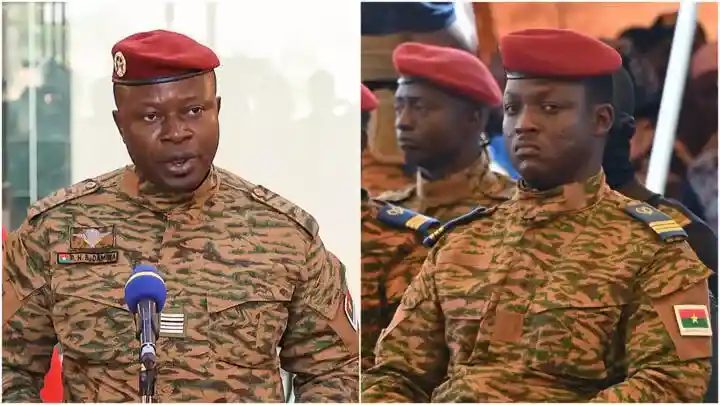
Burkina Faso Accuses Former Transitional President Damiba of Leading Foiled Coup Attempt Against Ibrahim Traoré
Burkina Faso has formally accused its former transitional president, Lieutenant-Colonel Paul-Henri Sandaogo Damiba, of orchestrating a foiled coup attempt aimed at overthrowing the current military-led government under Captain Ibrahim Traoré. The allegation, made public through official government channels, has intensified political tensions in Traoré Burkina Faso and raised broader questions about stability, regional security, and the persistent cycle of coups in the Sahel.
The Burkinabe authorities disclosed that the alleged plot involved plans to assassinate Captain Ibrahim Traoré and several other military and civilian figures, followed by coordinated military actions designed to destabilize the state.
Ejes Gist News reports that the government claims the operation was scheduled to be executed on Saturday, 3 January, but was neutralized following intelligence-led interventions by security agencies.
Also Read: Over 30 Killed, Several Abducted as Bandits Raid Market in Niger State
A Nation Shaped by Repeated Power Shifts
Burkina Faso’s Recent Political History
Burkina Faso has experienced a series of military takeovers since 2022, reflecting deep-rooted security and governance challenges. In January 2022, Lieutenant-Colonel Paul-Henri Sandaogo Damiba seized power from elected President Roch Marc Christian Kaboré, citing the government’s inability to contain jihadist violence.
Damiba himself was removed in September 2022 by a group of junior officers led by Captain Ibrahim Traoré, who accused the transitional leadership of failing to improve security conditions and of lacking strategic clarity. Traoré subsequently became the youngest head of state in the world at the time, positioning his leadership as a corrective response to previous failures.
Since then, Traoré Burkina Faso has remained under military rule, with the government emphasizing sovereignty, national security, and a break from traditional external alliances.
Government’s Account of the Foiled Coup Attempt
Official Statement by the Minister of Security
In a televised interview broadcast on state television, Burkina Faso’s Minister of Security, Mahamadou Sana, provided details of what authorities described as a “major destabilization operation.”
According to the minister, the alleged coup attempt was scheduled for Saturday, 3 January, at approximately 11:00 p.m. The plan reportedly involved a coordinated series of assassinations targeting both military and civilian figures.
The minister stated that the operation was to begin with what he described as the “neutralization” of Captain Ibrahim Traoré, followed by attacks on strategic military infrastructure.
Alleged Military Objectives
The government outlined several stages of the purported plan, including:
- The assassination of Captain Ibrahim Traoré and other senior figures.
- The decommissioning of a drone base considered critical to national defense operations.
- A ground military intervention allegedly involving external forces.
Authorities claimed that these steps were designed to create a power vacuum and facilitate a rapid seizure of control.
Alleged Role of Paul-Henri Sandaogo Damiba
Accusations Against the Former Transitional President
The Burkinabe government identified Paul-Henri Sandaogo Damiba as the principal architect of the alleged coup attempt. Damiba has been living in exile in Togo since his removal from power in September 2022.
Minister Mahamadou Sana asserted that Damiba’s role included planning and coordinating the operation, mobilizing financial resources, and recruiting both civilian and military participants.
Structure of the Alleged Network
According to the official account, the alleged destabilization network was divided into distinct roles:
- Military personnel were tasked with recruiting fellow soldiers, forming operational units, and executing armed actions.
- Civilian participants were allegedly responsible for mobilizing public support and legitimizing the operation following military action.
- Organizers and financiers were said to have coordinated logistics and funding.
The government emphasized that investigations are ongoing and that not all individuals involved have been publicly identified.
Arrests and Ongoing Investigations
Detentions Linked to the Alleged Plot
Burkina Faso’s authorities confirmed that several individuals have been arrested in connection with the alleged coup attempt. However, officials declined to disclose specific names, citing the need to preserve the integrity of ongoing investigations.
The Minister of Security stated that further arrests could follow as intelligence agencies continue to dismantle the network.
Release of a Confession Video
As part of its communication strategy, the government released a video showing what it described as the confession of an alleged economic operator implicated in the plot.
In the video, the individual reportedly explains his role in financing and facilitating the destabilization operation. Such public confessions have been used previously by governments in the region to demonstrate progress in security investigations, although they often attract scrutiny from human rights observers.
Alleged Foreign Financing and Regional Implications
Claims of Funding From Côte d’Ivoire
One of the most sensitive aspects of the government’s allegation concerns claims of external financing. Minister Mahamadou Sana stated that a “good part” of the funding for the alleged coup attempt originated from Côte d’Ivoire.
According to the minister, investigators traced a transfer of approximately 70 million CFA francs linked to the operation.
Diplomatic Sensitivities
The Burkinabe government’s assertion of foreign involvement introduces significant diplomatic implications. Côte d’Ivoire is a key regional actor and a member of the Economic Community of West African States (ECOWAS), an organization with which Burkina Faso’s current military government has had strained relations.
As of the time of the announcement, Ivorian authorities had not publicly responded to the claims. Analysts note that such allegations, if left unresolved, could further complicate regional cooperation on security and economic integration.
Security Context Under Ibrahim Traoré
Military Governance and Security Strategy
Since assuming power, Captain Ibrahim Traoré has positioned his administration as a corrective force aimed at restoring security and national dignity. The government has emphasized:
- Increased reliance on national armed forces and auxiliary units.
- A shift in international partnerships.
- A rhetoric of resistance against perceived external interference.
Supporters argue that these measures reflect popular frustration with prolonged insecurity, while critics question their effectiveness and long-term sustainability.
Persistent Security Challenges
Despite changes in leadership, Burkina Faso continues to face attacks from armed groups linked to extremist networks. Large portions of the country remain affected by violence, displacement, and humanitarian crises.
The alleged coup attempt underscores the fragile nature of governance in Traoré Burkina Faso, where internal dissent and external pressures coexist with ongoing security threats.
Legal and Political Dimensions
Accountability and Due Process
The government has stated that all individuals implicated in the alleged coup attempt will be prosecuted in accordance with Burkinabe law. However, details about the legal framework, charges, and judicial processes have not been fully disclosed.
Human rights organizations have historically expressed concerns about transparency and due process in cases involving national security and alleged coup plots.
Political Legitimacy and Transition Timeline
Burkina Faso’s military government has committed, at various points, to a transition toward civilian rule. Allegations of repeated coup attempts may influence the timeline and conditions under which such a transition is pursued.
Observers note that accusations against former leaders, such as Damiba, also serve to consolidate the current administration’s narrative of legitimacy and vigilance.
Media, Information, and Public Perception
State الإعلام and Official Communication
The announcement of the foiled coup attempt was delivered primarily through state television and official statements. This approach reflects the government’s reliance on controlled communication channels to shape public understanding of security developments.
The release of videos and detailed narratives is intended to demonstrate transparency and decisiveness, although independent verification remains limited.
Public Reaction Within Burkina Faso
Public responses have varied, with some citizens expressing support for strong measures to protect the government, while others remain cautious due to the country’s history of political instability.
Social discourse around ibrahim traoré often reflects broader debates about military rule, sovereignty, and the balance between security and democratic governance.
Regional Pattern of Coups and Counter-Coups
Sahelian Instability
Burkina Faso’s situation fits into a broader regional pattern in the Sahel, where military takeovers have occurred in Mali, Niger, and Guinea in recent years.
These developments have reshaped regional alliances and challenged existing frameworks for governance and security cooperation.
Implications for ECOWAS and Regional Order
Repeated coup allegations complicate ECOWAS’s efforts to enforce democratic norms while addressing security emergencies. Burkina Faso’s strained relationship with the bloc adds another layer of complexity to regional diplomacy.
What Is Known and What Remains Unclear
Established Facts
Based on official statements:
- Burkina Faso claims to have foiled a coup attempt planned for 3 January.
- Authorities allege that the plot targeted Captain Ibrahim Traoré and key infrastructure.
- Several individuals have been arrested, and investigations are ongoing.
- The government accuses former transitional president Paul-Henri Sandaogo Damiba of leading the operation.
Unresolved Questions
Several aspects remain unverified :
- The full list of individuals involved.
- Independent confirmation of the alleged foreign financing.
- The response of Paul-Henri Sandaogo Damiba and Côte d’Ivoire to the accusations.
- The judicial process that will follow the arrests.
Broader Significance for Traoré Burkina Faso
The accusations against Damiba and the alleged coup attempt highlight the ongoing volatility within Burkina Faso’s political system. For supporters of Ibrahim Traoré, the incident reinforces the narrative of a government under constant threat from internal and external forces.
For critics, it raises concerns about transparency, accountability, and the potential use of security allegations to suppress dissent.
As investigations continue, the situation remains a defining moment for Traoré Burkina Faso, with implications that extend beyond national borders into the wider Sahel and West African region.
You May Also Like
Trending Now