
Abuja, Nigeria – A public exchange on social media between former presidential aide Bashir Ahmad and a United States lobbyist has drawn international attention, sparking debate over governance and security comparisons between Nigeria and Venezuela.
Ejes Gist News reports that the discussion unfolded on X (formerly Twitter) on January 3, highlighting sharp contrasts in political rhetoric.
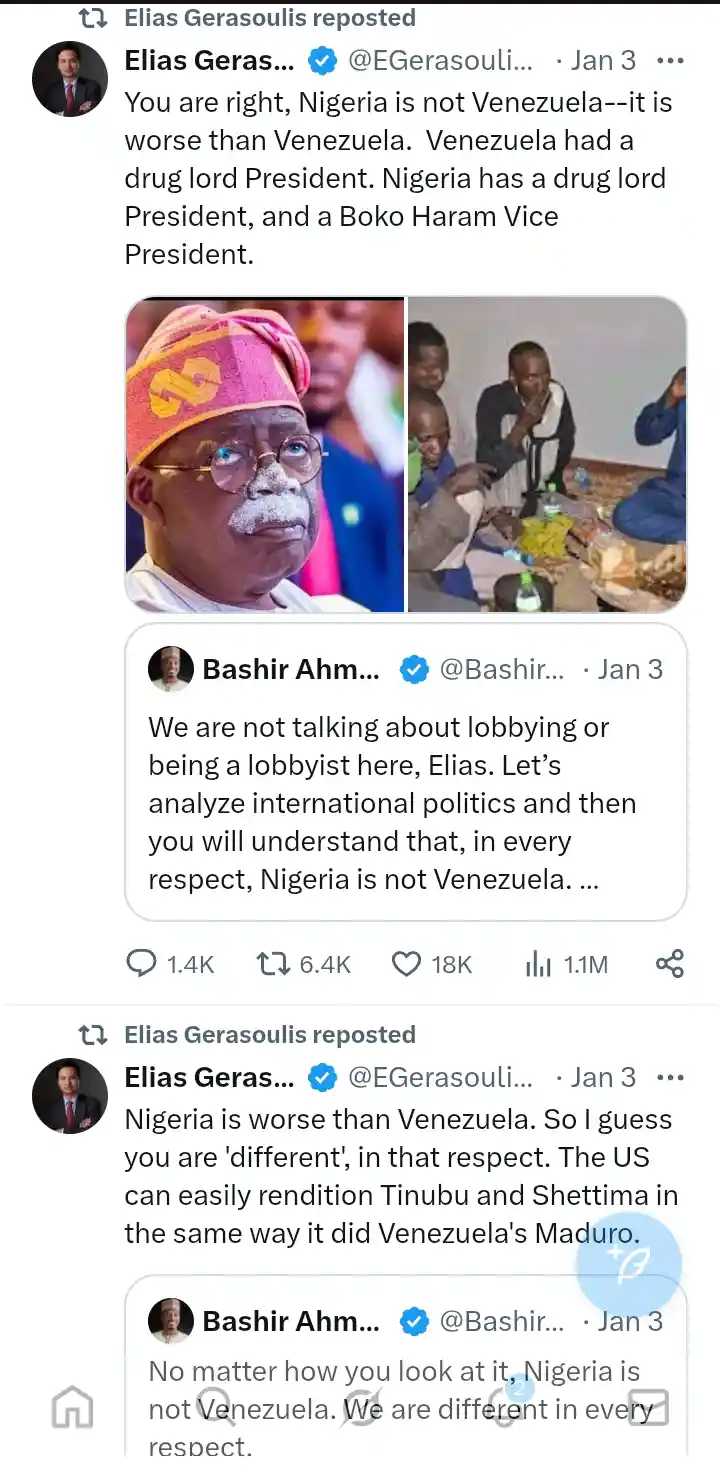
Bashir Ahmad (@BashirAhmaad) initially responded to commentary about international politics, stating: “No matter how you look at it, Nigeria is not Venezuela. We are different in every respect.” Ahmad emphasised that Nigeria and Venezuela operate under distinct political systems and face different national challenges.
In reply, Elias Gerasoulis (@EGerasouli35992), a lobbyist at Moran Global Strategies who describes himself as an “International Freedom Fighter”, argued that Nigeria faces more severe challenges than Venezuela. Gerasoulis posted: “You are right, Nigeria is not Venezuela—it is worse than Venezuela. Venezuela had a drug lord President. Nigeria has a drug lord President, and a Boko Haram Vice President.”
Also Read Russia Condemns US Military Action in Venezuela, Cites Ideological Hostility
Ahmad responded by urging a more structured discussion: “We are not talking about lobbying or being a lobbyist here, Elias. Let’s analyze international politics and then you will understand that, in every respect, Nigeria is not Venezuela….”
The exchange escalated as Gerasoulis reposted, writing: “Nigeria is worse than Venezuela. So I guess you are ‘different’, in that respect. The US can easily rendition Tinubu and Shettima in the same way it did Venezuela’s Maduro.” The conversation drew thousands of likes, retweets, and replies, with the final post generating over a million impressions.
Context: Nigeria and Venezuela
Nigeria operates a federal presidential system with elected leadership and a multi-party democracy. The country faces significant security challenges, particularly in the northeast, where Boko Haram remains active, and in the northwest, which contends with armed banditry. Economically, Nigeria is Africa’s largest economy, though structural issues such as inflation, unemployment, and dependence on oil revenue persist.
Venezuela has faced political and economic crises over the past decade, including hyperinflation, humanitarian emergencies, and mass migration. The governance of President Nicolás Maduro has drawn international scrutiny, with sanctions and diplomatic disputes complicating domestic and regional stability.
Experts note that while both countries face governance challenges, the contexts differ significantly, and direct comparisons can be misleading without nuanced analysis.
Social Media Reactions
The exchange has prompted discussions among journalists, political analysts, and civil society actors. Many caution against treating social media statements as factual, especially those involving criminal or terrorist allegations. Others have used the conversation to highlight public frustration over governance, accountability, and security in Nigeria.
Ejes Gist News can authoritatively report that the dialogue underscores how social media can influence public perceptions of national governance. It also highlights the potential for international commentators to enter discussions about domestic political affairs in a highly visible manner.