
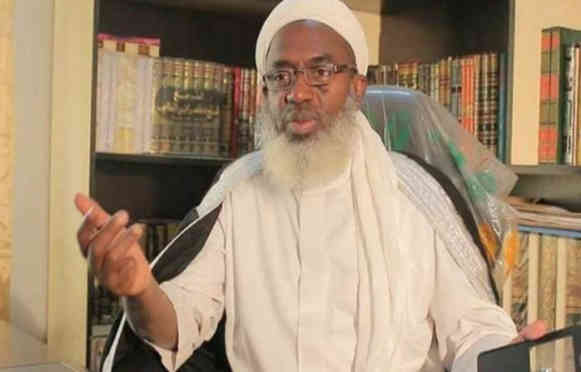
Sheikh Ahmad Abubakar Gumi, a controversial Islamic cleric based in northern Nigeria, has claimed that the United States government has marked him as part of an Islamic terrorist network allegedly responsible for killings of Christians in Nigeria, a development that has intensified national debate over security, religion, and foreign involvement in the country’s counter-terrorism efforts.
The cleric made the claim while addressing his congregation, asserting that he received information from security-linked sources in Abuja indicating that his name had surfaced during high-level security discussions connected to United States military operations.
Ejes Gist News reports that Gumi presented the alleged development as part of a wider crackdown following renewed U.S. counter-terrorism actions in Nigeria.
The allegation comes against the backdrop of U.S. airstrikes carried out on December 25, 2025, in parts of Sokoto State, targeting armed extremist groups linked to Islamic State affiliates. Those strikes, which drew mixed reactions across Nigeria, have continued to shape political, religious, and security discourse into the new year.
Gumi’s Claim of Being “Marked”
Speaking publicly, Sheikh Gumi told worshippers that he was informed during an early-morning phone call that he had been “marked for elimination” as a Boko Haram figure. According to the cleric, the caller claimed that his name appeared on a list discussed during a security meeting in Abuja.
Also Read : APC Chairman Nentawe Yilwatda Sets Conditions for Fubara’s Second Term Amid Rivers Crisis
“They called me from Abuja, that there was a security meeting,” Gumi said during the address. “They said I have been marked; that I will be eliminated. And who are Boko Haram?”
Gumi asserted that the alleged designation was tied to American counter-terrorism actions, suggesting that U.S. forces were targeting individuals identified as terrorists without, in his view, a proper understanding of Nigeria’s complex security environment.
According to him, the unnamed source warned that the alleged plan involved potential elimination through an American airstrike, a claim that has not been independently confirmed by Nigerian or U.S. authorities.
Reaction to U.S. Military Operations
The cleric has been a vocal critic of foreign military intervention in Nigeria. Following the December 25, 2025, U.S. airstrike in Sokoto, Gumi publicly opposed the operation, arguing that military force alone would not resolve Nigeria’s long-running insurgency and banditry crises.
He questioned the definition of “terrorists” used by foreign powers, stating that the labeling process itself could be politicized and misused. In his remarks to followers, he suggested that the United States bore responsibility for the emergence and evolution of extremist groups in parts of the region, a position that has drawn strong criticism from security analysts and civil society groups.
“Even the Americans, they say they came to fight terrorists,” Gumi said. “So who are the terrorists? They are the ones.”
Longstanding Controversy Over Engagement With Armed Groups
Sheikh Gumi is widely known in Nigeria for his role as a negotiator and intermediary in talks involving armed bandit groups operating across the northwest and parts of the north-central region. Over the years, he has advocated dialogue and amnesty for bandits as a strategy to reduce violence, a stance that has sharply divided public opinion.
On several occasions, Gumi has publicly called on the administration of President Bola Ahmed Tinubu to consider granting amnesty to armed groups willing to lay down their weapons. Supporters of this approach argue that it could reduce bloodshed and facilitate reintegration, while critics maintain that it legitimizes criminal violence and undermines justice for victims.
Human rights groups, Christian associations, and some political actors have repeatedly accused the cleric of sympathizing with extremists. They argue that his rhetoric minimizes the suffering of communities affected by attacks attributed to Boko Haram, Islamic State West Africa Province (ISWAP), and bandit factions, many of which have disproportionately affected Christian populations in parts of northern Nigeria.
Allegations of Support for Extremist Groups
Gumi’s critics frequently cite his statements describing some militants as “misguided” rather than inherently criminal, as well as his willingness to engage directly with armed groups in their camps. These actions have fueled accusations that he serves as an advocate or apologist for Islamist militants and bandits.
The cleric has consistently rejected such characterizations, insisting that his engagement is driven by a desire to reduce violence and protect civilian lives. He maintains that negotiation is a pragmatic response to a security crisis that has overwhelmed military and law enforcement institutions.
Despite these defenses, calls for his arrest or investigation have emerged periodically from advocacy groups, particularly following mass abductions, village raids, and attacks on Christian communities in Kaduna, Zamfara, Niger, and Plateau states.
Claims of Religious Targeting and Division
In his latest remarks, Gumi framed the alleged U.S. action against him as part of a broader narrative that, in his view, unfairly portrays Christians as the sole victims of Nigeria’s insecurity while marginalizing Muslim suffering.
He argued that such framing deepens religious division and fuels mistrust between communities. According to the cleric, Nigeria’s crisis has been worsened by what he described as foreign-backed narratives and financial interests that exploit religious identity for strategic ends.
“Because of lies, you brought violence,” Gumi said. “But where are the leaders? What did they do? What about the scholars? Everyone has gone to hide in their corners.”
He accused both political and religious elites of retreating from meaningful engagement, leaving ordinary Nigerians to bear the consequences of insecurity, poverty, and social fragmentation.
Sovereignty and Foreign Influence
Gumi further argued that no sovereign nation should accept external interference that risks dividing its population along religious or social lines. He questioned the legitimacy of foreign military actions conducted without broad national consensus and warned that such interventions could exacerbate existing tensions.
“Which country would agree to bring something in just to divide its people?” he asked. “There is no country that would accept that.”
His comments echo a wider national debate over Nigeria’s cooperation with foreign powers in counter-terrorism operations, particularly amid concerns about sovereignty, civilian casualties, and accountability.
Silence From Authorities
As of the time of reporting, neither the United States government nor Nigerian security agencies have publicly confirmed that Sheikh Gumi has been designated as a terrorist or placed on any official elimination list. No formal documentation has been released indicating that he has been classified under U.S. terrorism sanctions frameworks.
Security experts note that official U.S. terrorist designations typically involve public announcements by the Department of State or the Department of the Treasury. In the absence of such confirmation, analysts caution against treating the cleric’s claims as established fact.
Nevertheless, the allegation has already gained traction on social media, where it has been amplified alongside broader narratives about religious persecution, U.S. foreign policy, and Nigeria’s internal conflicts.
Broader Security Context
Nigeria continues to face multiple, overlapping security threats, including jihadist insurgency in the northeast, banditry in the northwest, farmer-herder violence in the Middle Belt, and separatist agitation in the southeast. These crises have resulted in thousands of deaths and mass displacement over the past decade.
The United States has identified Boko Haram and ISWAP as terrorist organizations and has periodically supported Nigerian counter-terrorism efforts through intelligence sharing, training, and, in rare cases, direct military action.
The December 25, 2025, airstrike in Sokoto marked a significant escalation in U.S. involvement and has since intensified scrutiny of individuals perceived as influential voices in the region’s security discourse..